







Question: If a multivariate function has continuous partial derivatives, the order in which the derivatives are calculated does not matter. Thus, for example, the function f(x,
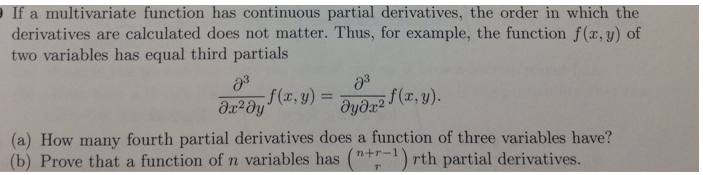
If a multivariate function has continuous partial derivatives, the order in which the derivatives are calculated does not matter. Thus, for example, the function f(x, y) of two variables has equal third partials 23 f(x, y) = dyor2 f (x, y ) . (a) How many fourth partial derivatives does a function of three variables have? (b) Prove that a function of n variables has (nor-1 ) rth partial derivatives
Step by Step Solution
There are 3 Steps involved in it
1 Expert Approved Answer
Step: 1 Unlock

Question Has Been Solved by an Expert!
Get step-by-step solutions from verified subject matter experts
Step: 2 Unlock
Step: 3 Unlock
 Study Help