







Question: If a network contains directed arcs it is called a directed network. Otherwise it is called an undirected network. The network is a specific sequence
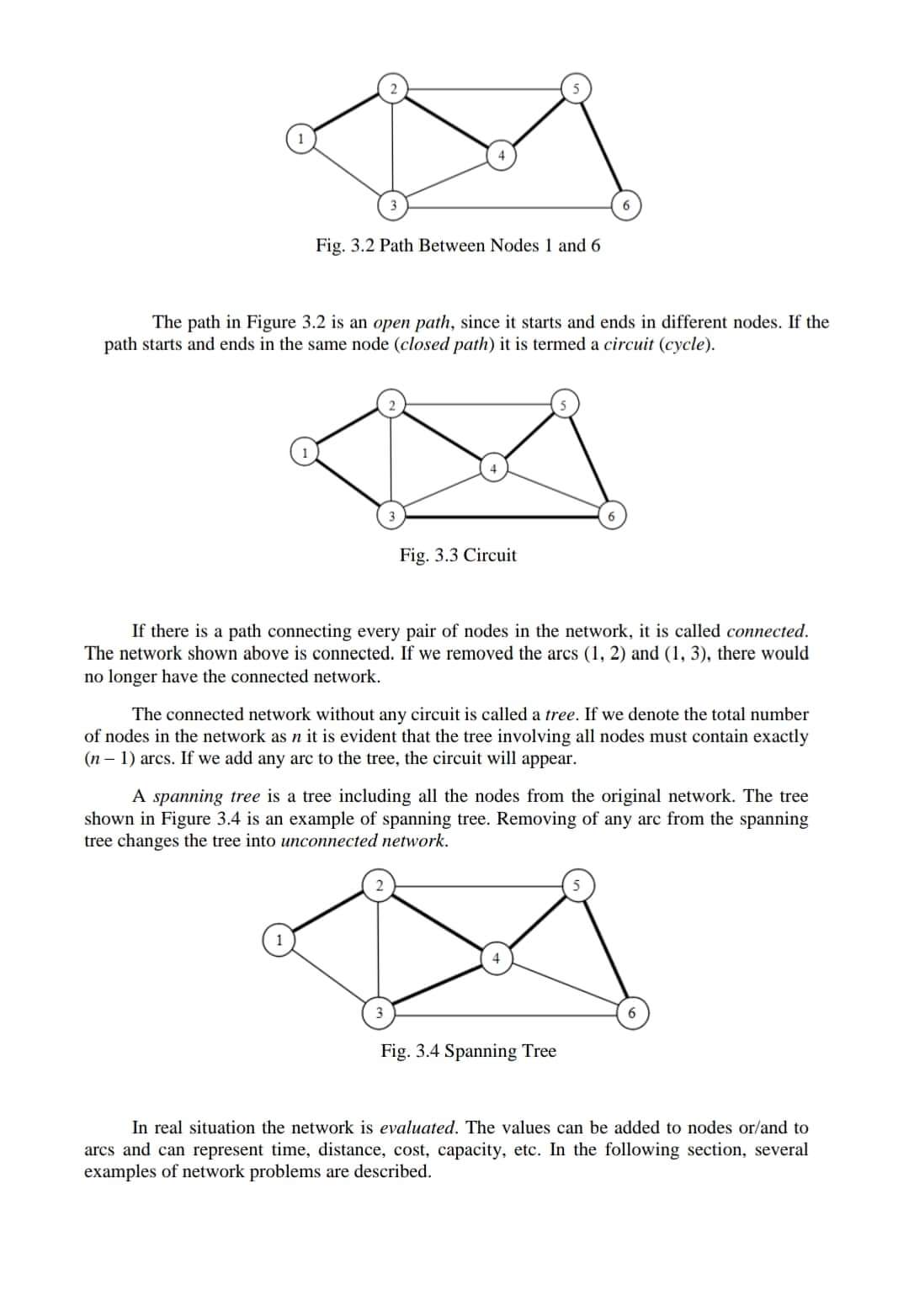
If a network contains directed arcs it is called a directed network. Otherwise it is called an undirected network. The network is a specific sequence of arcs in which the initial node of each arc is identical with the terminal node of the preceding arc in the sequence is a path. This sequence must cross the different nodes. In Figure 3.2 the example of such a path is shown (the sequence across the nodes 1 -2-4-5-6).Fig. 3.2 Path Between Nodes I and 6 The path in Figure 3.2 is an open pom. since it starts and ends in different nodes. If the path starts and ends in the same node (closed path) it is termed a circuit (c'vclc). Fig. 3.3 Circuit If there is a path connecting every pair of nodes in the network. it is called connected. The network shown above is connected. If we removed the arcs (l. 2) and (l. 3). there would no longer have the connected network. The connected network without any circuit is called a tree. If we denote the total number of nodes in the network as n it is evident that the tree involving all nodes must contain exactly in l) arcs. [f we add any are to the tree. the circuit will appear. A spanning tree is a tree including all the nodes from the original network. The tree shown in Figure 3.4 is an example of spanning tree. Removing of any arc from the spanning tree changes the tree into unconnected network. Fig. 3.4 Spanning Tree in real situation the network is evaluated. The values can be added to nodes orfand to arcs and can represent time, distance, cost, capacity, etc. In the following section, several examples of network problems are described
Step by Step Solution
There are 3 Steps involved in it

Get step-by-step solutions from verified subject matter experts
 Study Help