



Question: If a ray bisects one angle of a triangle, then it divides the opposite side into segments whose lengths are proportional to the lengths
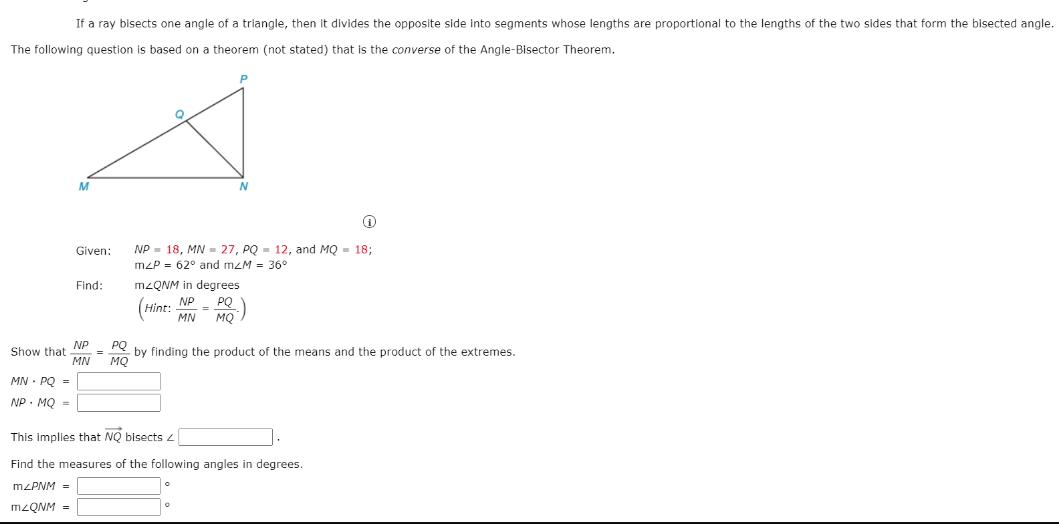
If a ray bisects one angle of a triangle, then it divides the opposite side into segments whose lengths are proportional to the lengths of the two sides that form the bisected angle. The following question is based on a theorem (not stated) that is the converse of the Angle-Bisector Theorem. M Given: Find: N - NP 18, MN 27, PQ 12, and MQ = 18; m2P = 62 and m2M = 36 mZQNM in degrees NP PQ Hint: MN Show that MN.PQ = NP MQ = = NP PQ MN by finding the product of the means and the product of the extremes. MQ This implies that NQ bisects Find the measures of the following angles in degrees. m2PNM = MZQWM =
Step by Step Solution
There are 3 Steps involved in it

Get step-by-step solutions from verified subject matter experts