







Question: If anyone could please help me do parts A, B, and C it would be greatly appreciated. With your solutions could you please show your
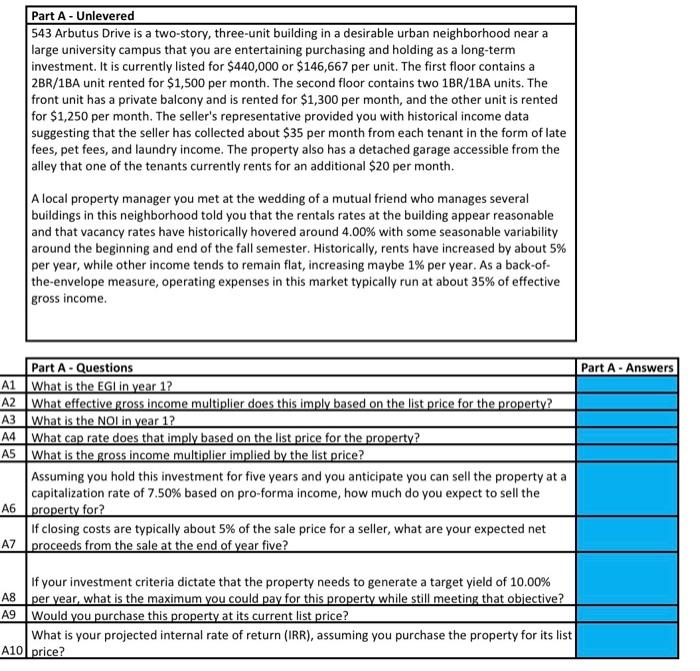
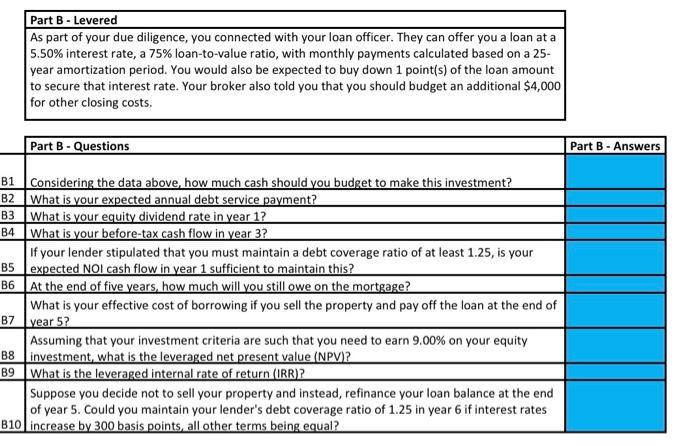
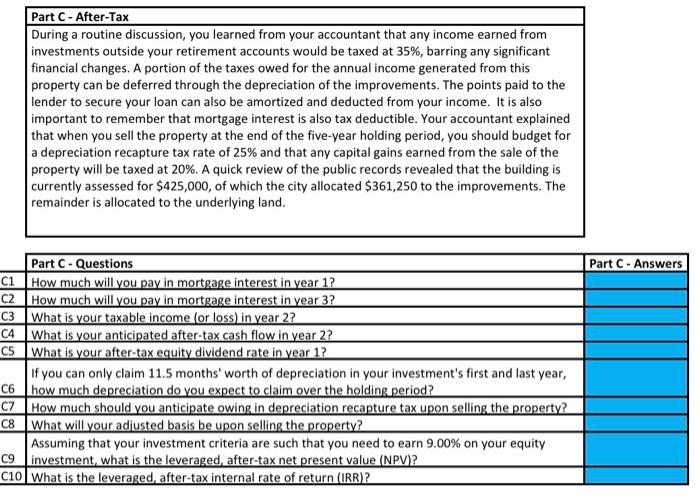
Part A - Unlevered 543 Arbutus Drive is a two-story, three-unit building in a desirable urban neighborhood near a large university campus that you are entertaining purchasing and holding as a long-term investment. It is currently listed for $440,000 or $146,667 per unit. The first floor contains a 2BR/1BA unit rented for $1,500 per month. The second floor contains two 1BR/1BA units. The front unit has a private balcony and is rented for $1,300 per month, and the other unit is rented for $1,250 per month. The seller's representative provided you with historical income data suggesting that the seller has collected about $35 per month from each tenant in the form of late fees, pet fees, and laundry income. The property also has a detached garage accessible from the alley that one of the tenants currently rents for an additional $20 per month. A local property manager you met at the wedding of a mutual friend who manages several buildings in this neighborhood told you that the rentals rates at the building appear reasonable and that vacancy rates have historically hovered around 4.00% with some seasonable variability around the beginning and end of the fall semester. Historically, rents have increased by about 5% per year, while other income tends to remain flat, increasing maybe 1% per year. As a back-ofthe-envelope measure, operating expenses in this market typically run at about 35% of effective gross income. \begin{tabular}{|l|} \hline Part B - Levered \\ \hline As part of your due diligence, you connected with your loan officer. They can offer you a loan at a \\ 5.50% interest rate, a 75% loan-to-value ratio, with monthly payments calculated based on a 25 - \\ year amortization period. You would also be expected to buy down 1 point(s) of the loan amount \\ to secure that interest rate. Your broker also told you that you should budget an additional $4,000 \\ for other closing costs. \end{tabular} \begin{tabular}{|l|} \hline Part C - After-Tax \\ \hline During a routine discussion, you learned from your accountant that any income earned from \\ investments outside your retirement accounts would be taxed at 35%, barring any significant \\ financial changes. A portion of the taxes owed for the annual income generated from this \\ property can be deferred through the depreciation of the improvements. The points paid to the \\ lender to secure your loan can also be amortized and deducted from your income. It is also \\ important to remember that mortgage interest is also tax deductible. Your accountant explained \\ that when you sell the property at the end of the five-year holding period, you should budget for \\ a depreciation recapture tax rate of 25% and that any capital gains earned from the sale of the \\ property will be taxed at 20%. A quick review of the public records revealed that the building is \\ currently assessed for $425,000, of which the city allocated $361,250 to the improvements. The \\ remainder is allocated to the underlying land. \end{tabular} \begin{tabular}{l|l|l|} \cline { 2 - 3 } & Part C - Questions & Part C - Answers \\ \hlineC1 & How much will you pay in mortgage interest in year 1? & \\ \hline C2 & How much will you pay in mortgage interest in year 3 ? \\ \hlineC3 & What is your taxable income (or loss) in year 2? & \\ \hlineC4 & What is your anticipated after-tax cash flow in year 2? & \\ \hline W & What is your after-tax equity dividend rate in year 1? & \\ \hlineC6 & Ifyoucanonlyclaim11.5monthsworthofdepreciationinyourinvestmentsfirstandlastyear,howmuchdepreciationdoyouexpecttoclaimovertheholdingperiod? & \\ \hlineC7 & How much should you anticipate owing in depreciation recapture tax upon selling the property? & \\ \hlineC8 & What will your adiusted basis be upon selling the property? & \\ \hline & Assumingthatyourinvestmentcriteriaaresuchthatyouneedtoearn9.00%onyourequityinvestment,whatistheleveraged,after-taxnetpresentvalue(NPV)? \\ \hline C10 & What is the leveraged, after-tax internal rate of return (IRR)? & \\ \hline \end{tabular}
Step by Step Solution
There are 3 Steps involved in it

Get step-by-step solutions from verified subject matter experts
 Study Help