







Question: If f and g are the functions whose graphs are shown, let u(x) = f(g(x)), v(x) = g(f(x)), and w(x) = g(g(x)). Find each derivative,
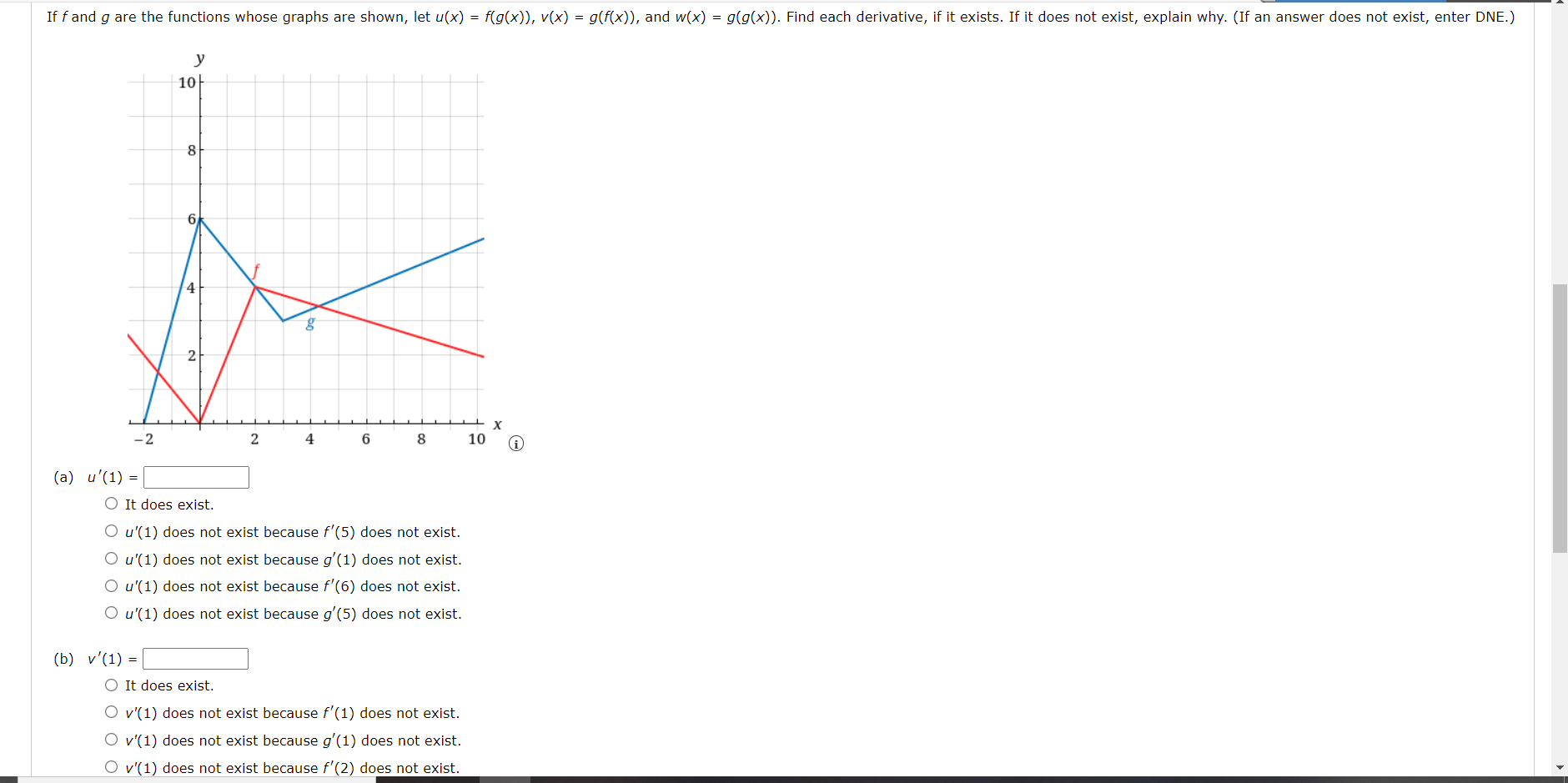
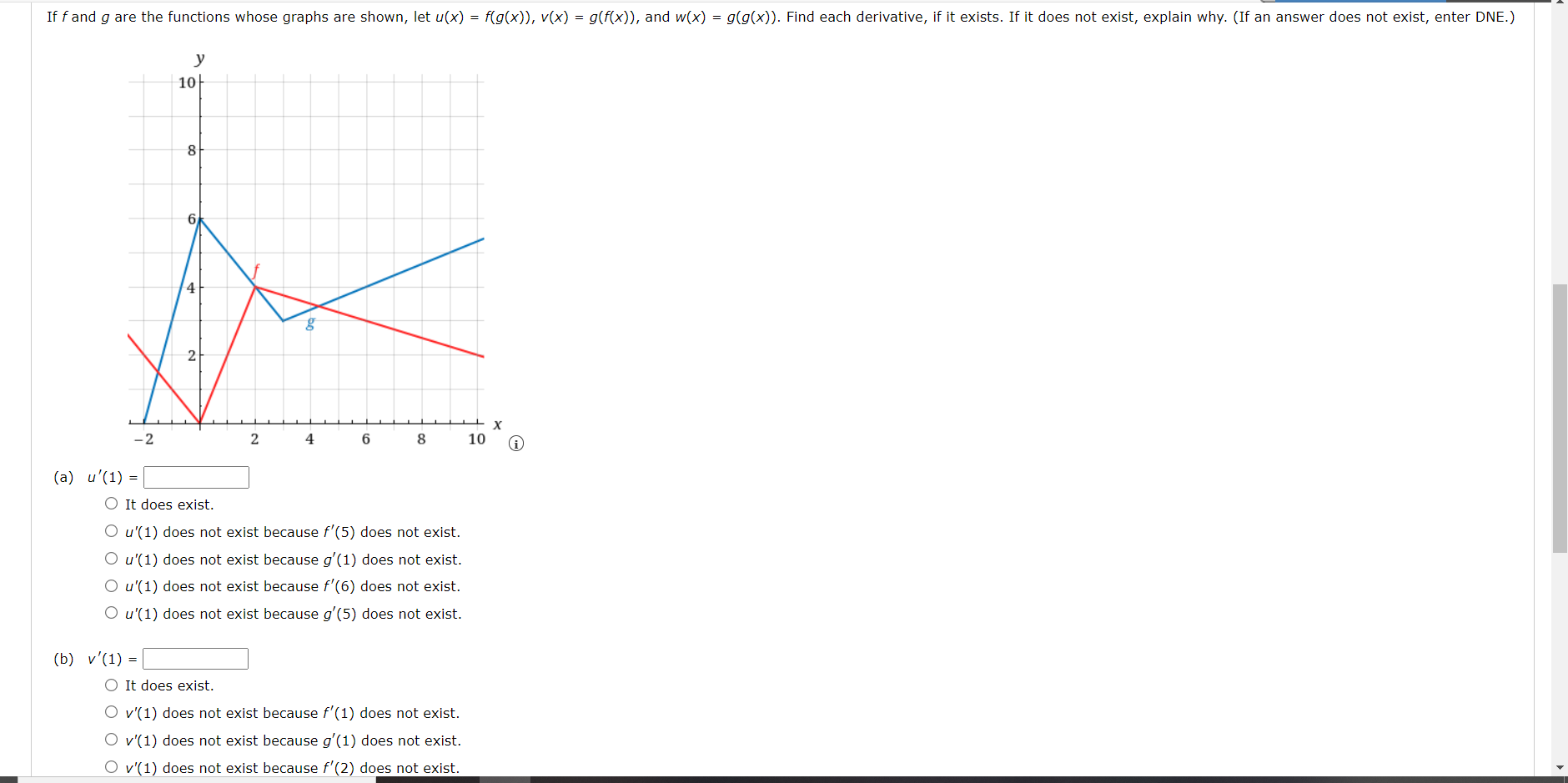
If f and g are the functions whose graphs are shown, let u(x) = f(g(x)), v(x) = g(f(x)), and w(x) = g(g(x)). Find each derivative, if it exists. If it does not exist, explain why. (If an answer does not exist, enter DNE.) 10 8 6 4 2 X -2 2 8 10 (a) u'(1) = O It does exist. O u'(1) does not exist because f'(5) does not exist. O u'(1) does not exist because g'(1) does not exist. O u'(1) does not exist because f'(6) does not exist. O u'(1) does not exist because g'(5) does not exist. (b) v'(1 ) = O It does exist. O v'(1) does not exist because f'(1) does not exist. O v'(1) does not exist because g'(1) does not exist. O v'(1) does not exist because f (2) does not exist
Step by Step Solution
There are 3 Steps involved in it

Get step-by-step solutions from verified subject matter experts
 Study Help