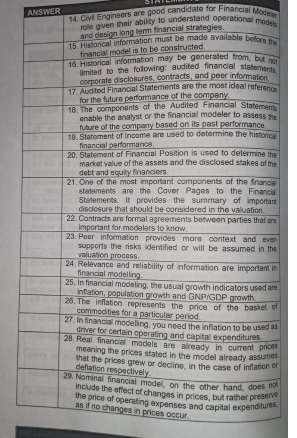
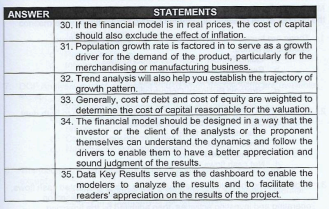
Question: If it is false, underline the word that make it incorrect and then write the correct answer and explain. ANSWER 14. Civil Engineers are good
If it is false, underline the word that make it incorrect and then write the correct answer and explain.
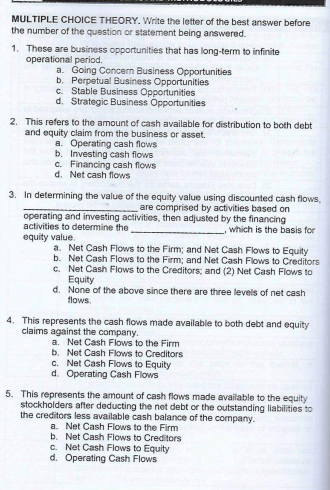
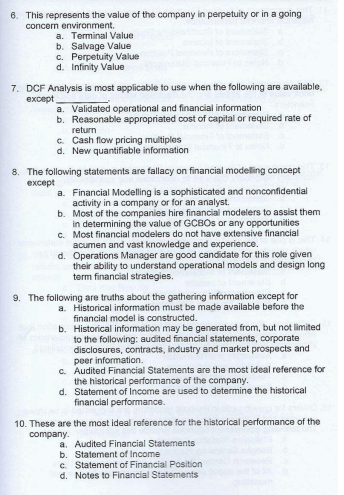
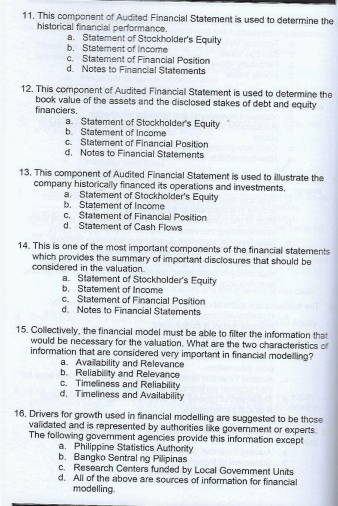
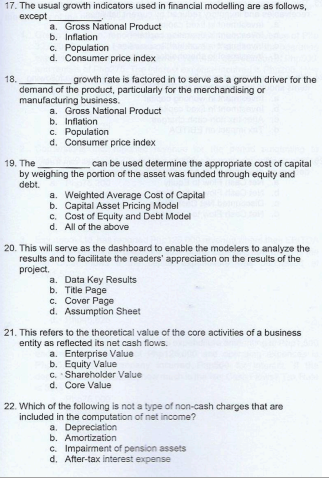
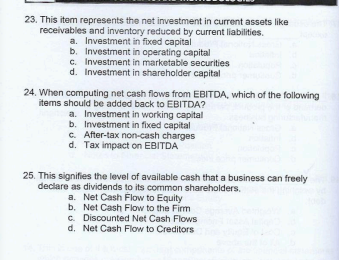
ANSWER 14. Civil Engineers are good candidate for Financial Mode me given their ability to understand operational model and design long term financial strategies. 15. Historical information must be made available before the financial model is to be constructed 15. Historical information may be generated from, but not limited to the following: audited financial statements Corporate disclosures, contracts, and peer information, 17, Audited Financial Statements are the most ideal reference for the future performance of the company 18. The components of the Audited Financial Statements enable the analyst or the financial modeler to assess the future of the company based on its past performance 18. Statement of Income are used to determine the historica financial performance. 20. Statement of Financial Position is used to determine the market value of the assets and the disclosed stakes of the debt and equity Inancies. 21. One of the most important components of the finance Statements are the Cover Pages to the Financial Statements. It provides the summary of important disclosure that should be considered in the valuation. 22. Contracts arn formal agreements between parties that are important for modelers to know, 23. Peor information provides more context and even supports the risks identified or will be assumed in the valuation process. 24 Relevance and reliability of information are important in financial modelling. 25. In financial modeling, the usual growth indicators used are inflation, population growth and GNP/GOP growth. 26. The Inflation represents the price of the basket of Commodities for a particular period. 27. In financial modeling, you need the inflation to be used as driver for certain operating and capital expenditures 20, Real financial models are already in current prices moaning the prices stated in the model already assumes that the prices grew or decding, in the case of inflation or deflation rospoctively. 20. Nominal financial model, on the other hand, does not Include the effect of changes in prices, but rather preserve the price of operating expenses and capital expenditures. as if no changes in prices occurANSWER STATEMENTS 30. If the financial model is in real prices, the cost of capital should also exclude the effect of inflation. 31. Population growth rate is factored in to serve as a growth driver for the demand of the product, particularly for the merchandising or manufacturing business. 32. Trend analysis will also help you establish the trajectory of growth pattern. 33. Generally, cost of debt and cost of equity are weighted to determine the cost of capital reasonable for the valuation, 34. The financial model should be designed in a way that the investor or the client of the analysts or the proponent themselves can understand the dynamics and follow the drivers to enable them to have a better appreciation and sound judgment of the results. 35. Data Key Results serve as the dashboard to enable the modelers to analyze the results and to facilitate the readers' appreciation on the results of the project.ANSWER STATEMENTS 1. Discounted cash flows analysis is meticulous but more conservative method or approach that can be used to determine the asset value for it clearly demonstrate the movement of the transactions 2. In discounted cash flows method, the value of investment opportunities is highly dependent on the value that the asset will generate from now until the future. 3. Discounted cash flows analysis can be done by determining the present value of the Net Cash Flows of the investment opportunity. 4. The amount that should be included in determining the value of the asset is the amount of cash that will be available for the claims of the equity owners and creditors. 5. The Net Cash Flows are the amounts of cash available for distribution to equity claim from the business or asset 6. For GCBO, the net cash flows generated will be based on Cash from Operations which are composed of the cash flows from operating and investing activities, since this represents already the amount earned or will be earned from the business and the amount that is required for you to infuse in the operations to generate more profit. 7. There are three levels of Net Cash Flows: (1) Net Cash Flows to the Firm; (2) Net Cash Flows to Creditors and (3) Net Cash Flows to Equity. 8. The Net Cash Flows to Equity represents the amount of cash flows made available to the equity stockholders after deducting the net debt or the outstanding Liabilities to the creditors less available cash balance of the company. 9. Terminal Value represents the value of the company in perpetuity of a going concern business, 10. The net present value of the Net Cash Flows represents the value of the equity. 11. Valuation is a sensitive and meticulous task for every analyst and investors. 12. Financial Modelling is a sophisticated and confidential activity in a company or for an analyst. 13. Information can also be considered as competitive advantage of a company or a person.MULTIPLE CHOICE THEORY. Write the letter of the best answer before the number of the question or statement being answered. 1. These are business opportunities that has long-term to infinite operational period. a. Going Concern Business Opportunities b. Perpetual Business Opportunities c. Stable Business Opportunities d. Strategic Business Opportunities 2. This refers to the amount of cash available for distribution to both debt and equity claim from the business or asset. a. Operating cash flows b. Investing cash flows C. Financing cash flows d. Net cash flows 3. In determining the value of the equity value using discounted cash flows, are comprised by activities based on operating and investing activities, then adjusted by the financing activities to determine the , which is the basis for equity value. a. Net Cash Flows to the Firm; and Net Cash Flows to Equity b. Net Cash Flows to the Firm; and Net Cash Flows to Creditors c. Net Cash Flows to the Creditors; and (2) Net Cash Flows to Equity d. None of the above since there are three levels of net cash flows. 4. This represents the cash flows made available to both debt and equity claims against the company. a. Net Cash Flows to the Firm b. Net Cash Flows to Creditors c. Net Cash Flows to Equity d. Operating Cash Flows 5. This represents the amount of cash flows made available to the equity stockholders after deducting the not debt or the outstanding liabilities to the creditors less available cash balance of the company. a. Net Cash Flows to the Firm b. Net Cash Flows to Creditors c. Net Cash Flows to Equity d. Operating Cash FlowsB. This represents the value of the company in perpetuity or in a going concern environment. a. Terminal Value b. Salvage Value C. Perpetuity Value d. Infinity Value 7. DCF Analysis is most applicable to use when the following are available. except a. Validated operational and financial information b. Reasonable appropriated cost of capital or required rate of return c. Cash flow pricing multiples d. New quantifiable information 8. The following statements are fallacy on financial modeling concept except a. Financial Modelling is a sophisticated and nonconfidential activity in a company or for an analyst. b. Most of the companies hire financial modelers to assist them in determining the value of GCBOs or any opportunities C. Most financial modelers do not have extensive financial acumen and vast knowledge and experience. d. Operations Manager are good candidate for this role given their ability to understand operational models and design long term financial strategies. 9. The following are truths about the gathering information except for a. Historical information must be made available before the financial model is constructed. b. Historical information may be generated from, but not limited to the following: audited financial statements, corporate disclosures, contracts, industry and market prospects and peer information. c. Audited Financial Statements are the most ideal reference for the historical performance of the company. d. Statement of Income are used to determine the historical financial performance. 10. These are the most Ideal reference for the historical performance of the company. a, Audited Financial Statements b. Statement of Income c. Statement of Financial Position d. Notes to Financial Statements11. This component of Audited Financial Statement is used to determine the historical financial performance. 8. Statement of Stockholder's Equity b. Statement of Income c. Statement of Financial Position d. Notes to Financial Statements 12. This component of Audited Financial Statement is used to determine the book value of the assets and the disclosed stakes of debt and equity financiers. a. Statement of Stockholder's Equity b. Statement of Income c. Statement of Financial Position d, Notes to Financial Statements 13. This component of Audited Financial Statement is used to illustrate the company historically financed its operations and investments. Statement of Stockholder's Equity b. Statement of Income c. Statement of Financial Position d. Statement of Cash Flows 14. This is one of the most important components of the financial statements which provides the summary of important disclosures that should be considered in the valuation. a. Statement of Stockholder's Equity b. Statement of Income c. Statement of Financial Position d. Notes to Financial Statements 15. Collectively, the financial model must be able to filter the information that would be necessary for the valuation. What are the two characteristics of information that are considered very important in financial modelling? a. Availability and Relevance b. Reliability and Relevance C. Timeliness and Reliability d. Timeliness and Availability 16. Drivers for growth used in financial modelling are suggested to be those validated and is represented by authorities like government or experts The following government agencies provide this information except a. Philippine Statistics Authority b. Bangko Sentral ng Pilipinas C. Research Centers funded by Local Government Units d. All of the above are sources of information for financial modelling17. The usual growth indicators used in financial modelling are as follows, except a. Gross National Product b. Inflation c. Population d. Consumer price index 18. growth rate is factored in to serve as a growth driver for the demand of the product, particularly for the merchandising or manufacturing business. a. Gross National Product b. Inflation C. Population d. Consumer price index 19. The can be used determine the appropriate cost of capital by weighing the portion of the asset was funded through equity and debt. a. Weighted Average Cost of Capital b. Capital Asset Pricing Model c. Cost of Equity and Debt Model d. All of the above 20. This will serve as the dashboard to enable the modelers to analyze the results and to facilitate the readers' appreciation on the results of the project. a. Data Key Results b. Title Page C. Cover Page d. Assumption Sheet 21. This refers to the theoretical value of the core activities of a business entity as reflected its net cash flows. a. Enterprise Value b. Equity Value C. " Shareholder Value d. Core Value 22. Which of the following is not a type of non-cash charges that are included in the computation of net income? a, Depreciation b. Amortization C. Impairment of pension 24gets d, After-tax interest expense23. This item represents the net investment in current assets like receivables and inventory reduced by current liabilities, a. Investment in fixed capital b, Investment in operating capital C. Investment in marketable securities d. Investment in shareholder capital 24. When computing net cash flows from EBITDA, which of the following items should be added back to EBITDA? a. Investment in working capital b. Investment in fixed capital c. After-tax non-cash charges d. Tax Impact on EBITDA 25. This signifies the level of available cash that a business can freely declare as dividends to its common shareholders. B. Net Cash Flow to Equity b. Net Cash Flow to the Firm c. Discounted Net Cash Flows d. Net Cash Flow to Creditors
Step by Step Solution
There are 3 Steps involved in it
1 Expert Approved Answer
Step: 1 Unlock
Question Has Been Solved by an Expert!
Get step-by-step solutions from verified subject matter experts
Step: 2 Unlock
Step: 3 Unlock
Students Have Also Explored These Related Accounting Questions!