







Question: If it is managed efficiently, Remel, Inc., will have assets with a market value of $49.8 million, $98.6 million, or $148.2 million next year, with
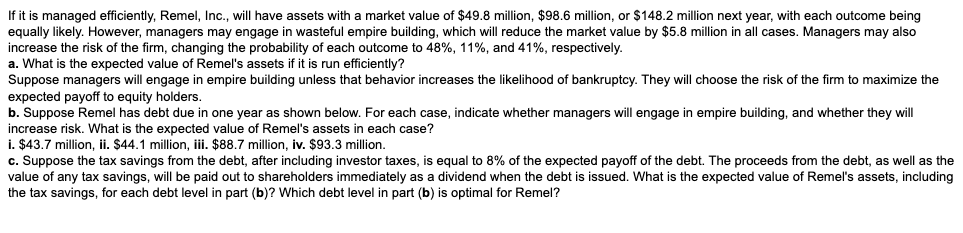
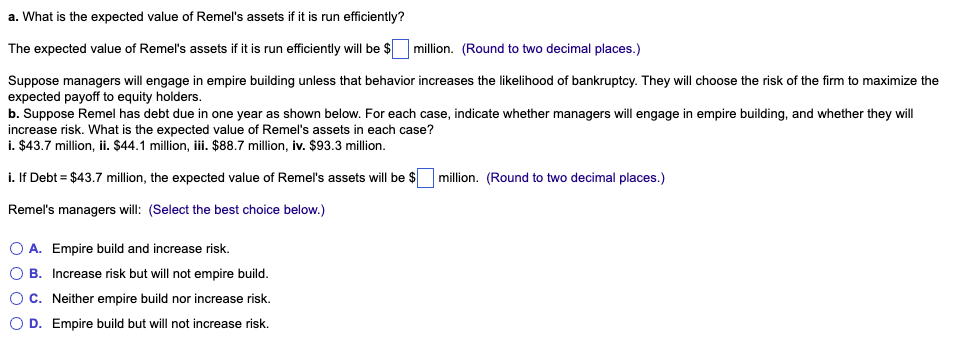
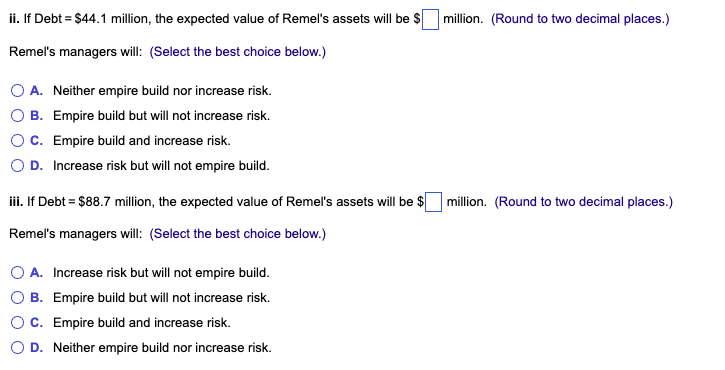
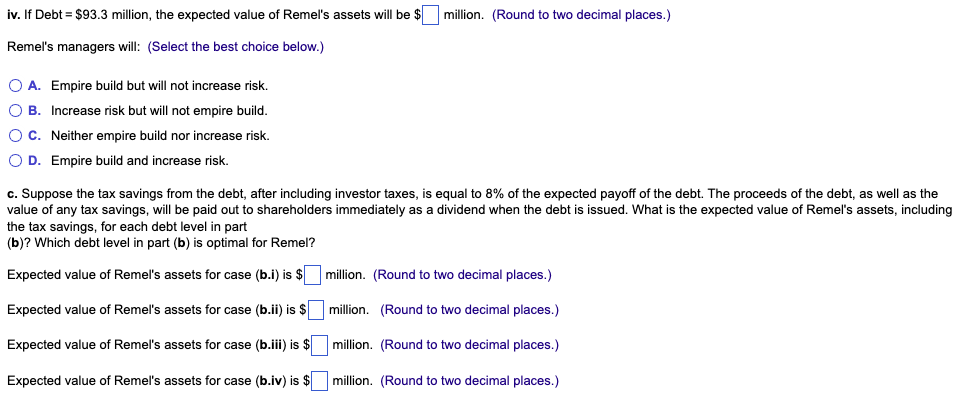
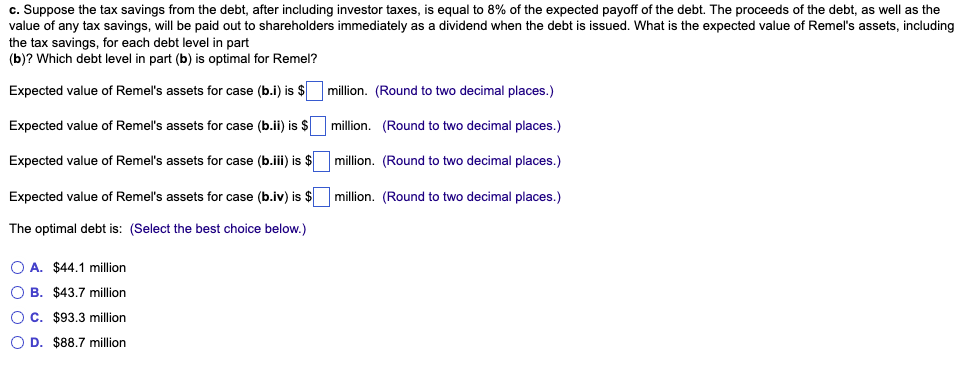
If it is managed efficiently, Remel, Inc., will have assets with a market value of $49.8 million, $98.6 million, or $148.2 million next year, with each outcome being equally likely. However, managers may engage wasteful empire building, which will reduce the market value by $5.8 million in all cases. Managers may also increase the risk of the firm, changing the probability of each outcome to 48%, 11%, and 41%, respectively. a. What is the expected value of Remel's assets if it is run efficiently? Suppose managers will engage in empire building unless that behavior increases the likelihood of bankruptcy. They will choose the risk of the firm to maximize the expected payoff to equity holders. b. Suppose Remel has debt due in one year as shown below. For each case, indicate whether managers will engage in empire building, and whether they will increase risk. What is the expected value of Remel's assets in each case? i. $43.7 million, ii. $44.1 million, iii. $88.7 million, iv. $93.3 million. c. Suppose the tax savings from the debt, after including investor taxes, is equal to 8% of the expected payoff of the debt. The proceeds from the debt, as well as the value of any tax savings will be paid out to shareholders immediately as a dividend when the debt is issued. What is the expected value of Remel's assets, including the tax savings, for each debt level in part (b)? Which debt level in part (b) is optimal for Remel? a. What is the expected value of Remel's assets if it is run efficiently? The expected value of Remel's assets if it is run efficiently will be $ million. (Round to two decimal places.) Suppose managers will engage in empire building unless that behavior increases the likelihood of bankruptcy. They will choose the risk of the firm to maximize the expected payoff to equity holders. b. Suppose Remel has debt due in one year as shown below. For each case, indicate whether managers will engage in empire building, and whether they will increase risk. What is the expected value of Remel's assets in each case? i. $43.7 million, ii. $44.1 million, iii. $88.7 million, iv. $93.3 million. i. If Debt = $43.7 million, the expected value of Remel's assets will be $ million. (Round to two decimal places.) Remel's managers will: (Select the best choice below.) O A. Empire build and increase risk. O B. Increase risk but will not empire build. O c. Neither empire build nor increase risk. O D. Empire build but will not increase risk. ii. If Debt = $44.1 million, the expected value of Remel's assets will be $ million. (Round to two decimal places.) Remel's managers will: (Select the best choice below.) A. Neither empire build nor increase risk. B. Empire build but will not increase risk. O C. Empire build and increase risk. OD. Increase risk but will not empire build. million. (Round to two decimal places.) iii. If Debt = $88.7 million, the expected value of Remel's assets will be $ Remel's managers will: (Select the best choice below.) A. Increase risk but will not empire build. B. Empire build but will not increase risk. O C. Empire build and increase risk. OD. Neither empire build nor increase risk. million. (Round to two decimal places.) iv. If Debt = $93.3 million, the expected value of Remel's assets will be $ Remel's managers will: (Select the best choice below.) O A. Empire build but will not increase risk. O B. Increase risk but will not empire build. OC. Neither empire build nor increase risk. OD. Empire build and increase risk. c. Suppose the tax savings from the debt, after including investor taxes, is equal to 8% of the expected payoff of the debt. The proceeds of the debt, as well as the value of any tax savings, will be paid out to shareholders immediately as a dividend when the debt is issued. What is the expected value of Remel's assets, including the tax savings, for each debt level in part (b)? Which debt level in part (b) is optimal for Remel? Expected value of Remel's assets for case (b.i) is $ million. (Round to two decimal places.) Expected value of Remel's assets for case (b.ii) is $ million. (Round to two decimal places.) Expected value of Remel's assets for case (b.iii) is $ million. (Round to two decimal places.) Expected value of Remel's assets for case (b.iv) is $ million. (Round to two decimal places.) c. Suppose the tax savings from the debt, after including investor taxes, is equal to 8% of the expected payoff of the debt. The proceeds of the debt, as well as the value of any tax savings will be paid out to shareholders immediately as a dividend when the debt is issued. What is the expected value of Remel's assets, including the tax savings, for each debt level in part (b)? Which debt level in part (b) is optimal for Remel? Expected value of Remel's assets for case (b.i) is $ million. (Round to two decimal places.) Expected value of Remel's assets for case (b.ii) is $ million. (Round to two decimal places.) Expected value of Remel's assets for case (b.iii) is $ million. (Round to two decimal places.) Expected value of Remel's assets for case (b.iv) is $ million. (Round to two decimal places.) The optimal debt is: (Select the best choice below.) O A. $44.1 million OB. $43.7 million O C. $93.3 million OD. $88.7 million If it is managed efficiently, Remel, Inc., will have assets with a market value of $49.8 million, $98.6 million, or $148.2 million next year, with each outcome being equally likely. However, managers may engage wasteful empire building, which will reduce the market value by $5.8 million in all cases. Managers may also increase the risk of the firm, changing the probability of each outcome to 48%, 11%, and 41%, respectively. a. What is the expected value of Remel's assets if it is run efficiently? Suppose managers will engage in empire building unless that behavior increases the likelihood of bankruptcy. They will choose the risk of the firm to maximize the expected payoff to equity holders. b. Suppose Remel has debt due in one year as shown below. For each case, indicate whether managers will engage in empire building, and whether they will increase risk. What is the expected value of Remel's assets in each case? i. $43.7 million, ii. $44.1 million, iii. $88.7 million, iv. $93.3 million. c. Suppose the tax savings from the debt, after including investor taxes, is equal to 8% of the expected payoff of the debt. The proceeds from the debt, as well as the value of any tax savings will be paid out to shareholders immediately as a dividend when the debt is issued. What is the expected value of Remel's assets, including the tax savings, for each debt level in part (b)? Which debt level in part (b) is optimal for Remel? a. What is the expected value of Remel's assets if it is run efficiently? The expected value of Remel's assets if it is run efficiently will be $ million. (Round to two decimal places.) Suppose managers will engage in empire building unless that behavior increases the likelihood of bankruptcy. They will choose the risk of the firm to maximize the expected payoff to equity holders. b. Suppose Remel has debt due in one year as shown below. For each case, indicate whether managers will engage in empire building, and whether they will increase risk. What is the expected value of Remel's assets in each case? i. $43.7 million, ii. $44.1 million, iii. $88.7 million, iv. $93.3 million. i. If Debt = $43.7 million, the expected value of Remel's assets will be $ million. (Round to two decimal places.) Remel's managers will: (Select the best choice below.) O A. Empire build and increase risk. O B. Increase risk but will not empire build. O c. Neither empire build nor increase risk. O D. Empire build but will not increase risk. ii. If Debt = $44.1 million, the expected value of Remel's assets will be $ million. (Round to two decimal places.) Remel's managers will: (Select the best choice below.) A. Neither empire build nor increase risk. B. Empire build but will not increase risk. O C. Empire build and increase risk. OD. Increase risk but will not empire build. million. (Round to two decimal places.) iii. If Debt = $88.7 million, the expected value of Remel's assets will be $ Remel's managers will: (Select the best choice below.) A. Increase risk but will not empire build. B. Empire build but will not increase risk. O C. Empire build and increase risk. OD. Neither empire build nor increase risk. million. (Round to two decimal places.) iv. If Debt = $93.3 million, the expected value of Remel's assets will be $ Remel's managers will: (Select the best choice below.) O A. Empire build but will not increase risk. O B. Increase risk but will not empire build. OC. Neither empire build nor increase risk. OD. Empire build and increase risk. c. Suppose the tax savings from the debt, after including investor taxes, is equal to 8% of the expected payoff of the debt. The proceeds of the debt, as well as the value of any tax savings, will be paid out to shareholders immediately as a dividend when the debt is issued. What is the expected value of Remel's assets, including the tax savings, for each debt level in part (b)? Which debt level in part (b) is optimal for Remel? Expected value of Remel's assets for case (b.i) is $ million. (Round to two decimal places.) Expected value of Remel's assets for case (b.ii) is $ million. (Round to two decimal places.) Expected value of Remel's assets for case (b.iii) is $ million. (Round to two decimal places.) Expected value of Remel's assets for case (b.iv) is $ million. (Round to two decimal places.) c. Suppose the tax savings from the debt, after including investor taxes, is equal to 8% of the expected payoff of the debt. The proceeds of the debt, as well as the value of any tax savings will be paid out to shareholders immediately as a dividend when the debt is issued. What is the expected value of Remel's assets, including the tax savings, for each debt level in part (b)? Which debt level in part (b) is optimal for Remel? Expected value of Remel's assets for case (b.i) is $ million. (Round to two decimal places.) Expected value of Remel's assets for case (b.ii) is $ million. (Round to two decimal places.) Expected value of Remel's assets for case (b.iii) is $ million. (Round to two decimal places.) Expected value of Remel's assets for case (b.iv) is $ million. (Round to two decimal places.) The optimal debt is: (Select the best choice below.) O A. $44.1 million OB. $43.7 million O C. $93.3 million OD. $88.7 million
Step by Step Solution
There are 3 Steps involved in it

Get step-by-step solutions from verified subject matter experts
 Study Help