







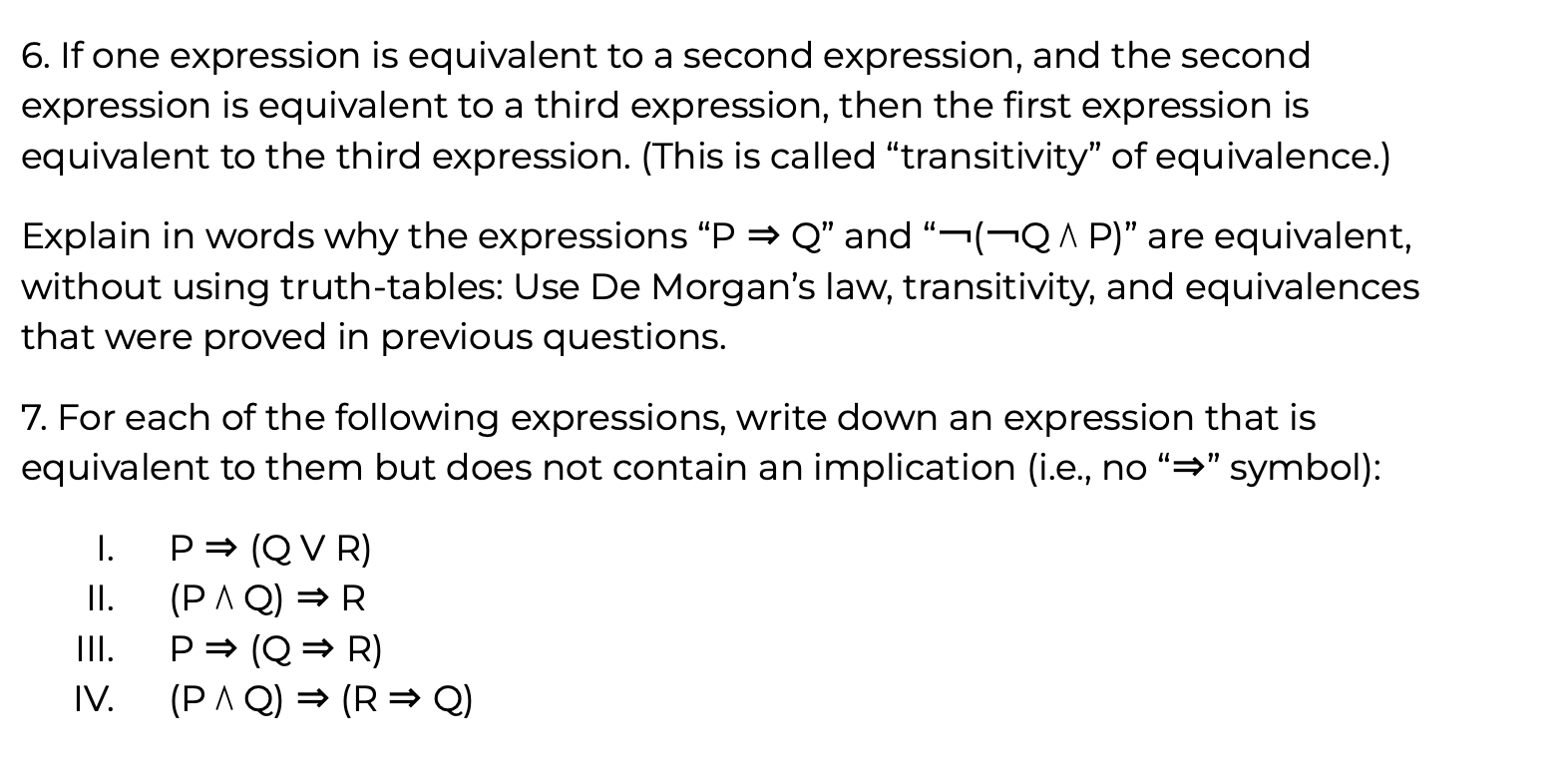
Question: If one expression is equivalent to a second expression, and the second expression is equivalent to a third expression, then the first expression is equivalent
If one expression is equivalent to a second expression, and the second
expression is equivalent to a third expression, then the first expression is
equivalent to the third expression. This is called "transitivity" of equivalence.
Explain in words why the expressions and not are equivalent,
without using truthtables: Use De Morgan's law, transitivity, and equivalences
that were proved in previous questions.
For each of the following expressions, write down an expression that is
equivalent to them but does not contain an implication ie no symbol:
I.
II
III.
IV
Step by Step Solution
There are 3 Steps involved in it
1 Expert Approved Answer
Step: 1 Unlock

Question Has Been Solved by an Expert!
Get step-by-step solutions from verified subject matter experts
Step: 2 Unlock
Step: 3 Unlock
 Study Help