







Question: (@) If one fits the simple linear regression model predi :ting SCORE from . P. one will fi a! that he best equation is (approximate!:).
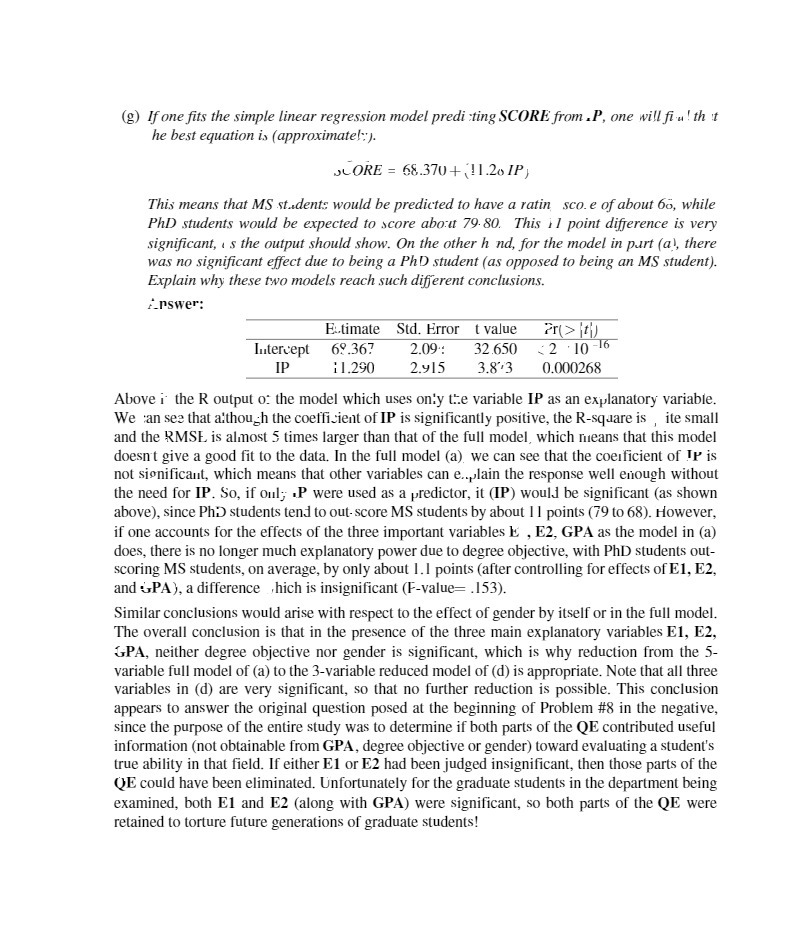
(@) If one fits the simple linear regression model predi :ting SCORE from . P. one will fi a! that he best equation is (approximate!:). JLORE = 68.370 + (!1.20 IP) This means that MS students would be predicted to have a ratin sco.e of about 60, while PhD students would be expected to score about 7980. This il point difference is very significant, .s the output should show. On the other h nd, for the model in part (a), there was no significant effect due to being a PhD student (as opposed to being an MS student). Explain why these two models reach such different conclusions. Answer: E.timate Std. Error t value Intercept 69.36? 2.09.: 32.650 :2 . 10 -16 IP 1 1.290 2.915 3.8''3 0.000268 Above i the R output o: the model which uses only the variable IP as an explanatory variable. We can see that although the coefficient of IP is significantly positive, the R-square is , ite small and the RMSE is almost 5 times larger than that of the full model, which means that this model doesn't give a good fit to the data. In the full model (a) we can see that the coeficient of IP is not significant, which means that other variables can e..plain the response well enough without the need for IP. So, if only .P were used as a predictor, it (IP) would be significant (as shown above), since PhD students tend to out-score MS students by about I I points (79 to 68). However, if one accounts for the effects of the three important variables E , E2, GPA as the model in (a) does, there is no longer much explanatory power due to degree objective, with PhD students out- scoring MS students, on average, by only about 1. I points (after controlling for effects of E1, E2, and &PA), a difference ,hich is insignificant (F-value= .153). Similar conclusions would arise with respect to the effect of gender by itself or in the full model. The overall conclusion is that in the presence of the three main explanatory variables E1, E2, GPA, neither degree objective nor gender is significant, which is why reduction from the 5- variable full model of (a) to the 3-variable reduced model of (d) is appropriate. Note that all three variables in (d) are very significant, so that no further reduction is possible. This conclusion appears to answer the original question posed at the beginning of Problem #8 in the negative, since the purpose of the entire study was to determine if both parts of the QE contributed useful information (not obtainable from GPA, degree objective or gender) toward evaluating a student's true ability in that field. If either El or E2 had been judged insignificant, then those parts of the QE could have been eliminated. Unfortunately for the graduate students in the department being examined, both El and E2 (along with GPA) were significant, so both parts of the QE were retained to torture future generations of graduate students
Step by Step Solution
There are 3 Steps involved in it

Get step-by-step solutions from verified subject matter experts
 Study Help