





Question: If possible Use R to help solve these problems: 11.3 Characterizing bone with fractal geometry. Refer to the Medical Engineering & Physics (May 2013) study

If possible Use R to help solve these problems:
If possible Use R to help solve these problems:If possible Use R to help solve these problems:
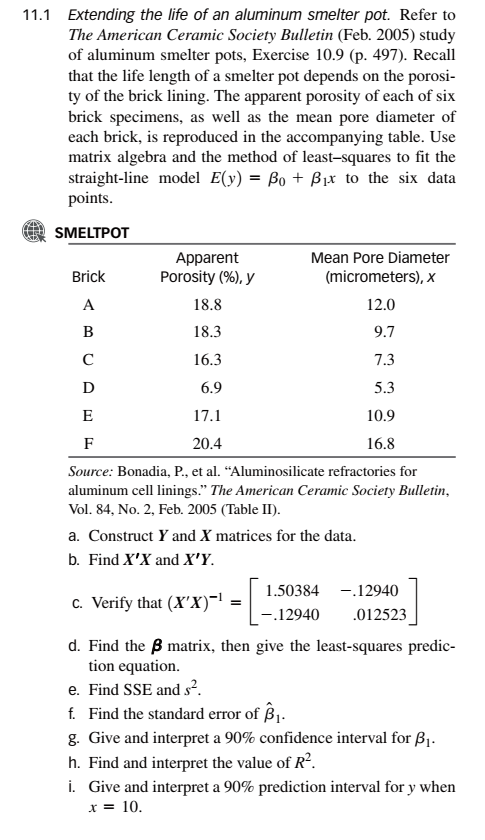
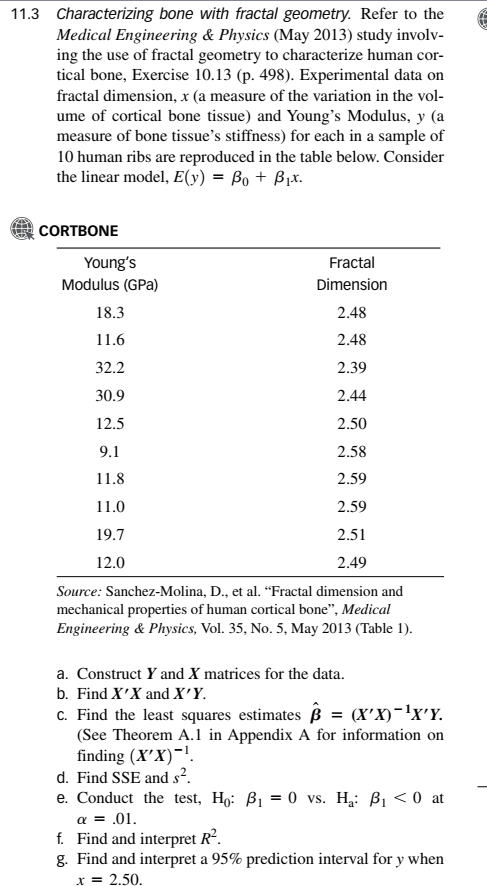
11.3 Characterizing bone with fractal geometry. Refer to the Medical Engineering & Physics (May 2013) study involv- ing the use of fractal geometry to characterize human cor- tical bone, Exercise 10.13 (p. 498). Experimental data on fractal dimension, x (a measure of the variation in the vol- ume of cortical bone tissue) and Young's Modulus, y (a measure of bone tissue's stiffness) for each in a sample of 10 human ribs are reproduced in the table below. Consider the linear model, E(y) = Bo + Bix. CORTBONE Young's Fractal Modulus (GPa) Dimension 18.3 2.48 11.6 2.48 32.2 2.39 30.9 2.44 12.5 2.50 9.1 2.58 11.8 2.59 11.0 2.59 19.7 2.51 12.0 2.49 Source: Sanchez-Molina, D., et al. "Fractal dimension and mechanical properties of human cortical bone", Medical Engineering & Physics, Vol. 35, No. 5, May 2013 (Table 1). a. Construct Y and X matrices for the data. b. Find X' X and X'Y. C. Find the least squares estimates B = (X'X) 'X'Y. (See Theorem A.1 in Appendix A for information on finding (XX) -1. d. Find SSE and s. e. Conduct the test, Ho: B1 = 0 vs. Ha: B1

Step by Step Solution

There are 3 Steps involved in it

1 Expert Approved Answer
Step: 1 Unlock blur-text-image

Question Has Been Solved by an Expert!

Get step-by-step solutions from verified subject matter experts

Step: 2 Unlock
Step: 3 Unlock

Students Have Also Explored These Related Mathematics Questions!