Question: If the JIT system is adopted, what changes, if any, should occur in the relationships between Ballenger's firm and his suppliers of components? Discuss. Case
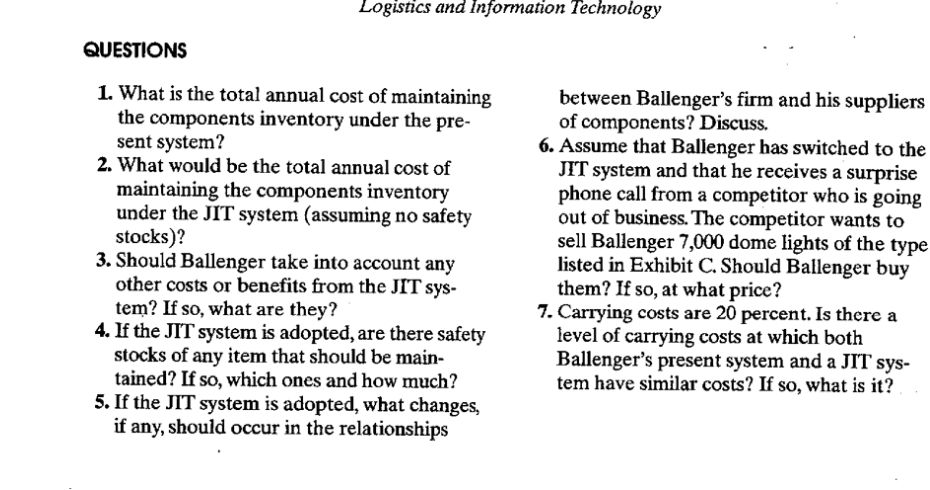
- If the JIT system is adopted, what changes, if any, should occur in the relationships between Ballenger's firm and his suppliers of components? Discuss.
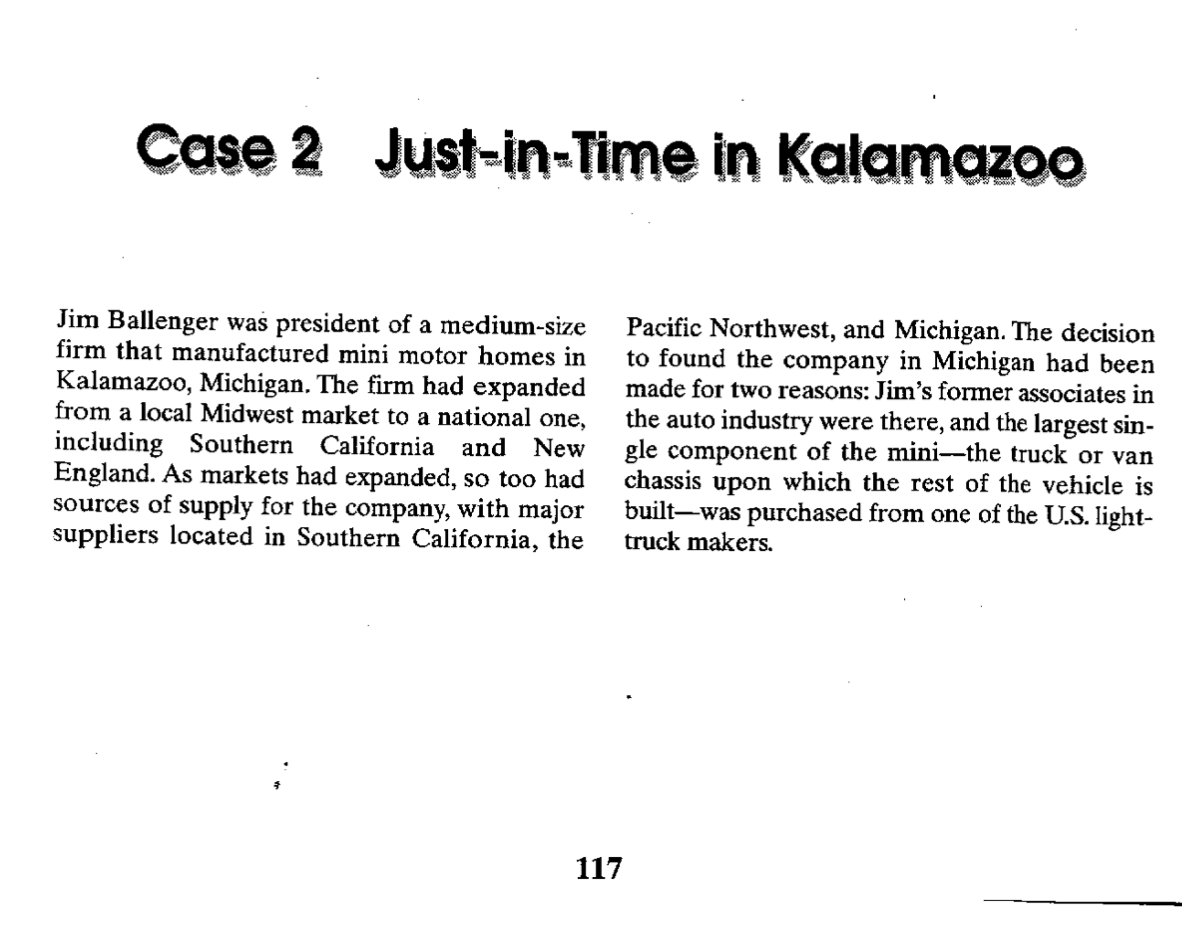
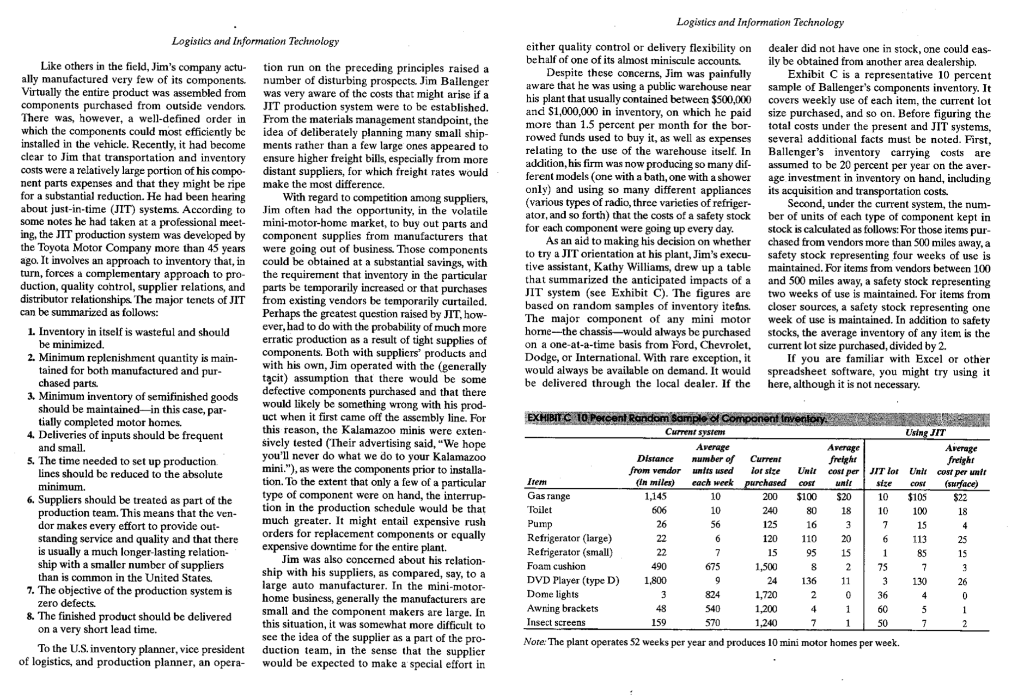
Case 2 Just-in-Time in Kalamazoo Jim Ballenger was president of a medium-size firm that manufactured mini motor homes in Kalamazoo, Michigan. The firm had expanded from a local Midwest market to a national one, including Southern California and New England. As markets had expanded, so too had sources of supply for the company, with major suppliers located in Southern California, the Pacific Northwest, and Michigan. The decision to found the company in Michigan had been made for two reasons: Jim's former associates in the auto industry were there, and the largest sin- gle component of the mini--the truck or van chassis upon which the rest of the vehicle is built-was purchased from one of the U.S. light- truck makers. 117 Logistics and Information Technology Like others in the field, Jim's company actu tion run on the preceding principles raised a ally manufactured very few of its components. number of disturbing prospects. Jim Ballenger Virtually the entire product was assembled from was very aware of the costs that might arise if a components purchased from outside vendors. JIT production system were to be established. There was, however, a well-defined order in From the materials management standpoint, the which the components could most efficiently be idea of deliberately planning many small ship- installed in the vehicle. Recently, it had become ments rather than a few large ones appeared to clear to Jim that transportation and inventory ensure higher freight bills, especially from more costs were a relatively large portion of his compo distant suppliers, for which freight rates would nent parts expenses and that they might be ripe make the most difference. for a substantial reduction. He had been hearing With regard to competition among suppliers, about just-in-time (JIT) systems. According to Jim often had the opportunity, in the volatile some notes he had taken at a professional meet mini-motor-home market, to buy out parts and ing, the JIT production system was developed by component supplies from manufacturers that the Toyota Motor Company more than 45 years were going out of business. Those components ago. It involves an approach to inventory that, in could be obtained at a substantial savings, with turn, forces a complementary approach to pro- the requirement that inventory in the particular duction, quality control, supplier relations, and parts be temporarily increased or that purchases distributor relationships. The major tenets of JIT from existing vendors be temporarily curtailed. can be summarized as follows: Perhaps the greatest question raised by JIT, how- 1. Inventory in itself is wasteful and should ever, had to do with the probability of much more be minimized. erratic production as a result of tight supplies of 2. Minimum replenishment quantity is main- components. Both with suppliers' products and tained for both manufactured and pur- with his own, Jim operated with the (generally chased parts. tacit) assumption that there would be some 3. Minimum inventory of semifinished goods defective components purchased and that there should be maintained in this case, par- would likely be something wrong with his prod- uct when it first came off the assembly line. For tially completed motor homes. this reason, the Kalamazoo minis were exten- 4. Deliveries of inputs should be frequent sively tested (Their advertising said, "We hope and small. 5. The time needed to set up production you'll never do what we do to your Kalamazoo mini."), as were the components prior to installa- lines should be reduced to the absolute tion. To the extent that only a few of a particular minimum type of component were on hand, the interrup- 6. Suppliers should be treated as part of the production team. This means that the ven- tion in the production schedule would be that dor makes every effort to provide out- much greater. It might entail expensive rush orders for replacement components or equally standing service and quality and that there is usually a much longer-lasting relation- expensive downtime for the entire plant. Jim was also concemed about his relation- ship with a smaller number of suppliers ship with his suppliers, as compared, say, to a than is common in the United States. 7. The objective of the production system is large auto manufacturer. In the mini-motor- home business, generally the manufacturers are zero defects. 8. The finished product should be delivered small and the component makers are large. In this situation, it was somewhat more difficult to on a very short lead time. see the idea of the supplier as a part of the pro- To the U.S. inventory planner, vice president duction team, in the sense that the supplier of logistics, and production planner, an opera would be expected to make a special effort in Logistics and Information Technology either quality control or delivery flexibility on dealer did not have one in stock, one could eas- behalf of one of its almost miniscule accounts. ily be obtained from another area dealership, Despite these concerns, Jim was painfully Exhibit C is a representative 10 percent aware that he was using a public warehouse near sample of Ballenger's components inventory. It his plant that usually contained between $500,000 covers weekly use of each item, the current lot and $1,000,000 in inventory, on which he paid size purchased, and so on. Before figuring the more than 1.5 percent per month for the bor total costs under the present and JIT systems, rowed funds used to buy it, as well as expenses several additional facts must be noted. First, relating to the use of the warehouse itself. In Ballenger's inventory carrying costs are addition, his firm was now producing so many dif assumed to be 20 percent per year on the aver- ferent models (one with a bath, one with a shower age investment in inventory on hand, including only) and using so many different appliances its acquisition and transportation costs. (various types of radio, three varieties of refriger Second, under the current system, the num- ator, and so forth) that the costs of a safety stock ber of units of each type of component kept in for each component were going up every day. stock is calculated as follows: For those items pur As an aid to making his decision on whether chased from vendors more than 500 miles away, a to try a JIT orientation at his plant, Jim's execu- safety stock representing four weeks of use is tive assistant, Kathy Williams, drew up a table maintained. For items from vendors between 100 that summarized the anticipated impacts of a and 500 miles away, a safety stock representing JIT system (see Exhibit C). The figures are two weeks of use is maintained. For items from based on random samples of inventory itens. closer sources, a safety stock representing one The major component of any mini motor week of use is maintained. In addition to safety home--the chassis would always be purchased stocks, the average inventory of any item is the on a one-at-a-time basis from Ford, Chevrolet, current lot size purchased, divided by 2. Dodge, or International. With rare exception, it If you are familiar with Excel or other would always be available on demand. It would spreadsheet software, you might try using it be delivered through the local dealer. If the here, although it is not necessary. cos EXHIBIT C TO Percent Random sample of Component inventory Current systems Using JIT Average Average Average Distance number of Current freight freight from vendor units used lor size Unit cost per cost per JIT lor Unit cost per unit Item in miles) each week purchased cost NE Size (surface) Gas range 1,145 10 200 $100 $20 10 $105 $22 Toilet 606 10 240 80 18 10 100 18 Pump 26 56 125 16 3 7 15 4 Refrigerator (large) 22 6 120 110 20 6 113 25 Refrigerator (small) 22 7 15 95 15 1 85 15 Foam cushion 490 675 1,500 8 2 75 7 3 DVD Player (type D) 1,800 9 24 136 11 3 3 130 26 Dome lights 3 824 1,720 2 0 36 4 0 Awning brackets 48 540 1,200 4 1 60 5 1 Insect screens 159 570 1,240 7 1 50 7 2 2 Note: The plant operates 52 weeks per year and produces 10 mini motor homes per week. Logistics and Information Technology QUESTIONS 1. What is the total annual cost of maintaining the components inventory under the pre- sent system? 2. What would be the total annual cost of maintaining the components inventory under the JIT system (assuming no safety stocks)? 3. Should Ballenger take into account any other costs or benefits from the JIT sys- tem? If so, what are they? 4. If the JIT system is adopted, are there safety stocks of any item that should be main- tained? If so, which ones and how much? 5. If the JIT system is adopted, what changes, if any, should occur in the relationships between Ballenger's firm and his suppliers of components? Discuss. 6. Assume that Ballenger has switched to the JIT system and that he receives a surprise phone call from a competitor who is going out of business. The competitor wants to sell Ballenger 7,000 dome lights of the type listed in Exhibit C. Should Ballenger buy them? If so, at what price? 7. Carrying costs are 20 percent. Is there a level of carrying costs at which both Ballenger's present system and a JIT sys- tem have similar costs? If so, what is it




