



Question: If the new JIT system is to work perfectly ( no claims spend any time in line waiting for processing ) , and the current
If the new JIT system is to work "perfectly" no claims spend any time in line waiting for processing and the current staff is adequate assume hours per day and days per week the system must be designed to process one claim about every
A hour.
B hours.
C hour.
D hours.
Which of the following would you not expect the Claims Processing Department at MICI to experience once the new JIT system is in place?
A Lower WIP
B Increased throughput
C Reduced floor space
D Increased flow time
The current system is clearly not in steady state because the inbound flow rate does not equal the outbound flow rate. Nevertheless, if we were to assume that the current system could process claims as fast as they arrive and the typical case takes weeks to process, how many claims would be in the system right now? Assume working days per week.Note that for a system in steady state, inventory WIP flow rate flow time.
A
B
C
D
The switch to the new JIT system should result in all except which of the following?
A Less idle workers
B Fewer workers
C Higher trained workers
D More specialized workers
of MICl's insurance claims for the entire nation. The company's sales have experienced rapid growth during the last year, and as expected, record levels in claims followed. Over forms for claims a day are now flowing into the office for processing. Unfortunately, fewer than forms a day are flowing out. The total time to process a claim, from the time it arrives to the time a check is mailed, has increased from days to weeks. As a result, some customers are threatening legal action. Sally Cook, the manager of Claims Processing, is particularly distressed, as she knows that a claim seldom requires more than hours of actual work. Under the current administrative procedures, human resources limitations and facility constraints, there appear to be no easy fixes for the problem. But clearly, something must be done, as the workload has overwhelmed the existing system.
MICI management wants aggressive, but economical, action taken to fix the problem. Ms Cook has decided to try a JIT approach to claim processing. With support from her bosses, and as a temporary fix, Cook has brought in parttime personnel from MICl sales divisions across the country to help. They are to work down the claims backlog while a new JIT system is installed.
Meanwhile, Claims Processing managers and employees are to be trained in JIT principles. With JIT principles firmly in mind, managers will redesign jobs to move responsibilities for quality control activities to each employee, holding them responsible for quality work and any necessary corrections. Cook will also initiate workertraining programs that explain the entire claim processing flow, as well as provide comprehensive training on each step in the process. Dataentry skills will also be taught to both employees and managers in an effort to fix responsibility for data accuracy on the processor rather than on data entry clerks. Additionally, crosstraining will be emphasized to enable workers within departments to process a variety of customer claim applications in their entirety.
Cook and her supervisors are also reexamining the insurance and claim forms currently in use. They want to see if standardization of forms will cut processing time, reduce dataentry time, and cut workinprocess.
They hope the changes will also save training time. Making changes in work methods and worker skills leads logically to a need for change in the layout of the Claims Processing Department. This potential change represents a major move from the departmental layout of the past and will be a costly step. To help ensure the successful implementation of this phase of the changeover, Cook established a team made up of supervisors, employees, and an outside office layout consultant. She also had the team visit the Kawasaki motorcycle plant in Lincoln, Nebraska, to observe their use of work cells to aid JIT.
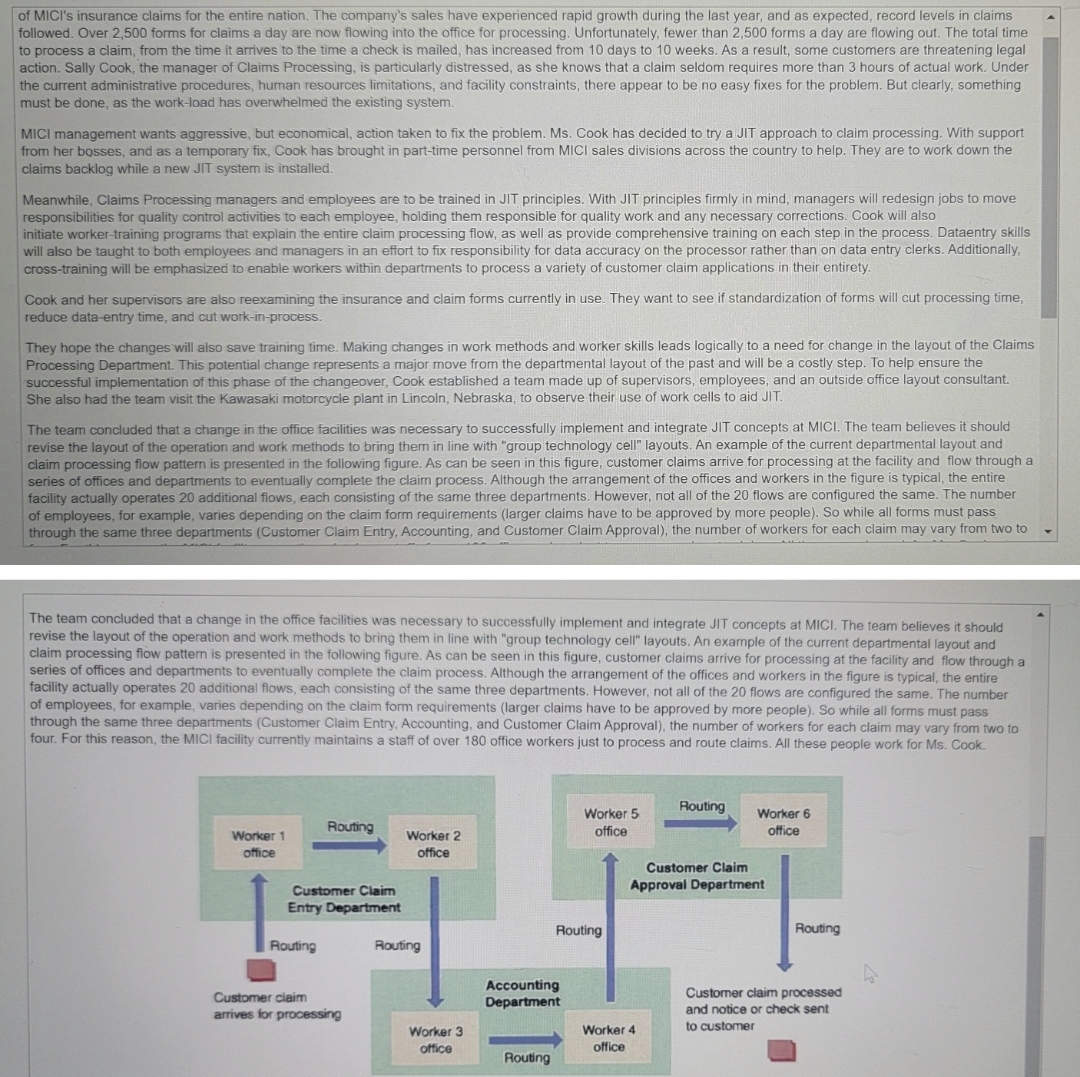
The team concluded that a change in the office facilities was necessary to successfully implement and integrate JIT concepts at MICI. The team believes it should revise the layout of the operation and work methods to bring them in line with "group technology cell" layouts. An example of the current departmental layout and claim processing flow pattern is presented in the following figure. As can be seen in this figure, customer claims arrive for processing at the facility and flow through a series of offices and departments to eventually complete the claim process. Although the arrangement of the offices and workers in the figure is typical, the entire facility actually operates additional flows, each consisting of the same three departments. However, not all of the flows are configured the same. The number of employee
Step by Step Solution
There are 3 Steps involved in it
1 Expert Approved Answer
Step: 1 Unlock

Question Has Been Solved by an Expert!
Get step-by-step solutions from verified subject matter experts
Step: 2 Unlock
Step: 3 Unlock