







Question: If you can please post the code window as well. I am unsure how to do 3 and 4, if you can please post comments



If you can please post the code window as well.
I am unsure how to do 3 and 4, if you can please post comments thanks!
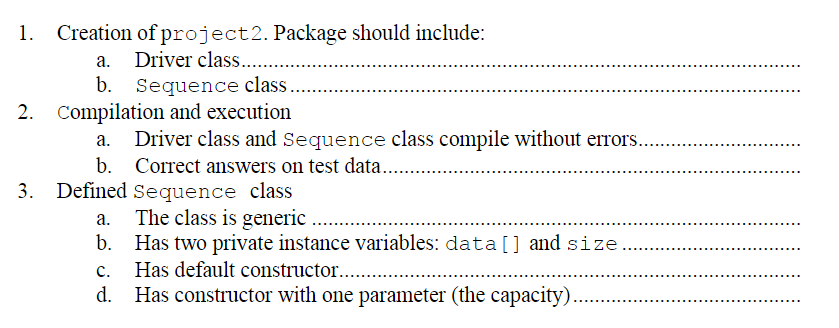
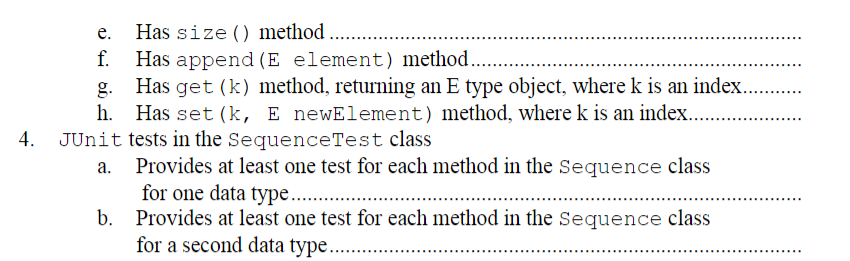
Objective: This assignment will help you get acquainted with parameterized classes, both from a developer and a user perspective. It will also help you understand how to perform unit testing. Program assignment: Implement and test a parametrized class. Design specifications Create a Java project project2 and a package package2. Design the Sequence class with E the type parameter. Define a driver class containing a main method that exercises the class Sequence as an application. The two classes should be saved in different files. Your driver class should have the following header: Create Junit 5 tests based on the method specifications and stubs. Implement the SequenceTest class and save it in a separate file. Read Section 2.2 in textbook Define the methods in the Sequence class. For the append () method, if the data array is full, its capacity must be increased before the new element can be appended (see Programming Exercise 2.10). The size () method returns the value of the private size instance variable. The size variable keeps the current number of elements and should be updated when appending elements. There is no need to create an input file to test the methods for the Sequence class. 1. Creation of project2. Package should include: a. Driver class....... b. Sequence class 2. Compilation and execution Driver class and Sequence class compile without errors... b. Correct answers on test data......... 3. Defined Sequence class The class is generic b. Has two private instance variables: data[] and size Has default constructor............ d. Has constructor with one parameter (the capacity).. a. c. 4. e. Has size () method f. Has append(E element) method..... g. Has get (k) method, returning an E type object, where k is an index......... Has set (k, E newElement) method, where k is an index... JUnit tests in the SequenceTest class Provides at least one test for each method in the Sequence class for one data type ........ b. Provides at least one test for each method in the Sequence class for a second data type
Step by Step Solution
There are 3 Steps involved in it

Get step-by-step solutions from verified subject matter experts
 Study Help