



Question: if you can solve all question then try otherwise don't Ramble, Inc, is a large food-processing company. It processes 154,000 pounds of peanuts in the
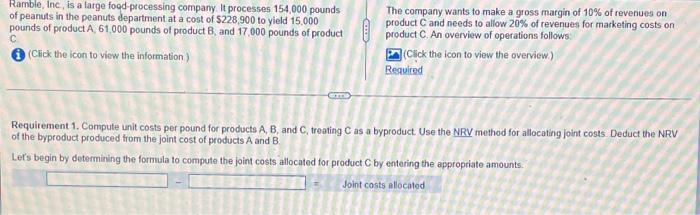
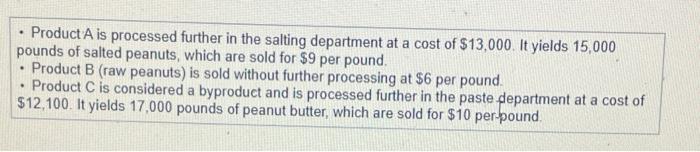
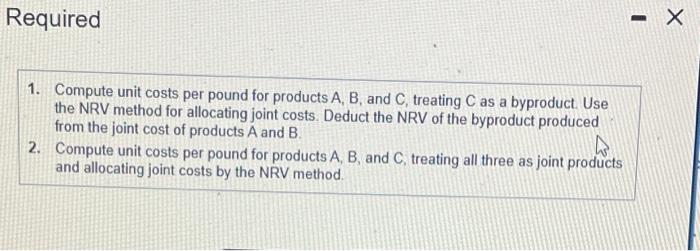
Ramble, Inc, is a large food-processing company. It processes 154,000 pounds of peanuts in the peanuts department at a cost of $228,900 to yield 15.000 pounds of product A, 61,000 pounds of product B, and 17,000 pounds of product C (Click the icon to view the information) Come The company wants to make a gross margin of 10% of revenues on product C and needs to allow 20% of revenues for marketing costs on product C. An overview of operations follows: (Click the icon to view the overview.) Required Requirement 1. Compute unit costs per pound for products A, B, and C, treating C as a byproduct. Use the NRV method for allocating joint costs. Deduct the NRV of the byproduct produced from the joint cost of products A and B Let's begin by determining the formula to compute the joint costs allocated for product C by entering the appropriate amounts Joint costs allocated Product A is processed further in the salting department at a cost of $13,000. It yields 15,000 pounds of salted peanuts, which are sold for $9 per pound. Product B (raw peanuts) is sold without further processing at $6 per pound. Product C is considered a byproduct and is processed further in the paste department at a cost of $12,100. It yields 17,000 pounds of peanut butter, which are sold for $10 per-pound. . . . Required 1. Compute unit costs per pound for products A, B, and C, treating C as a byproduct. Use the NRV method for allocating joint costs. Deduct the NRV of the byproduct produced from the joint cost of products A and B. 2. Compute unit costs per pound for products A, B, and C, treating all three as joint products and allocating joint costs by the NRV method. I X Ramble, Inc, is a large food-processing company. It processes 154,000 pounds of peanuts in the peanuts department at a cost of $228,900 to yield 15.000 pounds of product A, 61,000 pounds of product B, and 17,000 pounds of product C (Click the icon to view the information) Come The company wants to make a gross margin of 10% of revenues on product C and needs to allow 20% of revenues for marketing costs on product C. An overview of operations follows: (Click the icon to view the overview.) Required Requirement 1. Compute unit costs per pound for products A, B, and C, treating C as a byproduct. Use the NRV method for allocating joint costs. Deduct the NRV of the byproduct produced from the joint cost of products A and B Let's begin by determining the formula to compute the joint costs allocated for product C by entering the appropriate amounts Joint costs allocated Product A is processed further in the salting department at a cost of $13,000. It yields 15,000 pounds of salted peanuts, which are sold for $9 per pound. Product B (raw peanuts) is sold without further processing at $6 per pound. Product C is considered a byproduct and is processed further in the paste department at a cost of $12,100. It yields 17,000 pounds of peanut butter, which are sold for $10 per-pound. . . . Required 1. Compute unit costs per pound for products A, B, and C, treating C as a byproduct. Use the NRV method for allocating joint costs. Deduct the NRV of the byproduct produced from the joint cost of products A and B. 2. Compute unit costs per pound for products A, B, and C, treating all three as joint products and allocating joint costs by the NRV method. I X
Step by Step Solution
There are 3 Steps involved in it

Get step-by-step solutions from verified subject matter experts