







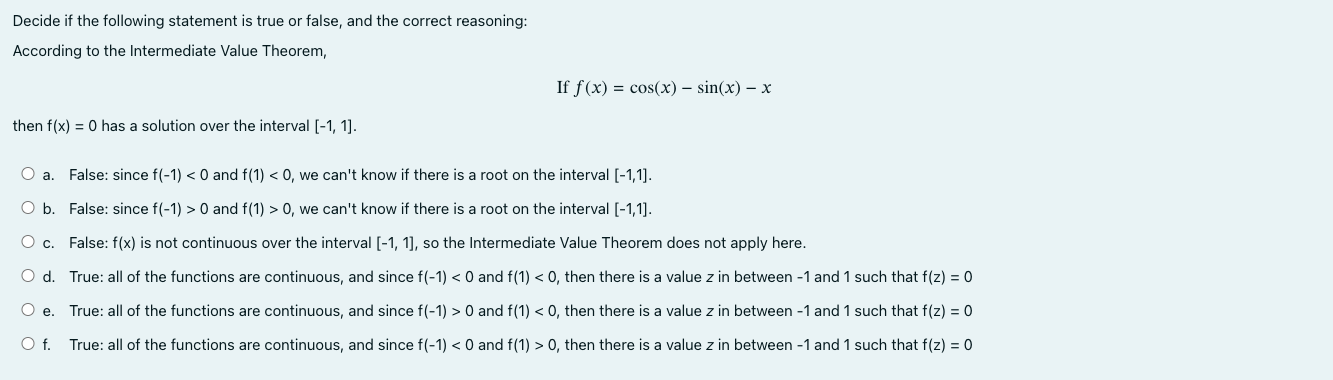
Question: If you could answer both, I'd appreciate it. Decide if the following statement is true or false, and the correct reasoning: According to the Intermediate
If you could answer both, I'd appreciate it.
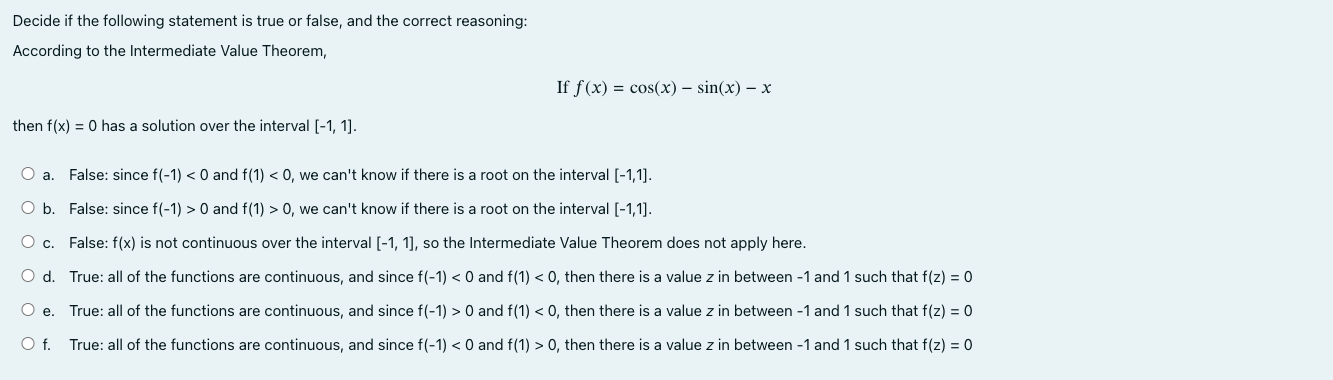
![then f(x) = 0 has a solution over the interval [-1, 1].](https://s3.amazonaws.com/si.experts.images/answers/2024/06/6664d73fe9706_7356664d73fc4b8f.jpg)
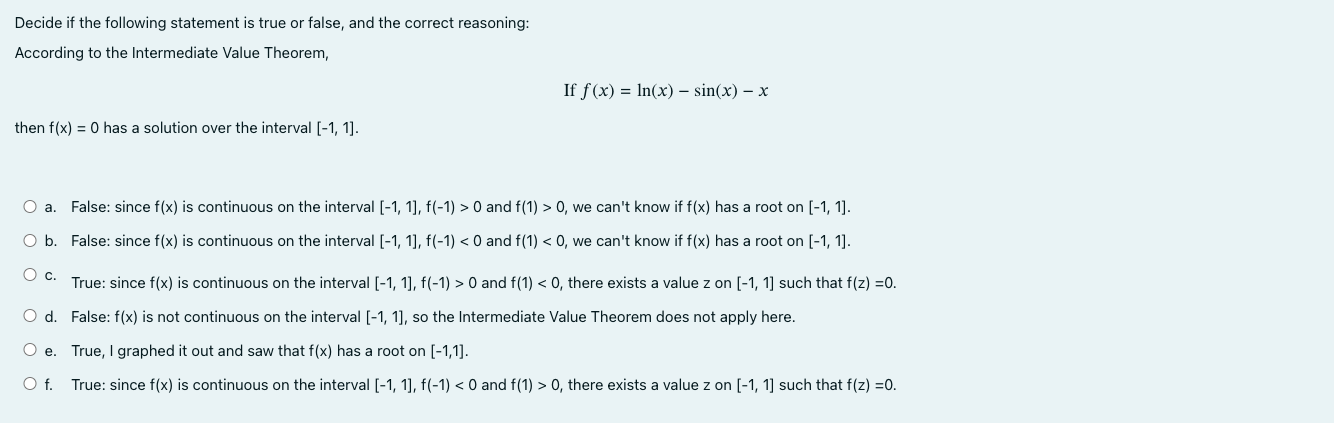
Decide if the following statement is true or false, and the correct reasoning: According to the Intermediate Value Theorem, If f(x) = cos(x) - sin(x) - x then f(x) = 0 has a solution over the interval [-1, 1]. O a. False: since f(-1) 0 and f(1) > 0, we can't know if there is a root on the interval [-1, 1]. O c. False: f(x) is not continuous over the interval [-1, 1], so the Intermediate Value Theorem does not apply here. O d. True: all of the functions are continuous, and since f(-1) 0 and f(1) 0, then there is a value z in between -1 and 1 such that f(z) = 0Decide if the following statement is true or false, and the correct reasoning: According to the Intermediate Value Theorem, If f (x) = In(x) - sin(x) - x then f(x) = 0 has a solution over the interval [-1, 1]. O a. False: since f(x) is continuous on the interval [-1, 1], f(-1) > 0 and f(1) > 0, we can't know if f(x) has a root on [-1, 1]. O b. False: since f(x) is continuous on the interval [-1, 1], f(-1) 0 and f(1) 0, there exists a value z on [-1, 1] such that f(z) =0
Step by Step Solution
There are 3 Steps involved in it

Get step-by-step solutions from verified subject matter experts
 Study Help