



Question: if you have part c please show answer as well thanks As you learned in the previous chapters, Current Designs has two main product lines-composite
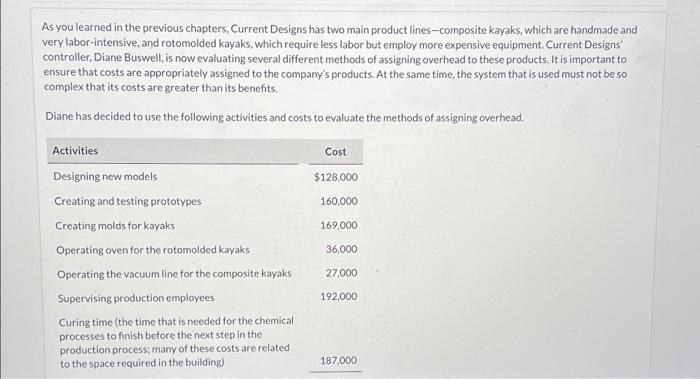
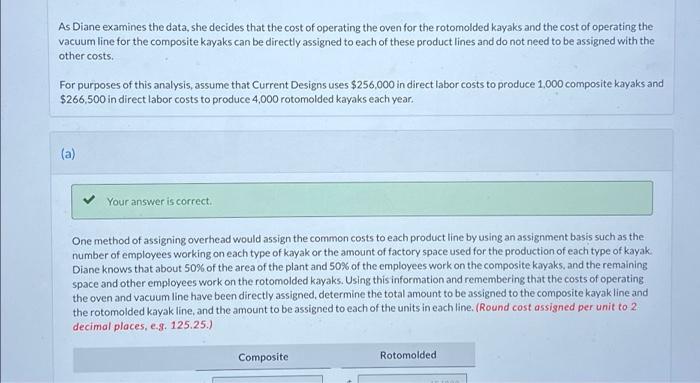
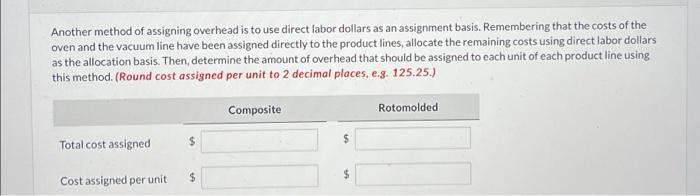

As you learned in the previous chapters, Current Designs has two main product lines-composite kayaks, which are handmade and very labor-intensive, and rotomolded kayaks, which require less labor but employ more expensive equipment. Current Designs controller, Diane Buswell, is now evaluating several different methods of assigning overhead to these products. It is important to ensure that costs are appropriately assigned to the company's products. At the same time, the system that is used must not be so complex that its costs are greater than its benefits. Diane has decided to use the following activities and costs to evaluate the methods of assigning overhead. Activities Cost Designing new models $128,000 Creating and testing prototypes 160,000 Creating molds for kayaks 169,000 Operating oven for the rotomolded kayaks 36,000 Operating the vacuum line for the composite kayaks 27,000 Supervising production employees 192,000 Curing time (the time that is needed for the chemical processes to finish before the next step in the production process; many of these costs are related to the space required in the building) 187,000 As Diane examines the data, she decides that the cost of operating the oven for the rotomolded kayaks and the cost of operating the vacuum line for the composite kayaks can be directly assigned to each of these product lines and do not need to be assigned with the other costs. For purposes of this analysis, assume that Current Designs uses $256,000 in direct labor costs to produce 1,000 composite kayaks and $266,500 in direct labor costs to produce 4,000 rotomolded kayaks each year. (a) Your answer is correct. One method of assigning overhead would assign the common costs to each product line by using an assignment basis such as the number of employees working on each type of kayak or the amount of factory space used for the production of each type of kayak. Diane knows that about 50% of the area of the plant and 50% of the employees work on the composite kayaks, and the remaining space and other employees work on the rotomolded kayaks. Using this information and remembering that the costs of operating the oven and vacuum line have been directly assigned, determine the total amount to be assigned to the composite kayak line and the rotomolded kayak line, and the amount to be assigned to each of the units in each line. (Round cost assigned per unit to 2 decimal places, e.g. 125.25.) Composite Rotomolded. Another method of assigning overhead is to use direct labor dollars as an assignment basis. Remembering that the costs of the oven and the vacuum line have been assigned directly to the product lines, allocate the remaining costs using direct labor dollars as the allocation basis. Then, determine the amount of overhead that should be assigned to each unit of each product line using this method. (Round cost assigned per unit to 2 decimal places, e.g. 125.25.) Composite Rotomolded Total cost assigned Cost assigned per unit 10% score reduction after attempt 2 (c) The parts of this question must be completed in order. This part will be available when you complete the part above. As you learned in the previous chapters, Current Designs has two main product lines-composite kayaks, which are handmade and very labor-intensive, and rotomolded kayaks, which require less labor but employ more expensive equipment. Current Designs controller, Diane Buswell, is now evaluating several different methods of assigning overhead to these products. It is important to ensure that costs are appropriately assigned to the company's products. At the same time, the system that is used must not be so complex that its costs are greater than its benefits. Diane has decided to use the following activities and costs to evaluate the methods of assigning overhead. Activities Cost Designing new models $128,000 Creating and testing prototypes 160,000 Creating molds for kayaks 169,000 Operating oven for the rotomolded kayaks 36,000 Operating the vacuum line for the composite kayaks 27,000 Supervising production employees 192,000 Curing time (the time that is needed for the chemical processes to finish before the next step in the production process; many of these costs are related to the space required in the building) 187,000 As Diane examines the data, she decides that the cost of operating the oven for the rotomolded kayaks and the cost of operating the vacuum line for the composite kayaks can be directly assigned to each of these product lines and do not need to be assigned with the other costs. For purposes of this analysis, assume that Current Designs uses $256,000 in direct labor costs to produce 1,000 composite kayaks and $266,500 in direct labor costs to produce 4,000 rotomolded kayaks each year. (a) Your answer is correct. One method of assigning overhead would assign the common costs to each product line by using an assignment basis such as the number of employees working on each type of kayak or the amount of factory space used for the production of each type of kayak. Diane knows that about 50% of the area of the plant and 50% of the employees work on the composite kayaks, and the remaining space and other employees work on the rotomolded kayaks. Using this information and remembering that the costs of operating the oven and vacuum line have been directly assigned, determine the total amount to be assigned to the composite kayak line and the rotomolded kayak line, and the amount to be assigned to each of the units in each line. (Round cost assigned per unit to 2 decimal places, e.g. 125.25.) Composite Rotomolded. Another method of assigning overhead is to use direct labor dollars as an assignment basis. Remembering that the costs of the oven and the vacuum line have been assigned directly to the product lines, allocate the remaining costs using direct labor dollars as the allocation basis. Then, determine the amount of overhead that should be assigned to each unit of each product line using this method. (Round cost assigned per unit to 2 decimal places, e.g. 125.25.) Composite Rotomolded Total cost assigned Cost assigned per unit 10% score reduction after attempt 2 (c) The parts of this question must be completed in order. This part will be available when you complete the part above
Step by Step Solution
There are 3 Steps involved in it

Get step-by-step solutions from verified subject matter experts