



Question: If you toss a rock at an initial height H with an initial velocity V then its height h(t) after t seconds is given by
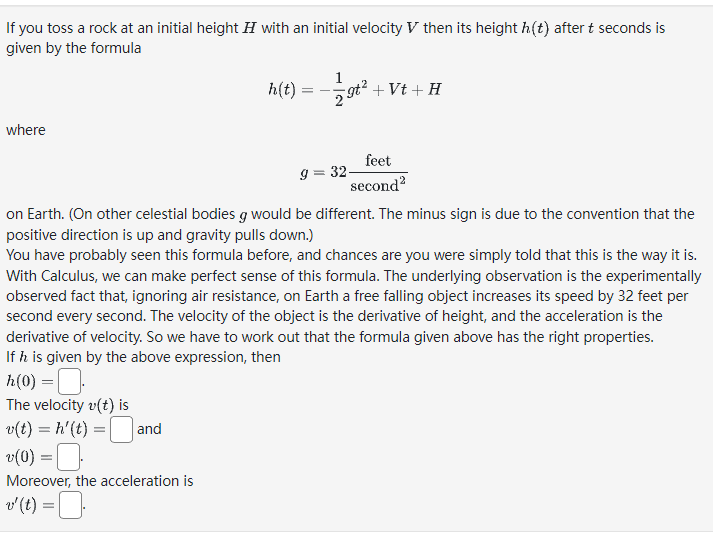
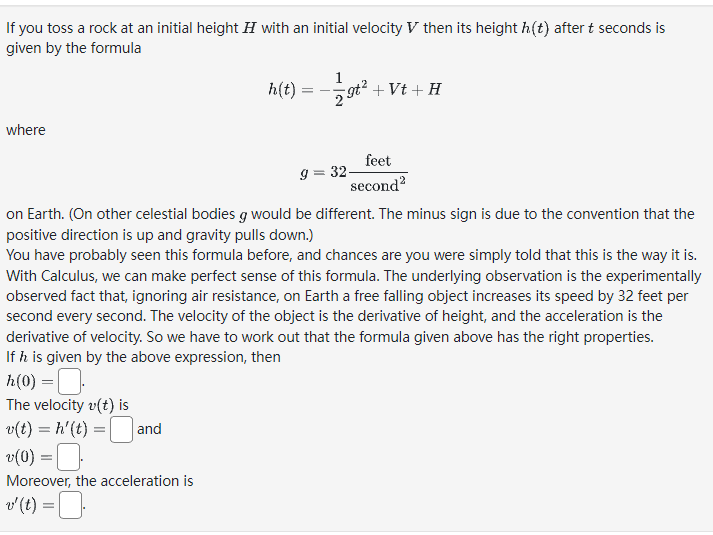
If you toss a rock at an initial height H with an initial velocity V then its height h(t) after t seconds is given by the formula h(t) = -gt* + Vt + H where feet 9 = 32 second on Earth. (On other celestial bodies g would be different. The minus sign is due to the convention that the positive direction is up and gravity pulls down.) You have probably seen this formula before, and chances are you were simply told that this is the way it is. With Calculus, we can make perfect sense of this formula. The underlying observation is the experimentally observed fact that, ignoring air resistance, on Earth a free falling object increases its speed by 32 feet per second every second. The velocity of the object is the derivative of height, and the acceleration is the derivative of velocity. So we have to work out that the formula given above has the right properties. If h is given by the above expression, then h(0) = The velocity v(t) is u(t) = h'(t) = and v.(0) = Moreover, the acceleration is v'(t) =
Step by Step Solution
There are 3 Steps involved in it

Get step-by-step solutions from verified subject matter experts