







Question: If you used a three-byte, static data structure to store a pointer address, what's the smallest address (ie, smallest number) you could represent? Write your
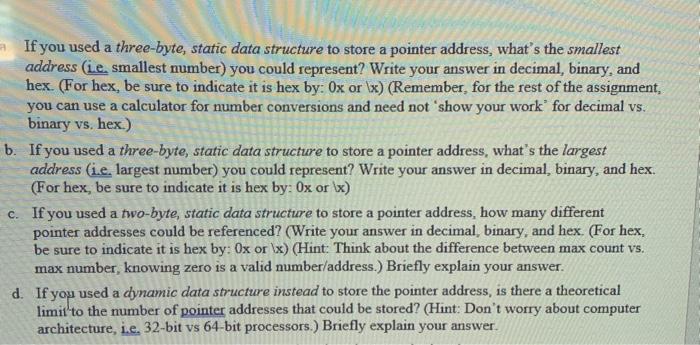
If you used a three-byte, static data structure to store a pointer address, what's the smallest address (ie, smallest number) you could represent? Write your answer in decimal, binary, and hex. (For hex, be sure to indicate it is hex by: 0x or \x) (Remember, for the rest of the assignment, you can use a calculator for number conversions and need not show your work for decimal vs. binary vs. hex.) b. If you used a three-byte, static data structure to store a pointer address, what's the largest address (ie, largest number) you could represent? Write your answer in decimal, binary, and hex. (For hex, be sure to indicate it is hex by: 0x or \x) c. If you used a two-byte, static data structure to store a pointer address, how many different pointer addresses could be referenced? (Write your answer in decim binary, and hex. (For hex, be sure to indicate it is hex by: Ox or \x) (Hint: Think about the difference between max count vs. max number, knowing zero is a valid number/address.) Briefly explain your answer. d. If you used a dynamic data structure instead to store the pointer address, is there a theoretical limit to the number of pointer addresses that could be stored? (Hint: Don't worry about computer architecture, i.e. 32-bit vs 64-bit processors.) Briefly explain your
Step by Step Solution
There are 3 Steps involved in it

Get step-by-step solutions from verified subject matter experts
 Study Help