







Question: if ysing matlab, please show the code 3. In lecture we discussed applying Poisson Blending to a simple 1D case. Now let's extend this for
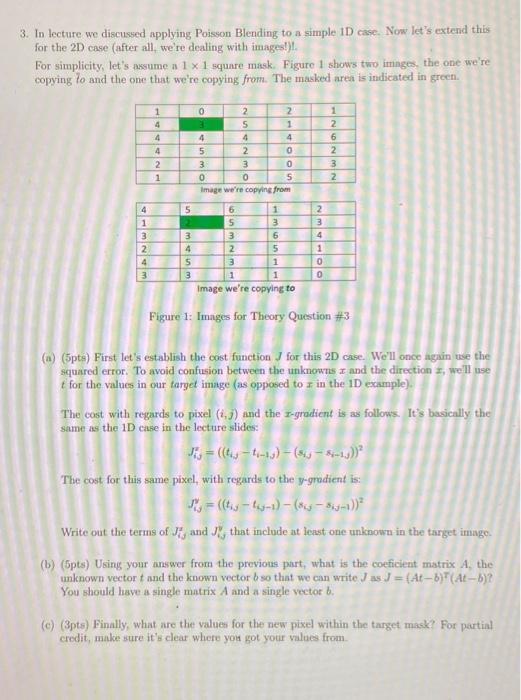
3. In lecture we discussed applying Poisson Blending to a simple 1D case. Now let's extend this for the 2D case (after all, we're dcaling with images!) L. For simplicity, let's assume a 11 square mask. Figure 1 shows two imnges, the one we're copying to and the one that we're copying from. The masked area is indicated in green. Figure 1: Images for Theory Question \#3 (a) (5ptg) First let's establish the cost function J for this 2D case. Well once again the the squared error. To avoid confusion between the unknowns x and the direction x, well use t for the values in our target image (as opposed to x in the 1D example). The cost with regards to pixel (i,j) and the x-yradient is as follows. It's basically the same as the 1D case in the lecture slides: JijR=((ti,jti1,j)(sj,jsi1,j))2 The cost for this same pixel, with regards to the y-gredient is: fij=((tijtij1)(sijsij1))2 Write out the terms of Ji, and Ji, that include at least one unknown in the target image. (b) (5pts) Using your answer from the previons part, what is the coeficient matrix A, the unknown vector t and the known vector b so that we can write J as J=(Atb)(Atb)T ? You should have a single matrix A and a single vector b. (c) (3pts) Finally, what are the values for the new pixel within the target mask? For partial crodit, make sure it's clear where you got your values from
Step by Step Solution
There are 3 Steps involved in it

Get step-by-step solutions from verified subject matter experts
 Study Help