







Question: 1. A vessel having a volume of 100 ft3 contains 1 ft of saturated liquid water and 99 ft of saturated water vapor at
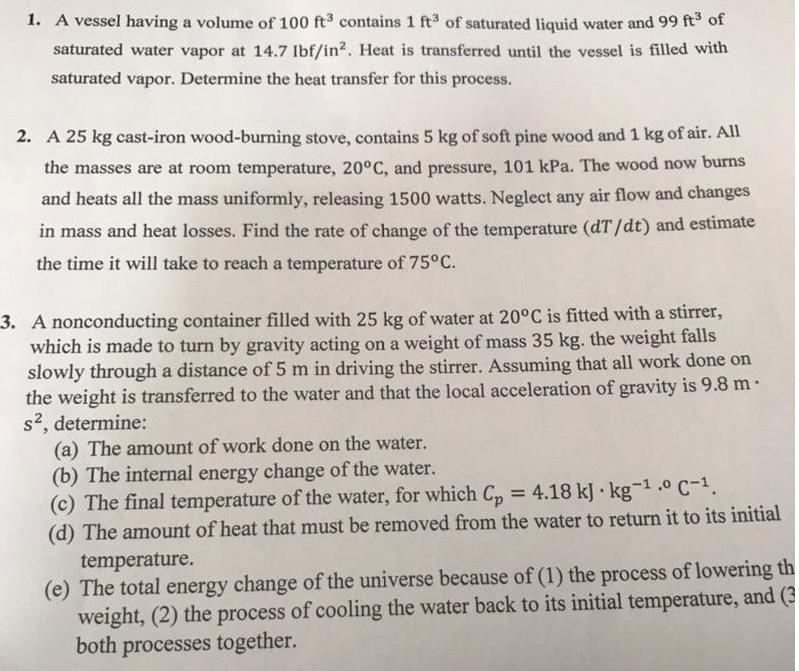
1. A vessel having a volume of 100 ft3 contains 1 ft of saturated liquid water and 99 ft of saturated water vapor at 14.7 Ibf/in2. Heat is transferred until the vessel is filled with saturated vapor. Determine the heat transfer for this process. 2. A 25 kg cast-iron wood-burning stove, contains 5 kg of soft pine wood and 1 kg of air. All the masses are at room temperature, 20C, and pressure, 101 kPa. The wood now burns and heats all the mass uniformly, releasing 1500 watts. Neglect any air flow and changes in mass and heat losses. Find the rate of change of the temperature (dT /dt) and estimate the time it will take to reach a temperature of 75C. 3. A nonconducting container filled with 25 kg of water at 20C is fitted with a stirrer, which is made to turn by gravity acting on a weight of mass 35 kg. the weight falls slowly through a distance of 5 m in driving the stirrer. Assuming that all work done on the weight is transferred to the water and that the local acceleration of gravity is 9.8 m s2, determine: (a) The amount of work done on the water. (b) The internal energy change of the water. (c) The final temperature of the water, for which C, = 4.18 kJ kg-1.0 C-1. (d) The amount of heat that must be removed from the water to return it to its initial %3D temperature. (e) The total energy change of the universe because of (1) the process of lowering th weight, (2) the process of cooling the water back to its initial temperature, and (? both processes together.
Step by Step Solution
3.45 Rating (148 Votes )
There are 3 Steps involved in it
2 1 The heat transfer will be found from the first law of thermodynamics State 1 is known so U1 can be calculated Also the specific volume at state 2 is known from state 1 and the process Since state ... View full answer

Get step-by-step solutions from verified subject matter experts
 Study Help