







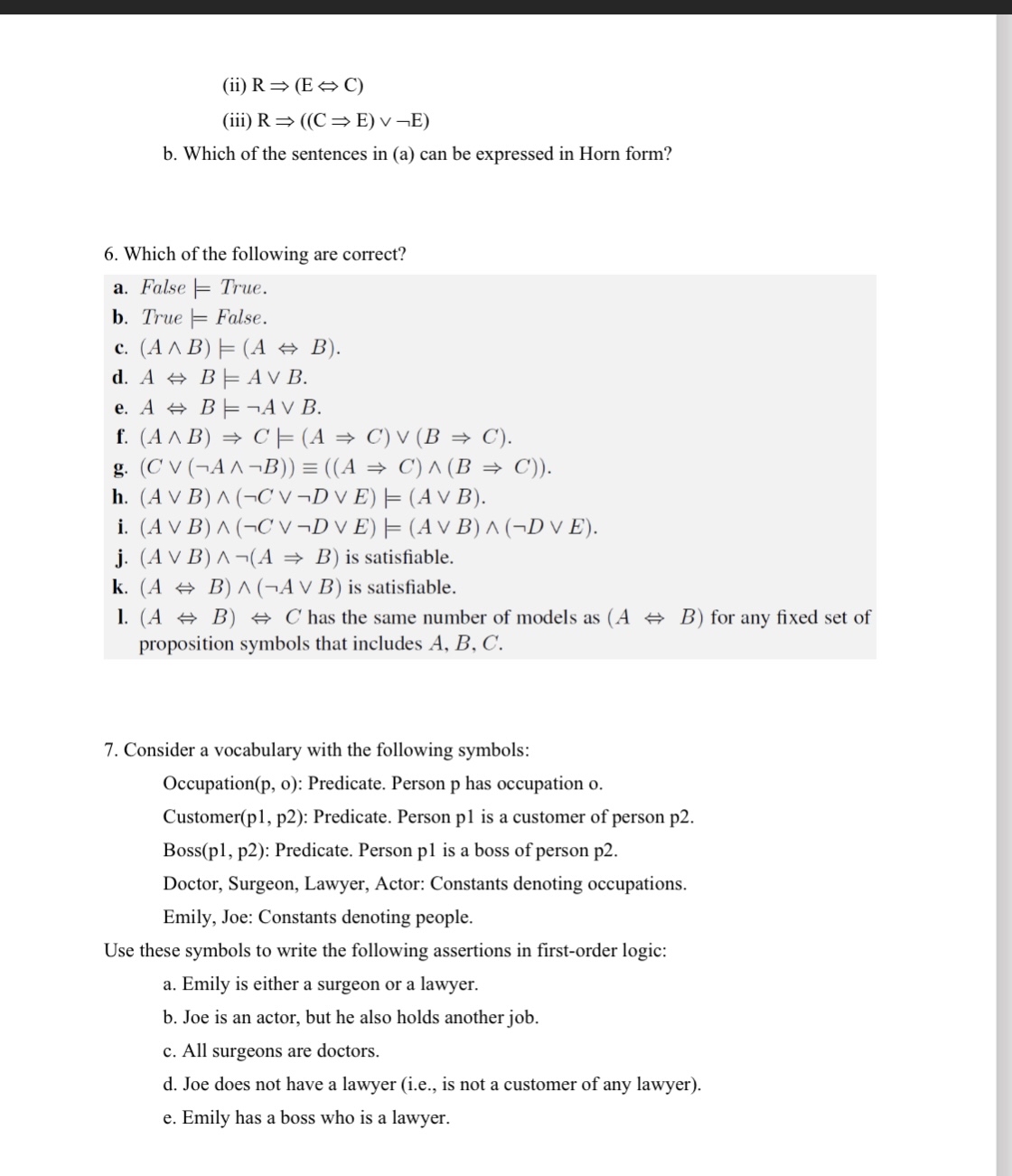
Question: ( ii ) ) > ( C ( iii ) ) ) = > ( ( E b . Which of the sentences in (
ii
iii
b Which of the sentences in a can be expressed in Horn form?
Which of the following are correct?
a False True.
b True False.
c
dAvvB.
enotAvvB.
f
g
h
i
j is satisfiable.
k is satisfiable.
l has the same number of models as for any fixed set of proposition symbols that includes
Consider a vocabulary with the following symbols:
Occupationp o: Predicate. Person has occupation o
Customerp p: Predicate. Person p is a customer of person p
Boss : Predicate. Person is a boss of person
Doctor, Surgeon, Lawyer, Actor: Constants denoting occupations.
Emily, Joe: Constants denoting people.
Use these symbols to write the following assertions in firstorder logic:
a Emily is either a surgeon or a lawyer.
b Joe is an actor, but he also holds another job.
c All surgeons are doctors.
d Joe does not have a lawyer ie is not a customer of any lawyer
e Emily has a boss who is a lawyer.
Step by Step Solution
There are 3 Steps involved in it
1 Expert Approved Answer
Step: 1 Unlock

Question Has Been Solved by an Expert!
Get step-by-step solutions from verified subject matter experts
Step: 2 Unlock
Step: 3 Unlock
 Study Help