







Question: II. Data Analysis and Interpretation A. Which compounds release heat when they dissolve? (This is termed an exothermic process. Which compounds gain heat when they
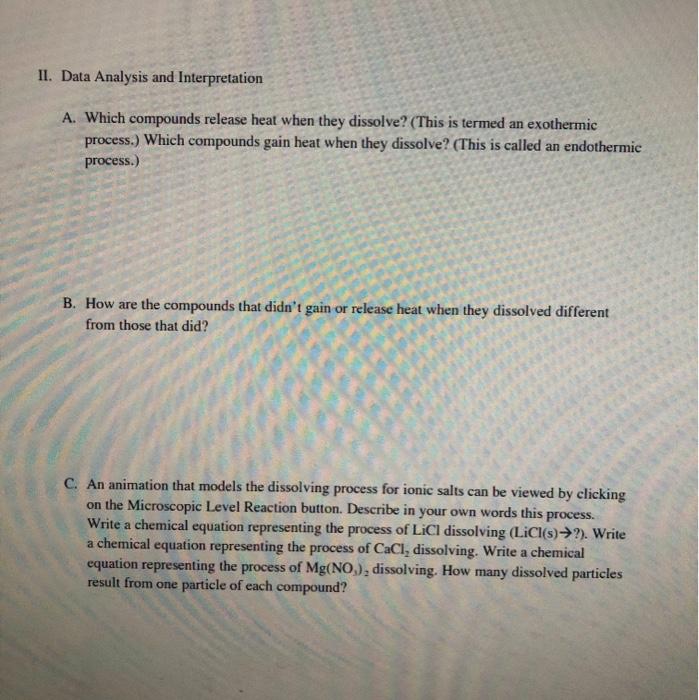
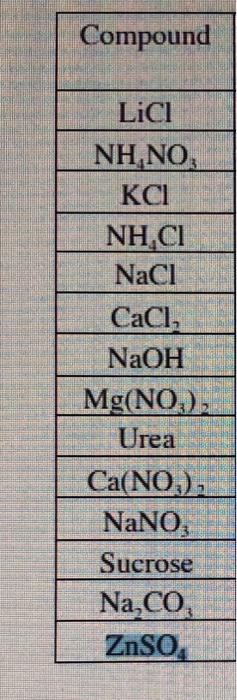
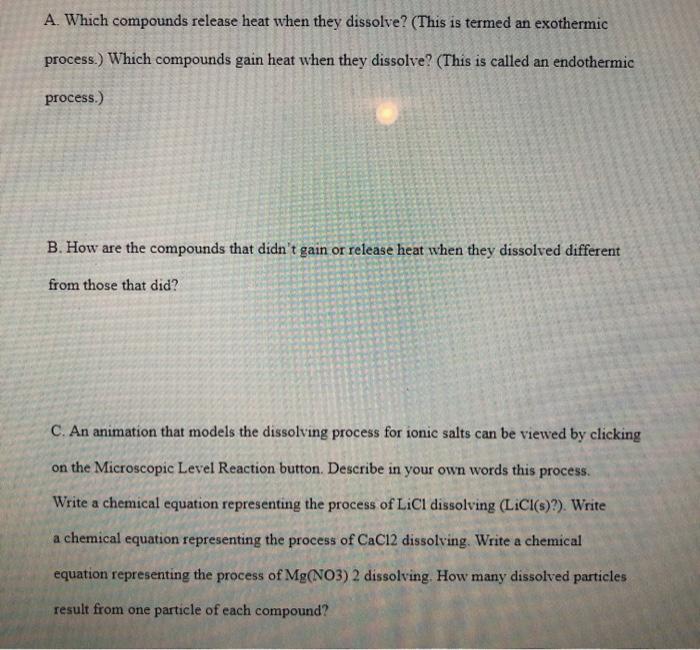
II. Data Analysis and Interpretation A. Which compounds release heat when they dissolve? (This is termed an exothermic process. Which compounds gain heat when they dissolve? (This is called an endothermic process.) B. How are the compounds that didn't gain or release heat when they dissolved different from those that did? C. An animation that models the dissolving process for ionic salts can be viewed by clicking on the Microscopic Level Reaction button. Describe in your own words this process. Write a chemical equation representing the process of LiCl dissolving (LiCl(s)?). Write a chemical equation representing the process of CaCl, dissolving. Write a chemical equation representing the process of Mg(NO), dissolving. How many dissolved particles result from one particle of each compound? Compound Lici NH,NO. NH4Cl Naci CaCl, NaOH Mg(NO), Urea Ca(NO.), NaNO, Sucrose Na.Co Znso, A Which compounds release heat when they dissolve? (This is termed an exothermic process.) Which compounds gain heat when they dissolve? (This is called an endothermic process.) B. How are the compounds that didn't gain or release heat when they dissolved different from those that did? C. An animation that models the dissolving process for ionic salts can be viewed by clicking on the Microscopic Level Reaction button. Describe in your own words this process. Write a chemical equation representing the process of Lici dissolving (LiCIE)?). Write a chemical equation representing the process of CaCl2 dissolving. Write a chemical equation representing the process of Mg(NO3)2 dissolving. How many dissolved particles result from one particle of each compound
Step by Step Solution
There are 3 Steps involved in it

Get step-by-step solutions from verified subject matter experts
 Study Help