







Question: ii) Now drop the four observations with bs > .5, that is, where average benefits are (supposedly) more than 50% of average salary. What
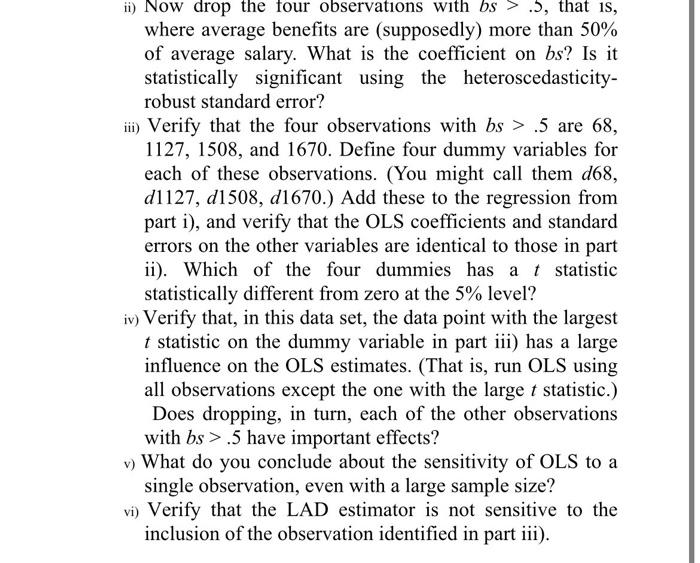
ii) Now drop the four observations with bs > .5, that is, where average benefits are (supposedly) more than 50% of average salary. What is the coefficient on bs? Is it statistically significant using the heteroscedasticity- robust standard error? iii) Verify that the four observations with bs >.5 are 68, 1127, 1508, and 1670. Define four dummy variables for each of these observations. (You might call them d68, d1127, d1508, d1670.) Add these to the regression from part i), and verify that the OLS coefficients and standard errors on the other variables are identical to those in part ii). Which of the four dummies has a t statistic statistically different from zero at the 5% level? iv) Verify that, in this data set, the data point with the largest t statistic on the dummy variable in part iii) has a large influence on the OLS estimates. (That is, run OLS using all observations except the one with the large t statistic.) Does dropping, in turn, each of the other observations with bs >.5 have important effects? v) What do you conclude about the sensitivity of OLS to a single observation, even with a large sample size? vi) Verify that the LAD estimator is not sensitive to the inclusion of the observation identified in part iii).
Step by Step Solution
There are 3 Steps involved in it

Get step-by-step solutions from verified subject matter experts
 Study Help