







Question: II. Problem Statement A foundry produces casting products with gold and silver raw materials. The production plant needs to produce 100 gold products and 60
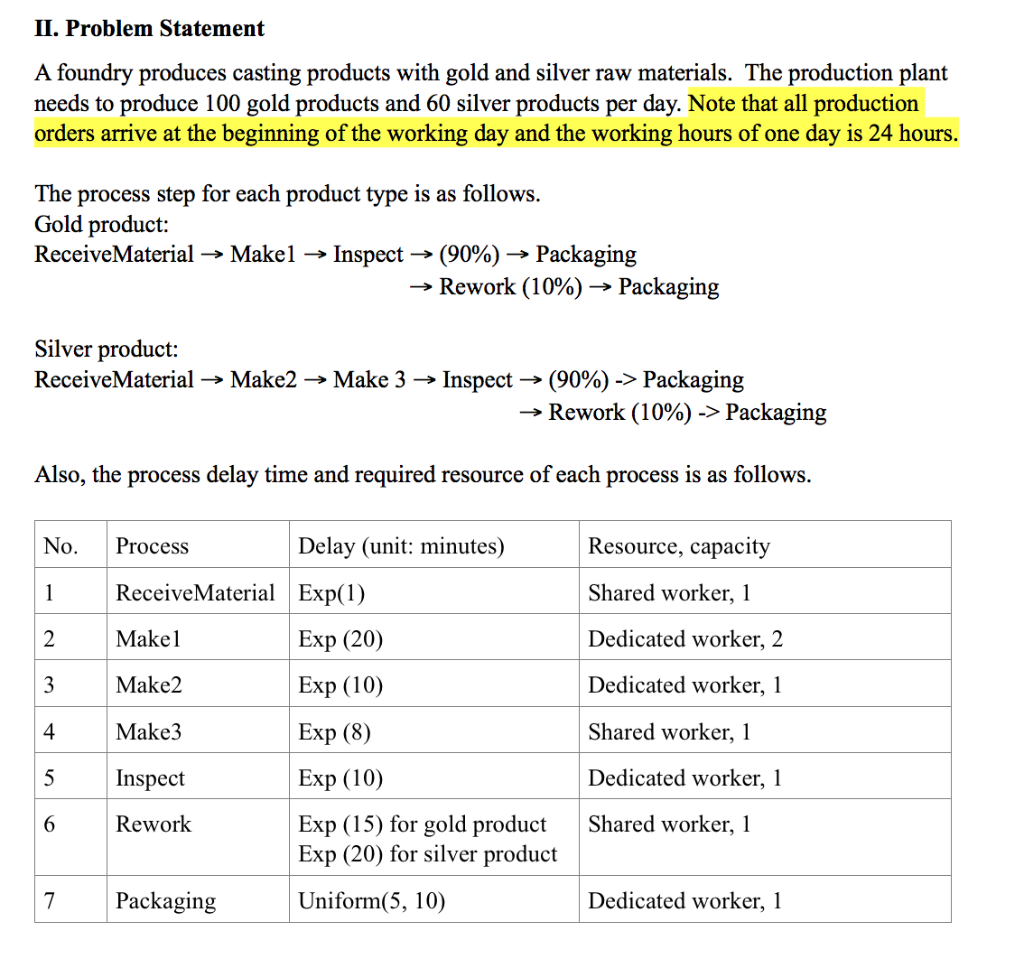
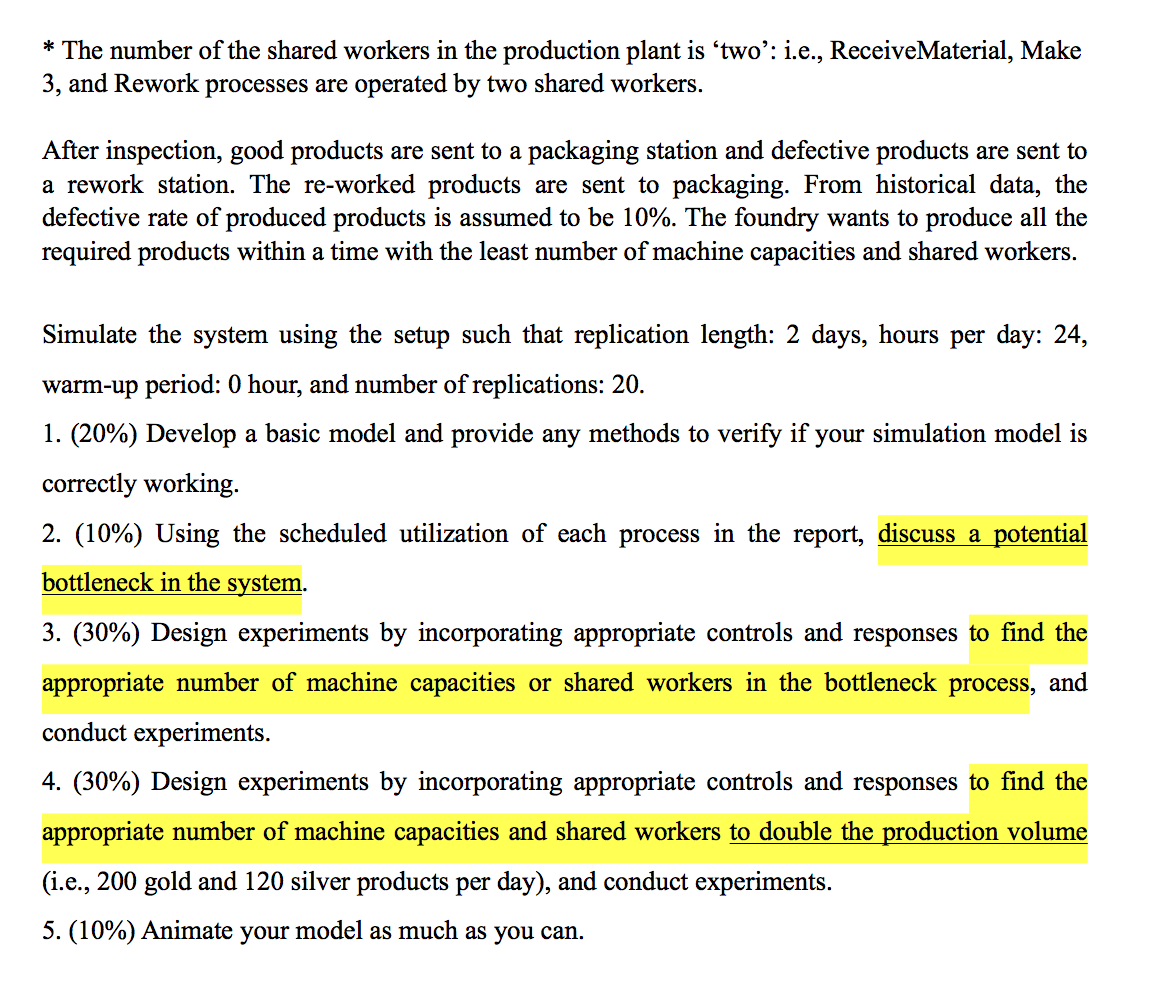
II. Problem Statement A foundry produces casting products with gold and silver raw materials. The production plant needs to produce 100 gold products and 60 silver products per day. Note that all production orders arrive at the beginning of the working day and the working hours of one day is 24 hours. The process step for each product type is as follows. Gold product: Receive Material Makel Inspect (90%) Packaging Rework (10%) Packaging Silver product: Receive Material Make2 Make 3 Inspect (90%) -> Packaging Rework (10%) -> Packaging Also, the process delay time and required resource of each process is as follows. No. Resource, capacity 1 Process Delay (unit: minutes) ReceiveMaterial Exp(1) Make1 Exp (20) Shared worker, 1 2 Dedicated worker, 2 3 Make2 Exp (10) Dedicated worker, 1 4 Make3 Exp (8) Shared worker, 1 5 Inspect Exp (10) Dedicated worker, 1 6 Rework Shared worker, 1 Exp (15) for gold product Exp (20) for silver product Uniform(5, 10) 7 Packaging Dedicated worker, 1 * The number of the shared workers in the production plant is 'two': i.e., Receive Material, Make 3, and Rework processes are operated by two shared workers. After inspection, good products are sent to a packaging station and defective products are sent to a rework station. The re-worked products are sent to packaging. From historical data, the defective rate of produced products is assumed to be 10%. The foundry wants to produce all the required products within a time with the least number of machine capacities and shared workers. Simulate the system using the setup such that replication length: 2 days, hours per day: 24, warm-up period: 0 hour, and number of replications: 20. 1. (20%) Develop a basic model and provide any methods to verify if your simulation model is correctly working. 2. (10%) Using the scheduled utilization of each process in the report, discuss a potential bottleneck in the system. 3. (30%) Design experiments by incorporating appropriate controls and responses to find the appropriate number of machine capacities or shared workers in the bottleneck process, and conduct experiments. 4. (30%) Design experiments by incorporating appropriate controls and responses to find the appropriate number of machine capacities and shared workers to double the production volume (i.e., 200 gold and 120 silver products per day), and conduct experiments. 5. (10%) Animate your model as much as you can. II. Problem Statement A foundry produces casting products with gold and silver raw materials. The production plant needs to produce 100 gold products and 60 silver products per day. Note that all production orders arrive at the beginning of the working day and the working hours of one day is 24 hours. The process step for each product type is as follows. Gold product: Receive Material Makel Inspect (90%) Packaging Rework (10%) Packaging Silver product: Receive Material Make2 Make 3 Inspect (90%) -> Packaging Rework (10%) -> Packaging Also, the process delay time and required resource of each process is as follows. No. Resource, capacity 1 Process Delay (unit: minutes) ReceiveMaterial Exp(1) Make1 Exp (20) Shared worker, 1 2 Dedicated worker, 2 3 Make2 Exp (10) Dedicated worker, 1 4 Make3 Exp (8) Shared worker, 1 5 Inspect Exp (10) Dedicated worker, 1 6 Rework Shared worker, 1 Exp (15) for gold product Exp (20) for silver product Uniform(5, 10) 7 Packaging Dedicated worker, 1 * The number of the shared workers in the production plant is 'two': i.e., Receive Material, Make 3, and Rework processes are operated by two shared workers. After inspection, good products are sent to a packaging station and defective products are sent to a rework station. The re-worked products are sent to packaging. From historical data, the defective rate of produced products is assumed to be 10%. The foundry wants to produce all the required products within a time with the least number of machine capacities and shared workers. Simulate the system using the setup such that replication length: 2 days, hours per day: 24, warm-up period: 0 hour, and number of replications: 20. 1. (20%) Develop a basic model and provide any methods to verify if your simulation model is correctly working. 2. (10%) Using the scheduled utilization of each process in the report, discuss a potential bottleneck in the system. 3. (30%) Design experiments by incorporating appropriate controls and responses to find the appropriate number of machine capacities or shared workers in the bottleneck process, and conduct experiments. 4. (30%) Design experiments by incorporating appropriate controls and responses to find the appropriate number of machine capacities and shared workers to double the production volume (i.e., 200 gold and 120 silver products per day), and conduct experiments. 5. (10%) Animate your model as much as you can
Step by Step Solution
There are 3 Steps involved in it

Get step-by-step solutions from verified subject matter experts
 Study Help