







Question: II. WHERE x = NULL III. WHERE X IN (NULL) IV. WHERE NOT(X IS NOT NULL) a) I and IV b) I and II c)
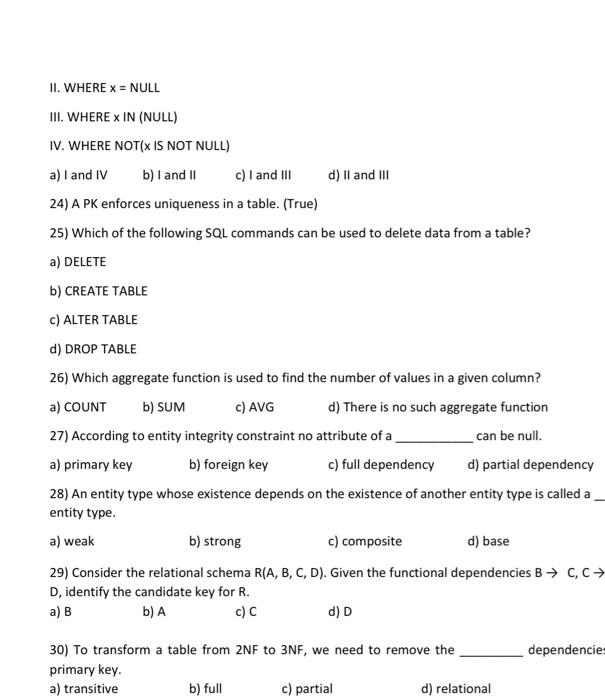
II. WHERE x = NULL III. WHERE X IN (NULL) IV. WHERE NOT(X IS NOT NULL) a) I and IV b) I and II c) I and III d) II and III 24) A PK enforces uniqueness in a table. (True) 25) Which of the following SQL commands can be used to delete data from a table? a) DELETE b) CREATE TABLE c) ALTER TABLE d) DROP TABLE 26) Which aggregate function is used to find the number of values in a given column? a) COUNT b) SUM c) AVG d) There is no such aggregate function 27) According to entity integrity constraint no attribute of a can be null. a) primary key b) foreign key c) full dependency d) partial dependency 28) An entity type whose existence depends on the existence of another entity type is called a entity type. a) weak b) strong c) composite d) base 29) Consider the relational schema R(A, B, C, D). Given the functional dependencies B C, C+ D, identify the candidate key for R. a) B b) A c) C d) D dependencie 30) To transform a table from 2NF to 3NF, we need to remove the primary key. a) transitive b) full c) partial d) relational
Step by Step Solution
There are 3 Steps involved in it

Get step-by-step solutions from verified subject matter experts
 Study Help