







Question: III ARNOLD'S CAT MAP In this problem we study a toy model of ergodic hamiltonian evolution. Instead of a real phase space we will have
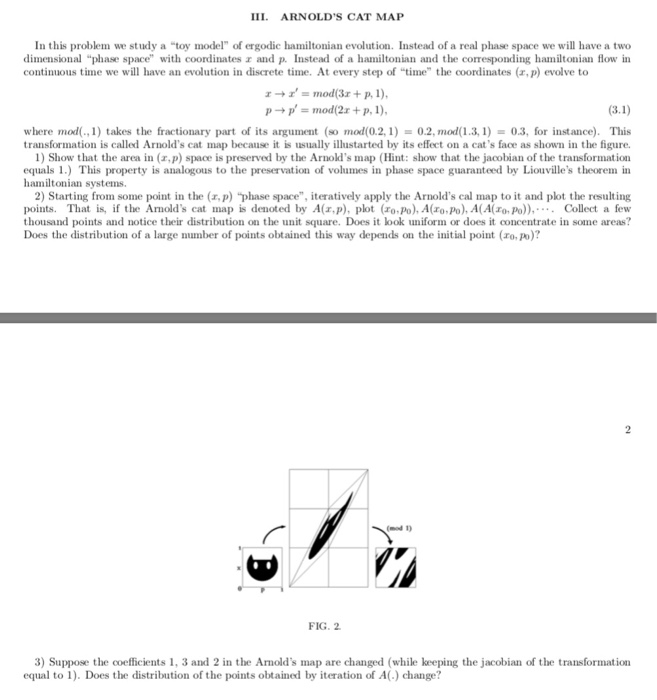
III ARNOLD'S CAT MAP In this problem we study a "toy model" of ergodic hamiltonian evolution. Instead of a real phase space we will have a two dimensional "phase space" with coordinates andp. Instead of a hamiltonian and the corresponding hamiltonian flow in continuous time we will have an evolution in discrete time. At every step of "ti e coordinates (r, p) evolve to zz'=mod(3x + p, 1), p p-mod(2x + p, 1), where mod(.,1) takes the fractionary part of its argument (so mod(021)-02. mod(1.3 1)0.3, for instance). This transformation is called Arnold's cat map because it is usually illustarted by its effect on a cat's face as shown in the figure 1) Show that the area in (,p) space is preserved by the Arnold's map (Hint: show that the jacobian of the transformation equals 1.) This property is analogous to the preservation of volumes in phase space guaranteed by Liouville's theorem in hamiltonian systems. 2) Starting from some point in the (x,p) "phase space", iteratively apply the Arnold's cal map to it and plot the resulting points. That is, if the Amold's cat map is denoted by A(x.p), plot (ro Po), A(ro Po), A(A(oPo)Collect a few thousand points and notice their distribution on the unit square. Does it look uniform or does it concentrate in some areas? Does the distribution of a large number of points obtained this way depends on the initial point (ro.po)? (mod 1 FIG. 2 3) Suppose the coefficients 1, 3 and 2 in the Arnold's map are changed (while keeping the jacobian of the transformation equal to 1). Does the distribution of the points obtained by iteration of A( change
Step by Step Solution
There are 3 Steps involved in it

Get step-by-step solutions from verified subject matter experts
 Study Help