Question: iii. siebbdes: S3igees CHARTERED . ; HERR COMPTABLES = tT PROFESSIONAL a i A PROFESSIONNELS Ld fom [Le ACCOUNTANTS | Nene ee r-rel Finance Integrated
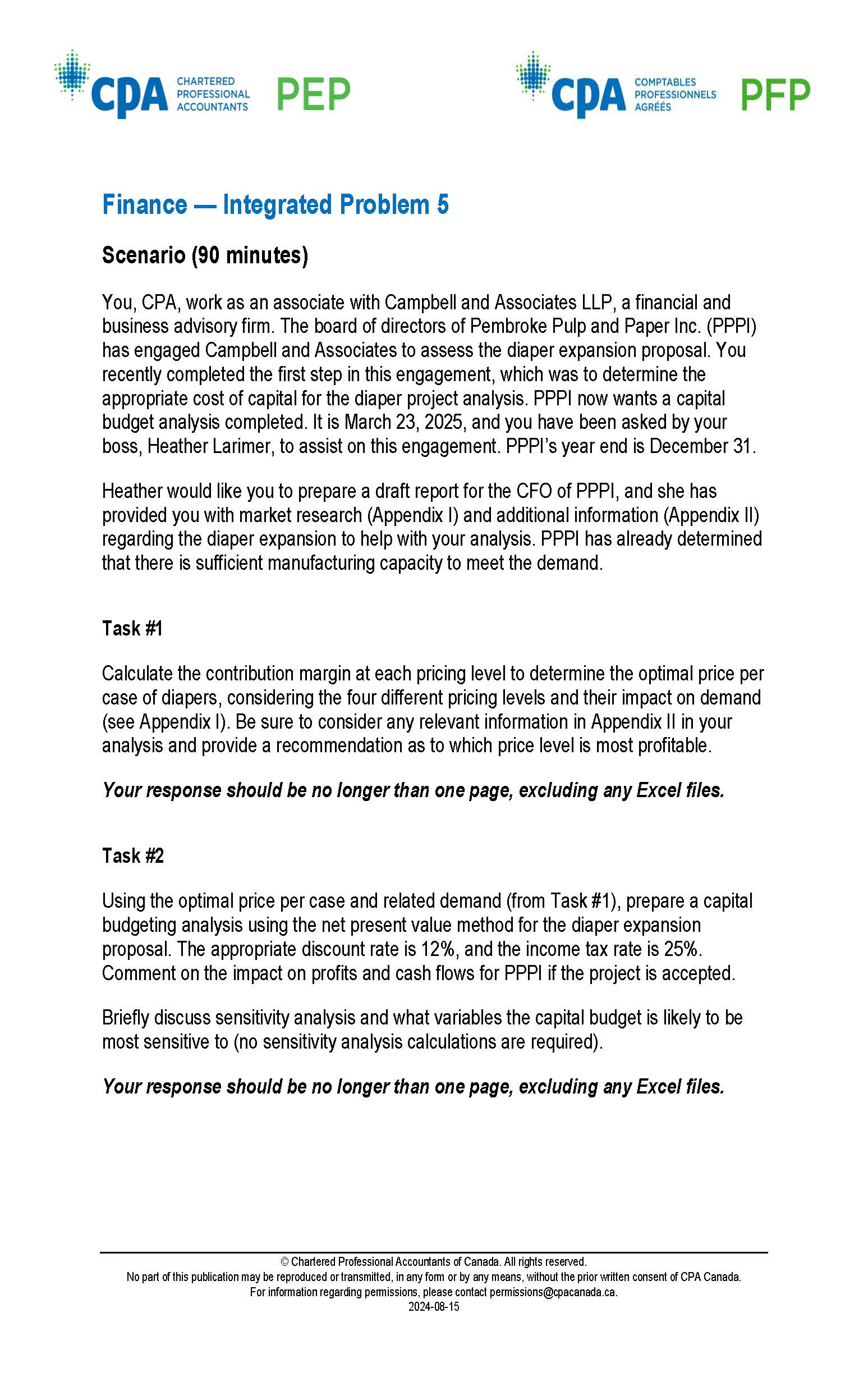
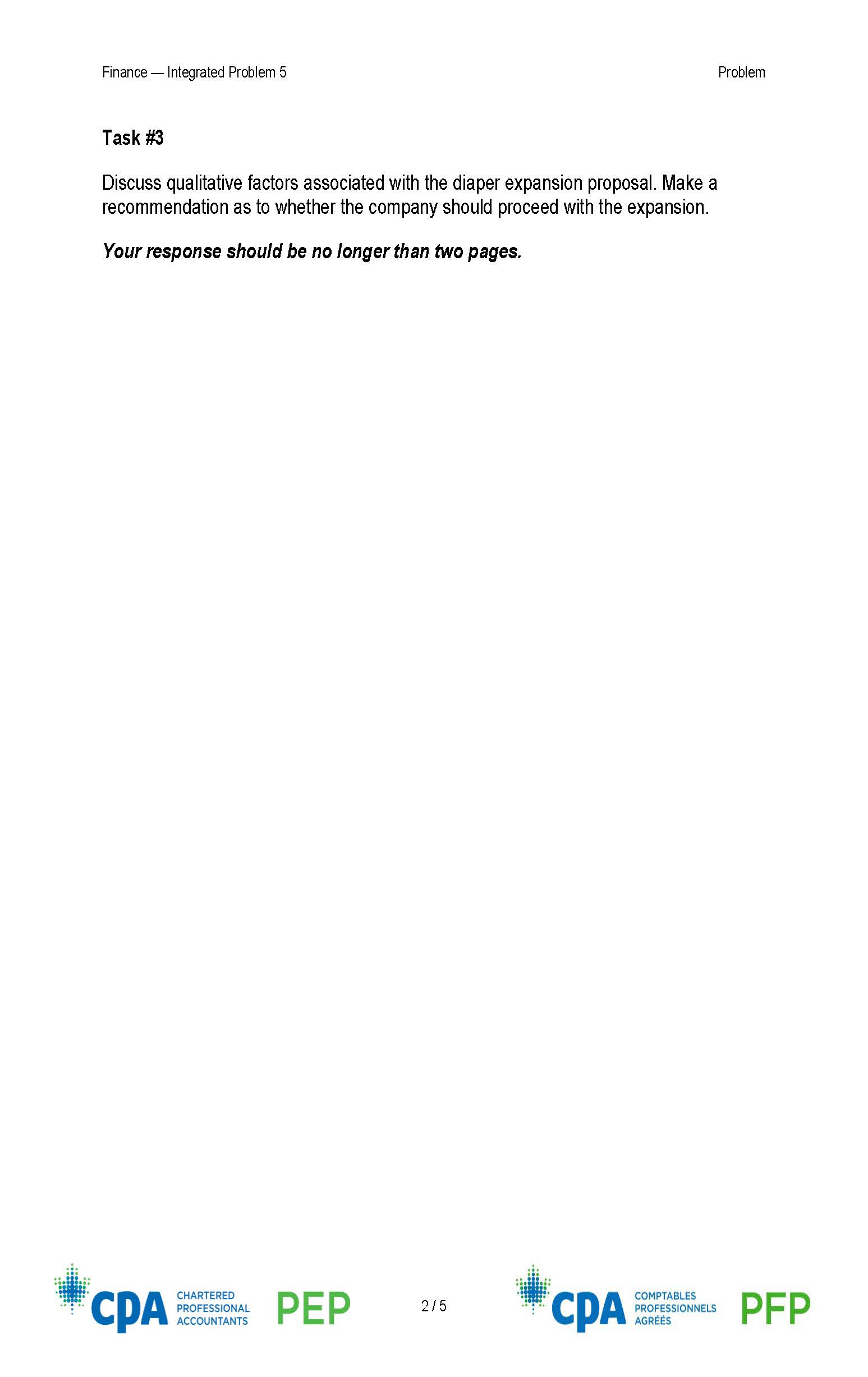
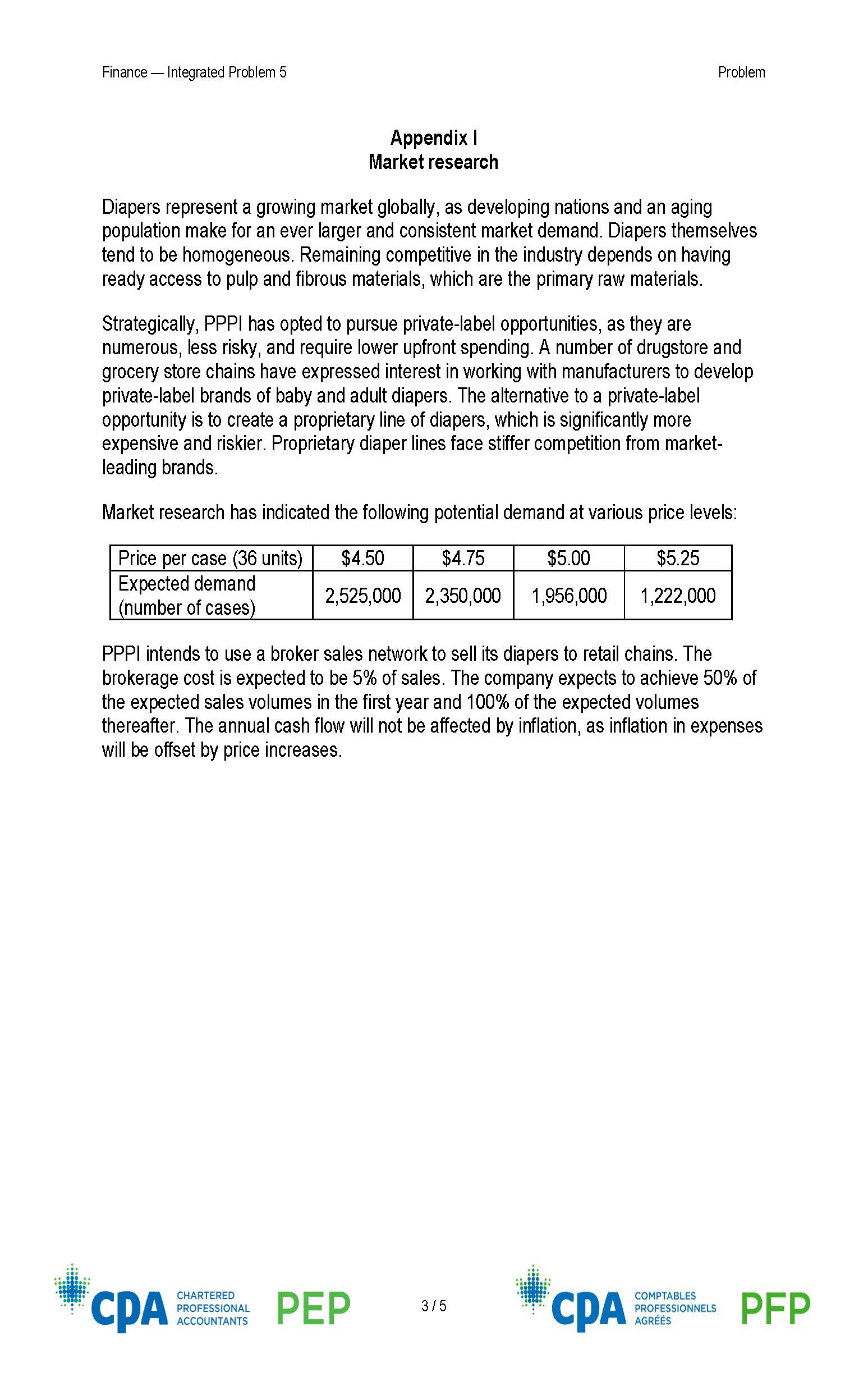
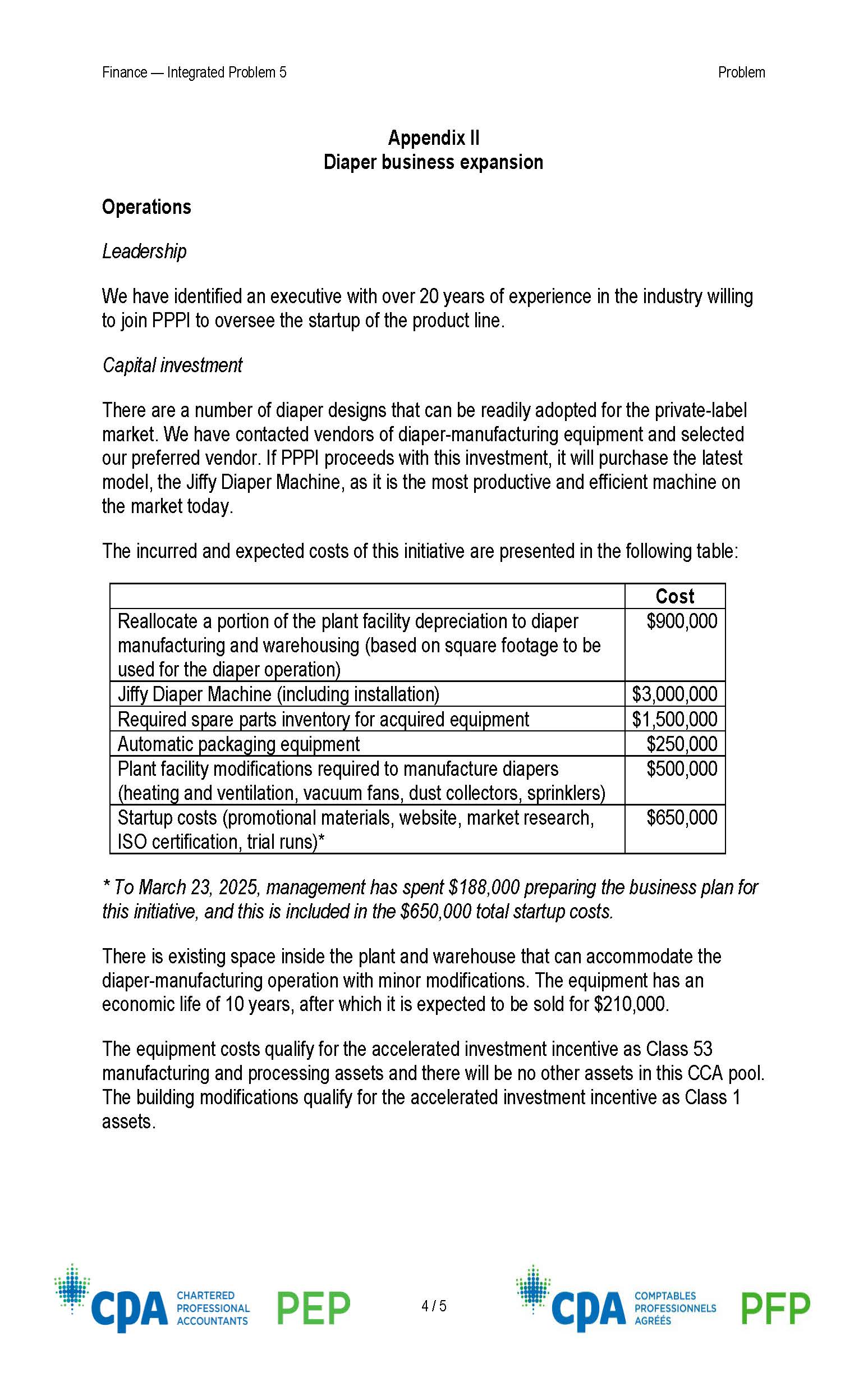
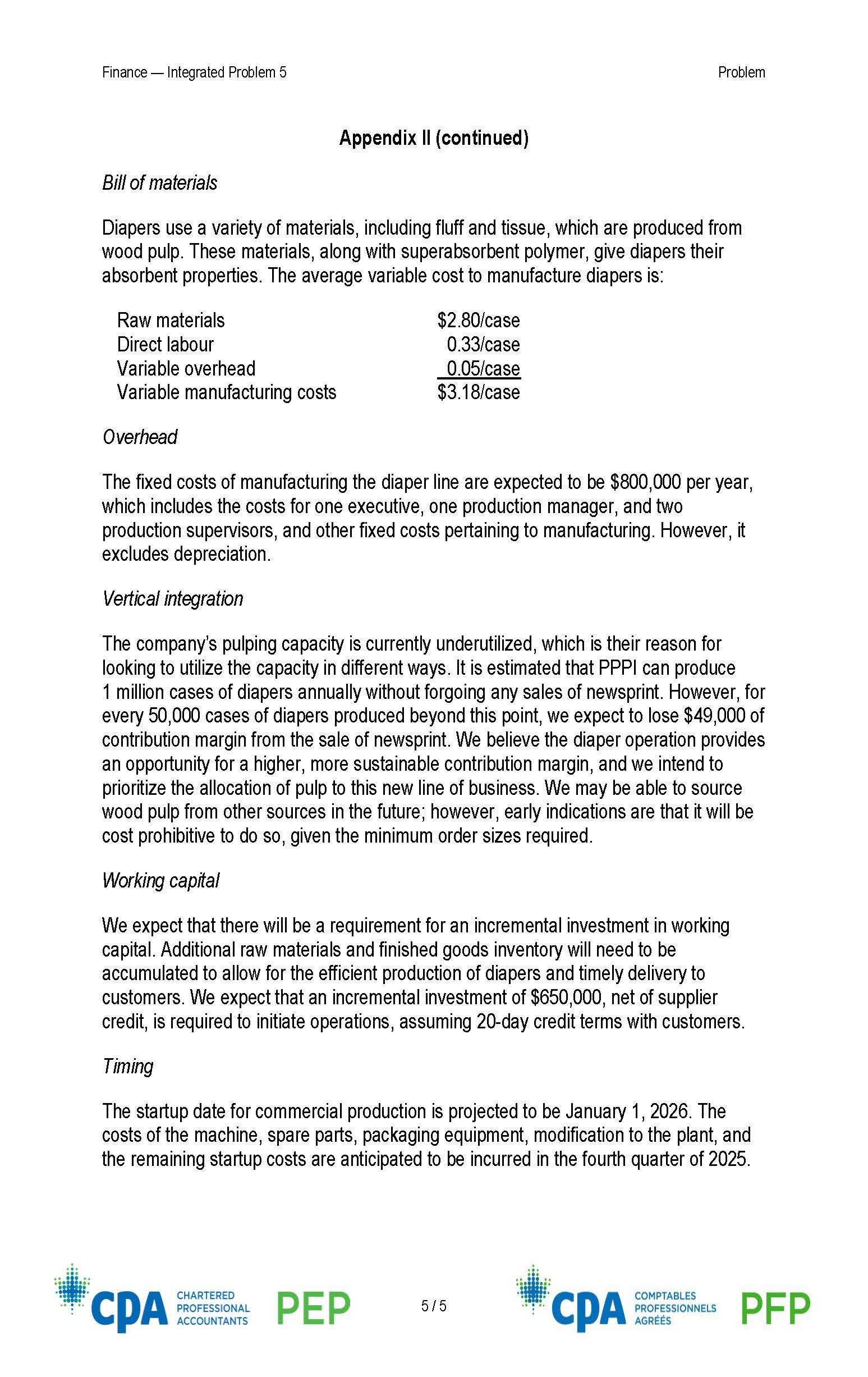
iii. siebbdes: \"S3igees CHARTERED . ; HERR COMPTABLES = \"tT PROFESSIONAL a i A PROFESSIONNELS Ld fom [Le ACCOUNTANTS | Nene ee r-rel Finance Integrated Problem 5 Scenario (90 minutes) You, CPA, work as an associate with Campbell and Associates LLP, a financial and business advisory firm. The board of directors of Pembroke Pulp and Paper Inc. (PPPI) has engaged Campbell and Associates to assess the diaper expansion proposal. You recently completed the first step in this engagement, which was to determine the appropriate cost of capital for the diaper project analysis. PPP| now wants a capital budget analysis completed. It is March 23, 2025, and you have been asked by your boss, Heather Larimer, to assist on this engagement. PPPI's year end is December 31. Heather would like you to prepare a draft report for the CFO of PPPI, and she has provided you with market research (Appendix I) and additional information (Appendix II) regarding the diaper expansion to help with your analysis. PPPI has already determined that there is sufficient manufacturing capacity to meet the demand. Task #1 Calculate the contribution margin at each pricing level to determine the optimal price per case of diapers, considering the four different pricing levels and their impact on demand (see Appendix |). Be sure to consider any relevant information in Appendix II in your analysis and provide a recommendation as to which price level is most profitable. Your response should be no longer than one page, excluding any Excel files. Task #2 Using the optimal price per case and related demand (from Task #1), prepare a capital budgeting analysis using the net present value method for the diaper expansion proposal. The appropriate discount rate is 12%, and the income tax rate is 25%. Comment on the impact on profits and cash flows for PPPI if the project is accepted. Briefly discuss sensitivity analysis and what variables the capital budget is likely to be most sensitive to (no sensitivity analysis calculations are required). Your response should be no longer than one page, excluding any Excel files. Chartered Professional Accountants of Canada. All rights reserved. No part of this publication may be reproduced or transmitted, in any form or by any means, without the prior written consent of CPA Canada. For information regarding permissions, please contact permissions@cpacanada.ca. 2024-08-15 Finance Integrated Problem 5 Problem Task #3 Discuss qualitative factors associated with the diaper expansion proposal. Make a recommendation as to whether the company should proceed with the expansion. Your response should be no longer than two pages. 2/95 gE CHARTERED at: COMPTABLES . PROFESSIONAL PROFESSIONNELS Pp [= Pp ACCOUNTANTS AGREES Finance Integrated Problem 5 Problem Appendix | Market research Diapers represent a growing market globally, as developing nations and an aging population make for an ever larger and consistent market demand. Diapers themselves tend to be homogeneous. Remaining competitive in the industry depends on having ready access to pulp and fibrous materials, which are the primary raw materials. Strategically, PPPI has opted to pursue private-label opportunities, as they are numerous, less risky, and require lower upfront spending. A number of drugstore and grocery store chains have expressed interest in working with manufacturers to develop private-label brands of baby and adult diapers. The alternative to a private-label opportunity is to create a proprietary line of diapers, which is significantly more expensive and riskier. Proprietary diaper lines face stiffer competition from market- leading brands. Market research has indicated the following potential demand at various price levels: Price per case (36 units) $4.50 $4.75 $5.00 $5.25 Expected demand 2,525,000 | 2,350,000 1,956,000 1,222,000 number of cases PPPI intends to use a broker sales network to sell its diapers to retail chains. The brokerage cost is expected to be 5% of sales. The company expects to achieve 50% of the expected sales volumes in the first year and 100% of the expected volumes thereafter. The annual cash flow will not be affected by inflation, as inflation in expenses will be offset by price increases. \"i: ik. oeaRHE- CHARTERED . \"TERRE. COMPTABLES >= ; PROFESSIONAL 375 _ A PROFESSIONNELS La fmm fd ACCOUNTANTS AGREES i Finance Integrated Problem 5 Problem Appendix Il Diaper business expansion Operations Leadership We have identified an executive with over 20 years of experience in the industry willing to join PPPI to oversee the startup of the product line. Capital investment There are a number of diaper designs that can be readily adopted for the private-label market. We have contacted vendors of diaper-manufacturing equipment and selected our preferred vendor. If PPPI proceeds with this investment, it will purchase the latest model, the Jiffy Diaper Machine, as it is the most productive and efficient machine on the market today. The incurred and expected costs of this initiative are presented in the following table: Cost Reallocate a portion of the plant facility depreciation to diaper $900,000 manufacturing and warehousing (based on square footage to be Jiffy Diaper Machine (including installation) $3,000 000 Required spare parts inventory for acquired equipment $1,500,000 Automatic packaging ipment $250,000 Plant facility modifications required to manufacture diapers $500,000 ing and ventilation, vacuum fans, dust collectors, sprinklers Startup costs (promotional materials, website, market research, $650,000 ISO certification, trial runs)* *To March 23, 2025, management has spent $188,000 preparing the business pian for this initiative, and this is included in the $650,000 tofal startup costs. There is existing space inside the plant and warehouse that can accommodate the diaper-manufacturing operation with minor modifications. The equipment has an economic life of 10 years, after which it is expected to be sold for $210,000. The equipment costs qualify for the accelerated investment incentive as Class 53 manufacturing and processing assets and there will be no other assets in this CCA pool. The building modifications qualify for the accelerated investment incentive as Class 1 assets. \"i: ik. oeigH?- CHARTERED . \"ERR COMPTABLES =) ; PROFESSIONAL 4/5 Pony A PROFESSIONNELS Law om [a ACCOUNTANTS AGREES Finance Integrated Problem 5 Problem Appendix Il (continued) Biff of materials Diapers use a variety of materials, including fluff and tissue, which are produced from wood pulp. These materials, along with superabsorbent polymer, give diapers their absorbent properties. The average variable cost to manufacture diapers is: Raw materials $2. 80/case Direct labour 0.33/case Variable overhead 0.05/case Variable manufacturing costs $3.18/case Overhead The fixed costs of manufacturing the diaper line are expected to be $800,000 per year, which includes the costs for one executive, one production manager, and two production supervisors, and other fixed costs pertaining to manufacturing. However, it excludes depreciation. Vertical integration The company's pulping capacity is currently underutilized, which is their reason for looking to utilize the capacity in different ways. It is estimated that PPPI can produce 1 million cases of diapers annually without forgoing any sales of newsprint. However, for every 50,000 cases of diapers produced beyond this point, we expect to lose $49,000 of contribution margin from the sale of newsprint. We believe the diaper operation provides an opportunity for a higher, more sustainable contribution margin, and we intend to prioritize the allocation of pulp to this new line of business. We may be able to source wood pulp from other sources in the future; however, early indications are that it will be cost prohibitive to do so, given the minimum order sizes required. Working capital We expect that there will be a requirement for an incremental investment in working capital. Additional raw materials and finished goods inventory will need to be accumulated to allow for the efficient production of diapers and timely delivery to customers. We expect that an incremental investment of $650,000, net of supplier credit, is required to initiate operations, assuming 20-day credit terms with customers. Timing The startup date for commercial production is projected to be January 1, 2026. The costs of the machine, spare parts, packaging equipment, modification to the plant, and the remaining startup costs are anticipated to be incurred in the fourth quarter of 2025. 333. so bEb cs oeigH?- CHARTERED . \"ERR COMPTABLES =) ; PROFESSIONAL 5/5 Pony A PROFESSIONNELS Law om [a ACCOUNTANTS AGREES
Step by Step Solution
There are 3 Steps involved in it
1 Expert Approved Answer
Step: 1 Unlock
Question Has Been Solved by an Expert!
Get step-by-step solutions from verified subject matter experts
Step: 2 Unlock
Step: 3 Unlock
Students Have Also Explored These Related Accounting Questions!









 Study Help