





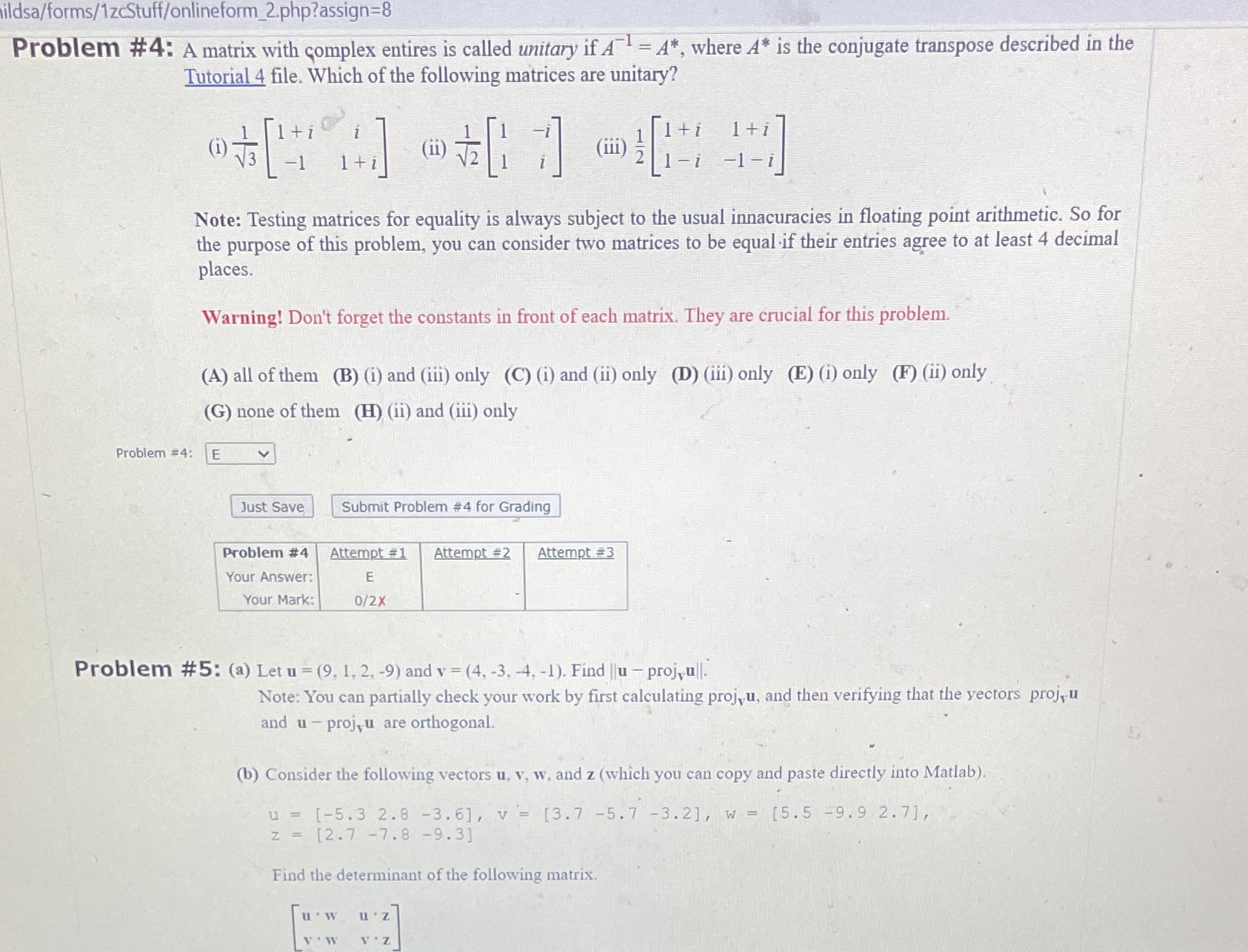
Question: ildsa/forms/1zcStuff/onlineform_2.php?assign=8 Problem #4: A matrix with complex entires is called unitary if A = A*, where A* is the conjugate transpose described in the Tutorial
ildsa/forms/1zcStuff/onlineform_2.php?assign=8
ildsa/forms/1zcStuff/onlineform_2.php?assign=8 Problem #4: A matrix with complex entires is called unitary if A = A*, where A* is the conjugate transpose described in the Tutorial 4 file. Which of the following matrices are unitary? Note: Testing matrices for equality is always subject to the usual innacuracies in floating point arithmetic. So for the purpose of this problem, you can consider two matrices to be equal if their entries agree to at least 4 decimal places. Warning! Don't forget the constants in front of each matrix. They are crucial for this problem. (A) all of them (B) (i) and (iii) only (C) (i) and (ii) only (D) (iii) only (E) (i) only (F) (ii) only (G) none of them (H) (ii) and (iii) only Problem #4: v Just Save Submit Problem #4 for Grading Problem #4 |Attempt # 1 Attempt #2 Attempt # 3 Your Answer: Your Mark: 0/2X Problem #5: (a) Let u = (9, 1, 2, -9) and v = (4, -3, -4, -1). Find u - projyull. Note: You can partially check your work by first calculating projyu, and then verifying that the vectors proj, u and u - projyu are orthogonal. (b) Consider the following vectors u, v, w, and z (which you can copy and paste directly into Matlab). u = [-5.3 2.8 -3. 6], v = [3.7 -5.7 -3. 2] , w = [5.5 -9. 9 2.7], z = [2.7 -7.8 -9.3] Find the determinant of the following matrix. u . W z . n V . W

Step by Step Solution

There are 3 Steps involved in it

1 Expert Approved Answer
Step: 1 Unlock blur-text-image

Question Has Been Solved by an Expert!

Get step-by-step solutions from verified subject matter experts

Step: 2 Unlock
Step: 3 Unlock

Students Have Also Explored These Related Mathematics Questions!