


Question: Illustration: Joint Cost Allocation - Market Value Method: By-Product Cost Allocation - Market Value or Reversal Cost Method Ericson Company manufactured joint products X and
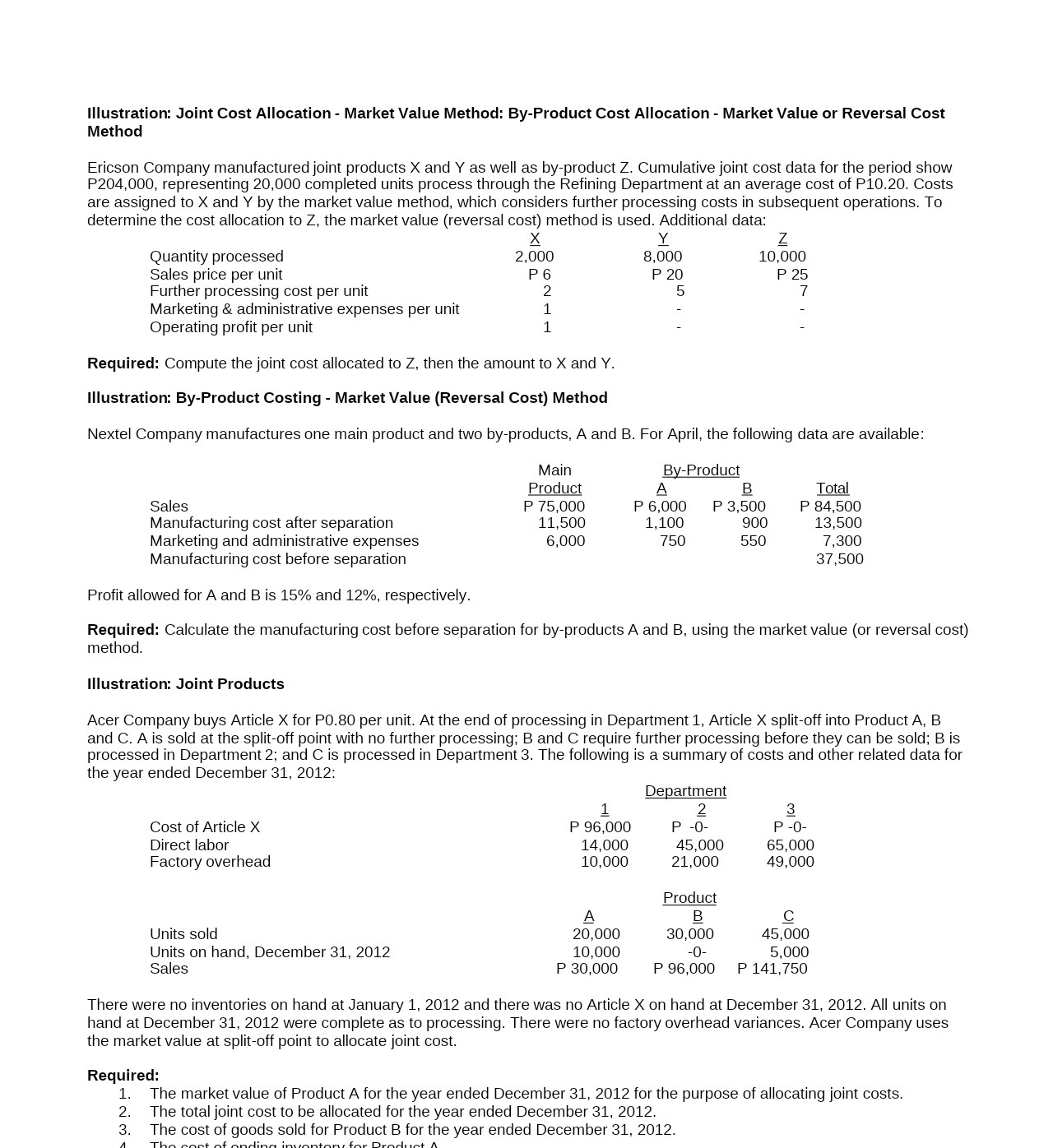
Illustration: Joint Cost Allocation - Market
Illustration: Joint Cost Allocation - Market Value Method: By-Product Cost Allocation - Market Value or Reversal Cost Method Ericson Company manufactured joint products X and Y as well as byproduct Z. Cumulative joint cost data for the period show P204.000. representing 20,000 completed units process through the Refining Department at an average cost of P10.20. Costs are assigned to X and Y by the market value method. which considers further processing costs in subsequent operations. To determine the cost allocation to Z. the market value (reversal cost) method is used. Additional data: X I Z Quantity processed 2,000 8,000 10.000 Sales price per unit P 6 P 20 P 25 Further processing cost per unit 2 5 7 Marketing & administrative expenses per unit 1 Operating profit per unit 1 Required: Compute the joint cost allocated to Z, then the amount to X and Y. Illustration: By-Product Costing - Market Value (Reversal Cost) Method Nextel Company manufactures one main product and two layproducts. A and B. For April. the following data are available: Main ByProduct Product A B To_tal Sales P 75,000 P 6.000 P 3.500 P 84,500 Manufacturing cost after separation 11.500 1,100 900 13.500 Marketing and administrative expenses 6.000 750 550 7.300 Manufacturing cost before separation 37.500 Profit allowed for A and B is 15% and 12%. respectively. Required: Calculate the manufacturing cost before separation for byproducts A and B, using the market value (or reversal cost) method. Illustration: Joint Products Acer Company buys Article X for P080 per unit. At the end of processing in Department 1. Article X splitoff into Product A. B and C. A is sold at the splitroff point with no further processing; B and C require further processing before they can be sold; B is processed in Department 2; and C is processed in Department 3. The following is a summary of costs and other related data for the year ended December 31, 2012: Department 1 2 3 Cost of Article X P 96.000 P 0 P 0 Direct labor 14.000 45.000 65.000 Factory overhead 10.000 21.000 49.000 Product A E 9 Units sold 20.000 30.000 45.000 Units on hand, December 31. 2012 10.000 0 5,000 Sales P 30,000 P 96,000 P 141.?50 There were no inventories on hand at January 1, 2012 and there was no Article X on hand at December 31. 2012. All units on hand at December 31. 2012 were complete as to processing. There were no factory overhead variances. Acer Company uses the market value at splitsoff point to allocate joint cost. Required: The market value of Product A for the year ended December 31. 2012 for the purpose of allocating joint costs. The total joint cost to be allocated for the year ended December 31, 2012. The cost of goods sold for Product B for the year ended December 31. 2012. Tina nnnr n'l nnrlinn inunnnum {nr Drnrlllnr A \".03.\

Step by Step Solution

There are 3 Steps involved in it

1 Expert Approved Answer
Step: 1 Unlock blur-text-image

Question Has Been Solved by an Expert!

Get step-by-step solutions from verified subject matter experts

Step: 2 Unlock
Step: 3 Unlock

Students Have Also Explored These Related Accounting Questions!