Question: I'm having a hard time with questions 5 CASE STUDY 19: Texahoma Highway Construction Les Livingstone, MBA, Ph.D., CPA (NY &TX) University of Maryland University
I'm having a hard time with questions 5
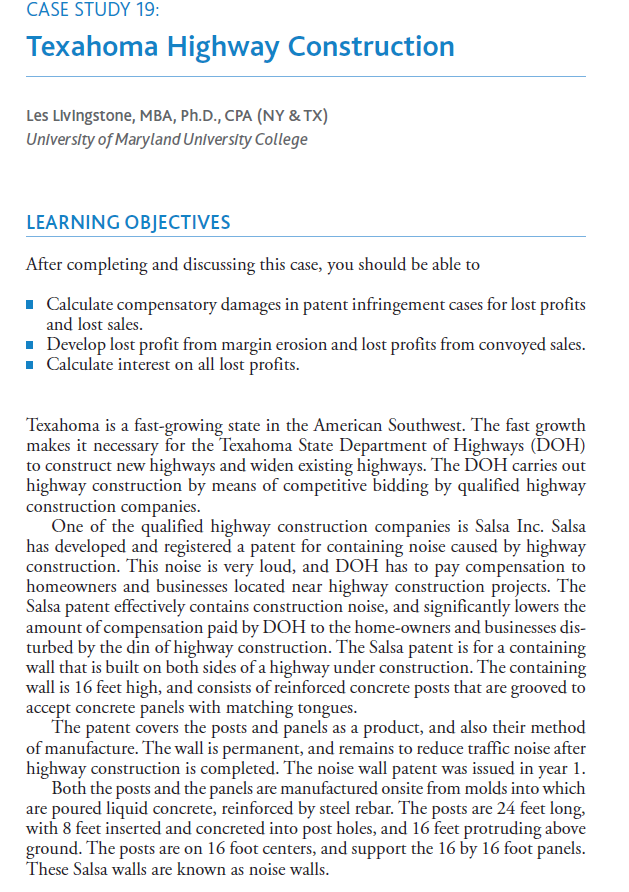
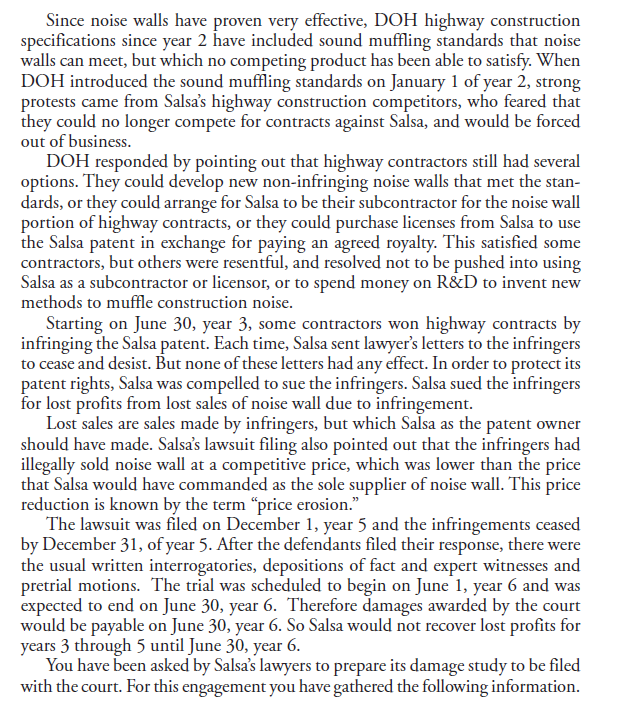
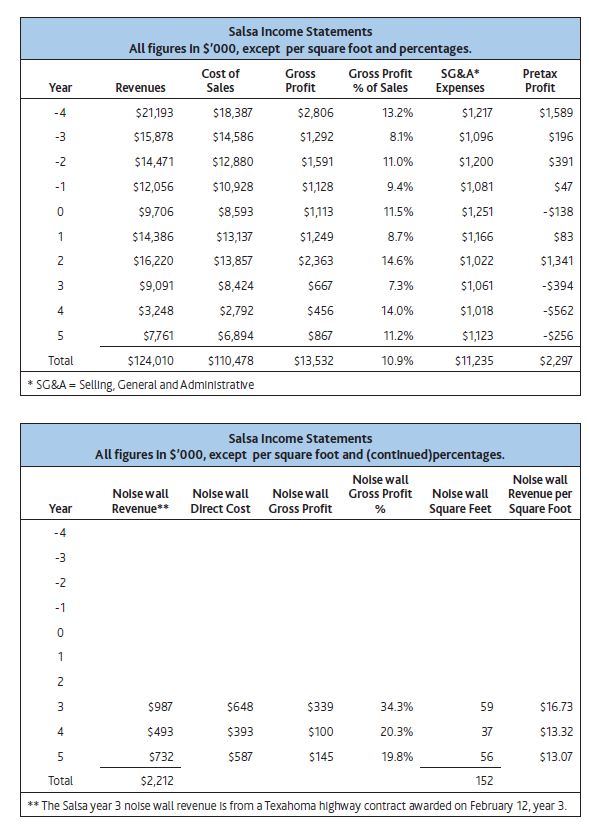
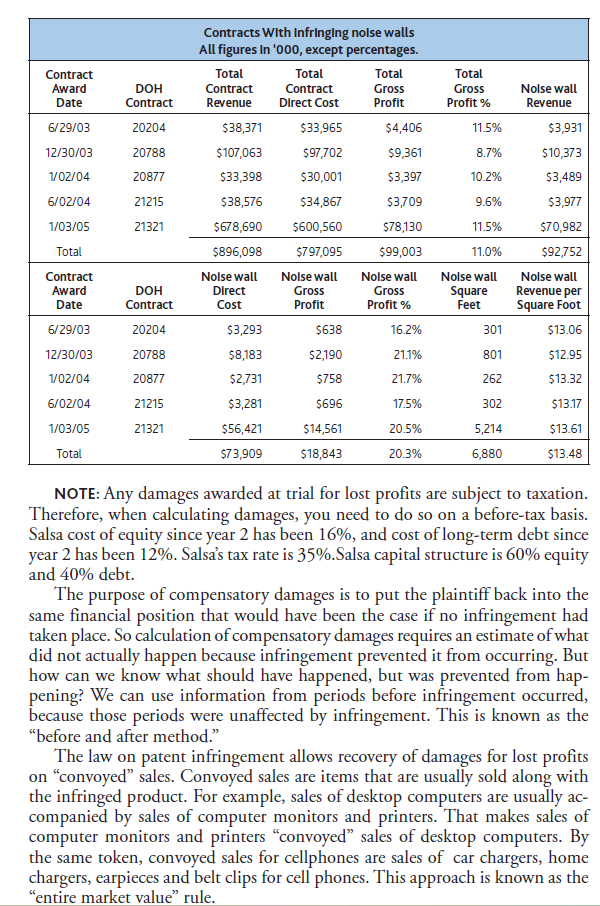
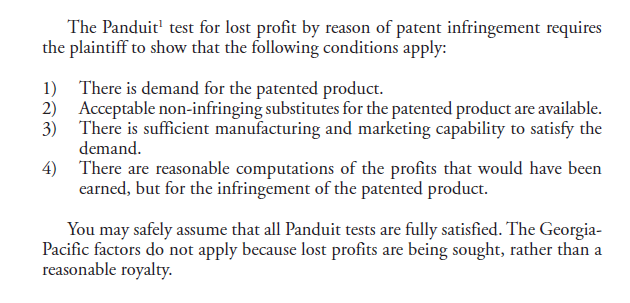
CASE STUDY 19: Texahoma Highway Construction Les Livingstone, MBA, Ph.D., CPA (NY &TX) University of Maryland University College LEARNING OBJECTIVES After completing and discussing this case, you should be able to Calculate compensatory damages in patent infringement cases for lost profits and lost sales. Develop lost profit from margin erosion and lost profits from convoyed sales. m Calculate interest on all lost profits. Texahoma is a fast-growing state in the American Southwest. The fast growth makes it necessary for the Texahoma State Department of Highways (DOH) to construct new highways and widen existing highways. The DOH carries out highway construction by means of competitive bidding by qualified highway construction companies. One of the qualified highway construction companies is Salsa Inc. Salsa has developed and registered a patent for containing noise caused by highway construction. This noise is very loud, and DOH has to pay compensation to homeowners and businesses located near highway construction projects. The Salsa patent effectively contains construction noise, and significantly lowers the amount of compensation paid by DOH to the home-owners and businesses dis- turbed by the din of highway construction. The Salsa patent is for a containing wall that is built on both sides of a highway under construction. The containing wall is 16 feet high, and consists of reinforced concrete posts that are grooved to accept concrete panels with matching tongues. The patent covers the posts and panels as a product, and also their method of manufacture. The wall is permanent, and remains to reduce traffic noise after highway construction is completed. The noise wall patent was issued in year 1. Both the posts and the panels are manufactured onsite from molds into which are poured liquid concrete, reinforced by steel rebar. The posts are 24 feet long, with 8 feet inserted and concreted into post holes, and 16 feet protruding above ground. The posts are on 16 foot centers, and support the 16 by 16 foot panels. These Salsa walls are known as noise walls. Since noise walls have proven very effective, DOH highway construction specifications since year 2 have included sound muftling standards that noise walls can meet, but which no competing product has been able to satisfy. When DOH introduced the sound muftling standards on January 1 of year 2, strong protests came from Salsa's highway construction competitors, who feared that they could no longer compete for contracts against Salsa, and would be forced out of business. DOH responded by pointing out that highway contractors still had several options. They could develop new non-infringing noise walls that met the stan- dards, or they could arrange for Salsa to be their subcontractor for the noise wall portion of highway contracts, or they could purchase licenses from Salsa to use the Salsa patent in exchange for paying an agreed royalty. This satisfied some contractors, but others were resentful, and resolved not to be pushed into using Salsa as a subcontractor or licensor, or to spend money on R&D to invent new methods to muftle construction noise. Starting on June 30, year 3, some contractors won highway contracts by infringing the Salsa patent. Each time, Salsa sent lawyer's letters to the infringers to cease and desist. But none of these letters had any effect. In order to protect its patent rights, Salsa was compelled to sue the infringers. Salsa sued the infringers for lost profits from lost sales of noise wall due to infringement. Lost sales are sales made by infringers, but which Salsa as the patent owner should have made. Salsa's lawsuit filing also pointed out that the infringers had illegally sold noise wall at a competitive price, which was lower than the price that Salsa would have commanded as the sole supplier of noise wall. This price reduction is known by the term \"price erosion.\" The lawsuit was filed on December 1, year 5 and the infringements ceased by December 31, of year 5. After the defendants filed their response, there were the usual written interrogatories, depositions of fact and expert witnesses and pretrial motions. The trial was scheduled to begin on June 1, year 6 and was expected to end on June 30, year 6. Therefore damages awarded by the court would be payable on June 30, year 6. So Salsa would not recover lost profits for years 3 through 5 until June 30, year 6. You have been asked by Salsa's lawyers to prepare its damage study to be filed with the court. For this engagement you have gathered the following information. Salsa Income Statements All figures In $'000, except per square foot and percentages. Cost of Gross Gross Profit SG&A* Pretax Year Revenues Sales Profit % of Sales Expenses Profit -4 $21,193 $18,387 $2,806 13.2% $1,217 $1,589 $15,878 $14,586 $1,292 8.1% $1,096 $196 -2 $14,471 $12,880 $1,591 11.0% $1,200 $391 $12,056 $10,928 $1,128 9.4% $1,081 $47 $9,706 $8,593 $1,113 11.5% $1,251 -$138 - O $14,386 $13,137 $1,249 8.7% $1,166 $83 $16,220 $13,857 $2,363 14.6% $1,022 $1,341 W $9,091 $8,424 $667 7.3% $1,061 -$394 $3,248 $2,792 $456 14.0% $1,018 -$562 $7,761 $6,894 $867 11.2% $1,123 -$256 Total $124,010 $110,478 $13,532 10.9% $11,235 $2,297 * SG&A = Selling, General and Administrative Salsa Income Statements All figures In $'000, except per square foot and (continued) percentages. Nolse wall Nolse wall Nolse wall Nolse wall Nolse wall Gross Profit Nolse wall Revenue per Year Revenue* * Direct Cost Gross Profit % Square Feet Square Foot -4 w N O $987 $648 $339 34.3% 59 $16.73 $493 $393 $100 20.3% 37 $13.32 $732 $587 $145 19.8% 56 $13.07 Total $2,212 152 ** The Salsa year 3 noise wall revenue is from a Texahoma highway contract awarded on February 12, year 3.Contracts With Infringing nolse walls All figures In '000, except percentages. Contract Total Total Total Total Award DOH Contract Contract Gross Gross Molse wall Date Contract Revenue Direct Cost Profit Profit % Revenue 6/25/03 20204 5383N 533,965 54,406 1.5% 53,931 12/30/03 20788 5107063 s8r 702 59,361 8.7% 510,373 102/04 20877 533,353 530,001 53,397 10.2% 53,489 5/02/04 21215 538,575 534 857 53709 9.6% 53,977 1403405 21321 5678,690 5600560 578130 MN5% 570,982 Total 806,008 797,095 1M.0% 592,752 Contract Molse wall Molse wall Molse wall MNolse wall MNolse wall Award Direct Gross Gross Square Revenue per Date Cost Profit Profit % Feet Square Foot 6/29/03 53,293 5638 12/30403 58,183 52,190 Vo204 52731 5758 E/02/04 53,281 56096 1403405 556,427 514 561 Total 518,843 NOTE: Any damages awarded at trial for lost profits are subject to taxation. Therefore, when calculating damages, you need to do so on a before-tax basis. Salsa cost of equity since year 2 has been 16%, and cost of long-term debt since year 2 has been 12%. Salsa's tax rate is 35%.5alsa capital structure is 60% equity and 40% debt. The purpose of compensatory damages is to put the plaintiff back into the same financial position that would have been the case if no infringement had taken place. So calculation of compensatory damages requires an estimate of what did not actually happen because infringement prevented it from occurring. But how can we know what should have happened, but was prevented from hap- pening? We can use information from periods before infringement occurred, because those periods were unaffected by infringement. This is known as the \"before and after method.\" The law on patent infringement allows recovery of damages for lost profits on \"convoyed\" sales. Convoyed sales are items that are usually sold along with the infringed product. For example, sales of desktop computers are usually ac- companied by sales of computer monitors and printers. That makes sales of computer monitors and printers \"convoyed\" sales of desktop computers. By the same token, convoyed sales for cellphones are sales of car chargers, home chargers, earpieces and belt clips for cell phones. This approach is known as the \"entire market value\" rule. The Panduit' test for lost profit by reason of patent infringement requires the plaintiff to show that the following conditions apply: 1) There is demand for the patented product. 2) Acceptable non-infringing substitutes for the patented product are available. 3) There is sufficient manufacturing and marketing capability to satisfy the demand. 4) There are reasonable computations of the profits that would have been earned, but for the infringement of the patented product. You may safely assume that all Panduit tests are fully satisfied. The Georgia- Pacific factors do not apply because lost profits are being sought, rather than a reasonable royalty
Step by Step Solution
There are 3 Steps involved in it
1 Expert Approved Answer
Step: 1 Unlock
Question Has Been Solved by an Expert!
Get step-by-step solutions from verified subject matter experts
Step: 2 Unlock
Step: 3 Unlock
Students Have Also Explored These Related Accounting Questions!









 Study Help