Question: I'm having trouble with a few problems on my homework. I don't understand how to do the calculation 6.18 Is college worth it? Part II:

I'm having trouble with a few problems on my homework. I don't understand how to do the calculation
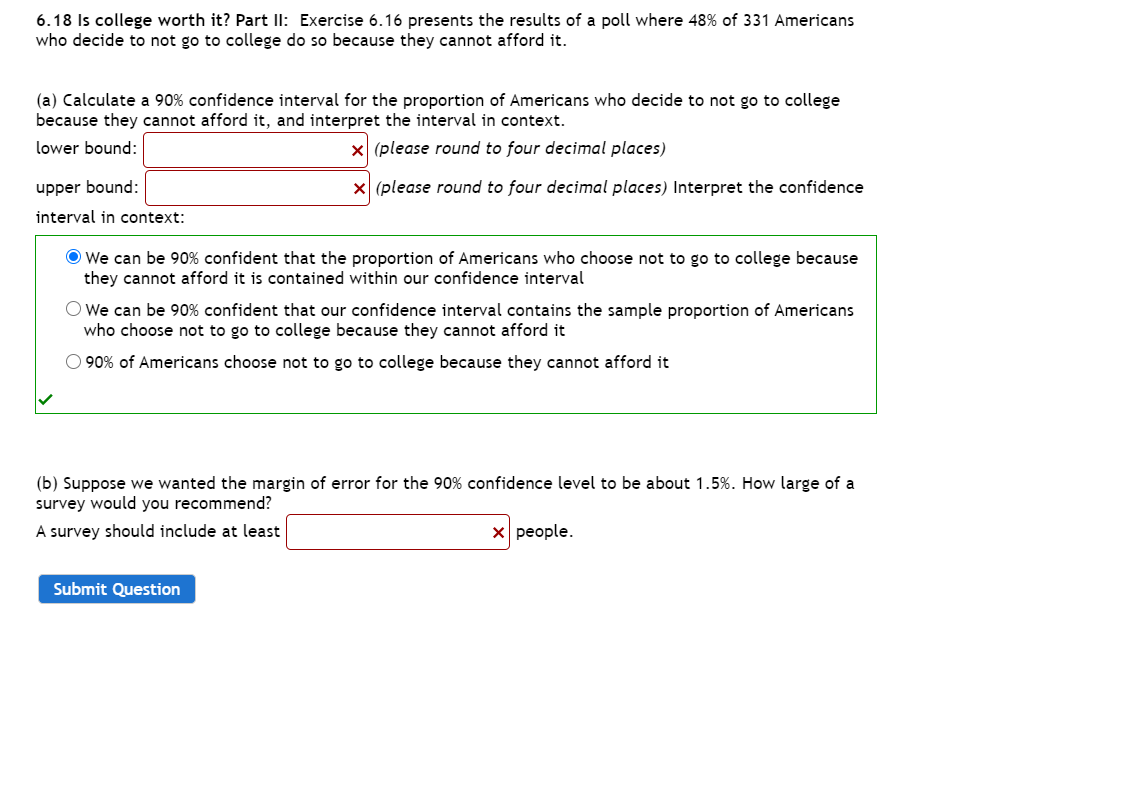
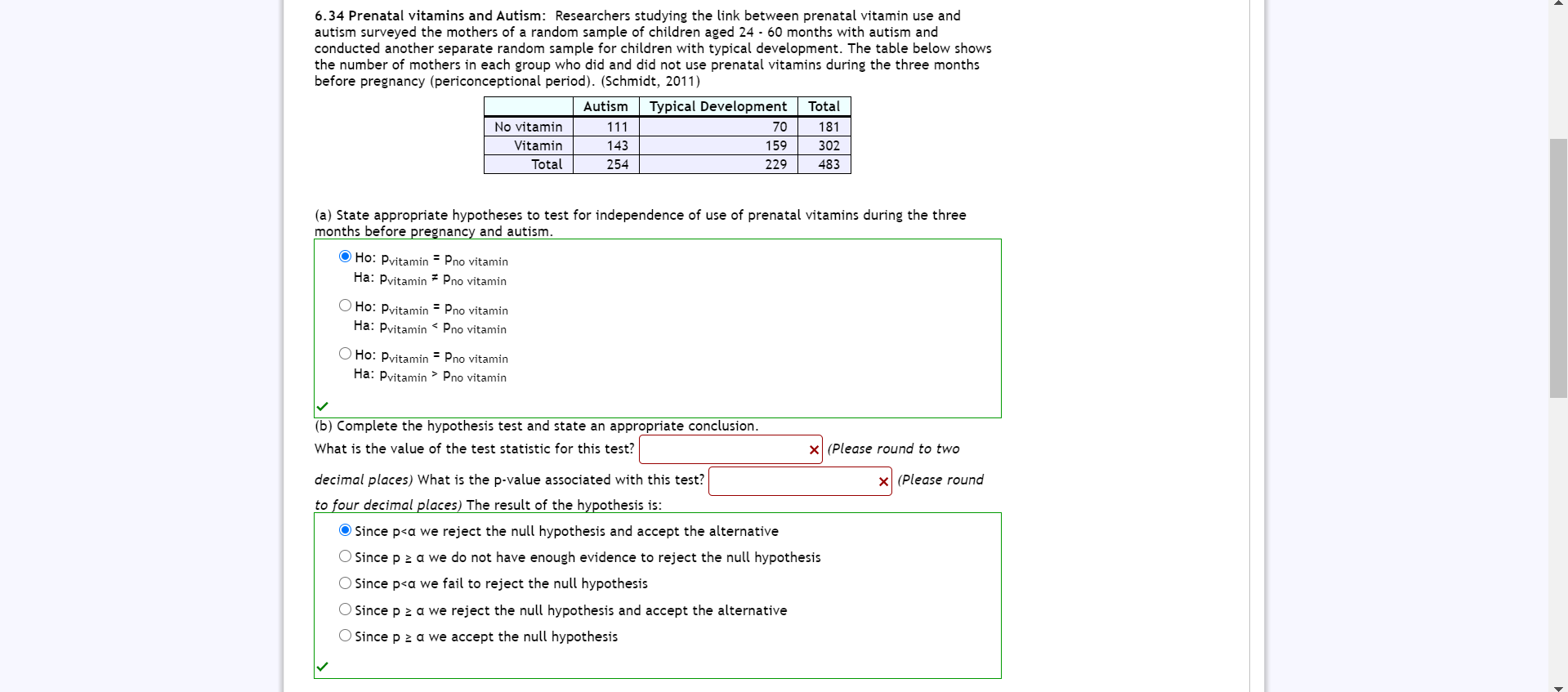
I'm having trouble with a few problems on my homework. I don'tunderstand how to do the calculation 6.18 Is college worth it? PartII: Exercise 6.16 presents the results of a poll where 48% of331 Americans who decide to not go to college do so becausethey cannot afford it. (a) Calculate a 90% confidence interval for theproportion of Americans who decide to not go to college because theycannot afford it, and interpret the interval in context. lower bound: :](please round to four decimal places) upper bound: :] (please round to
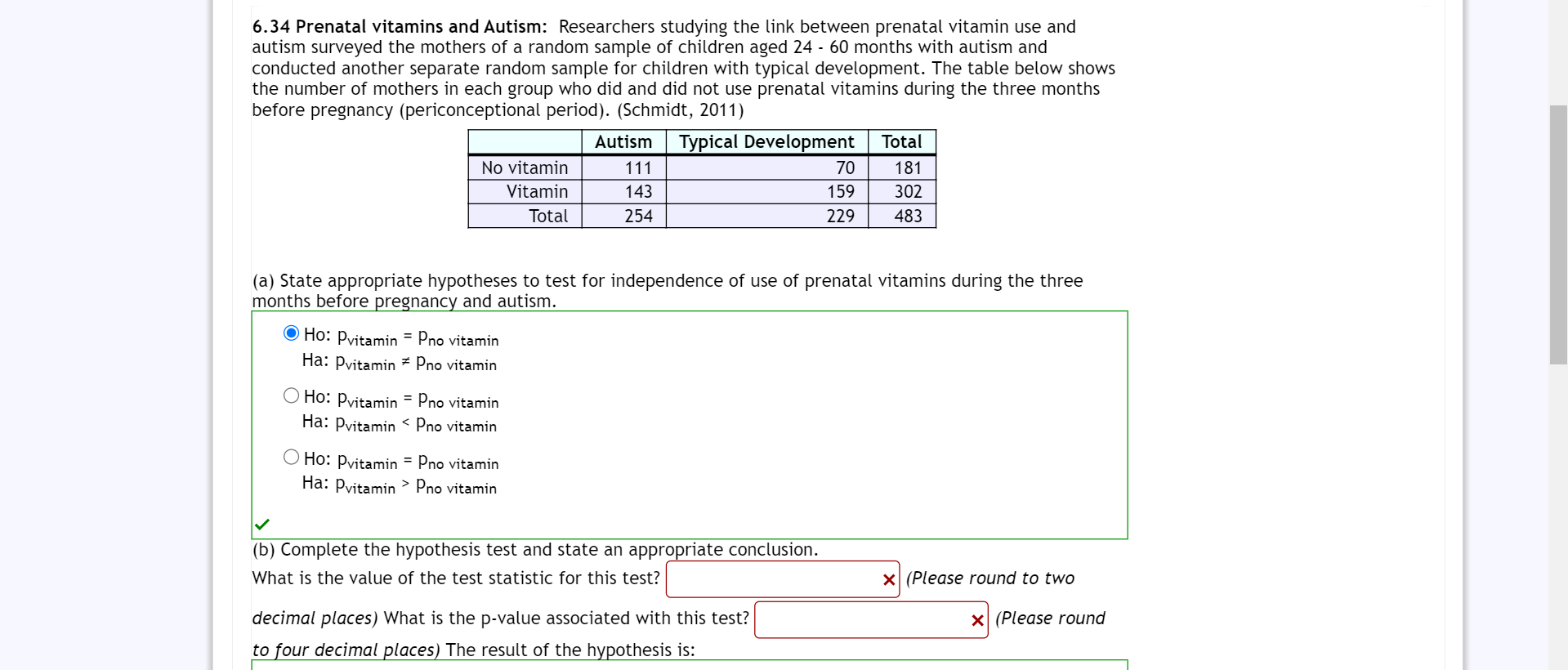
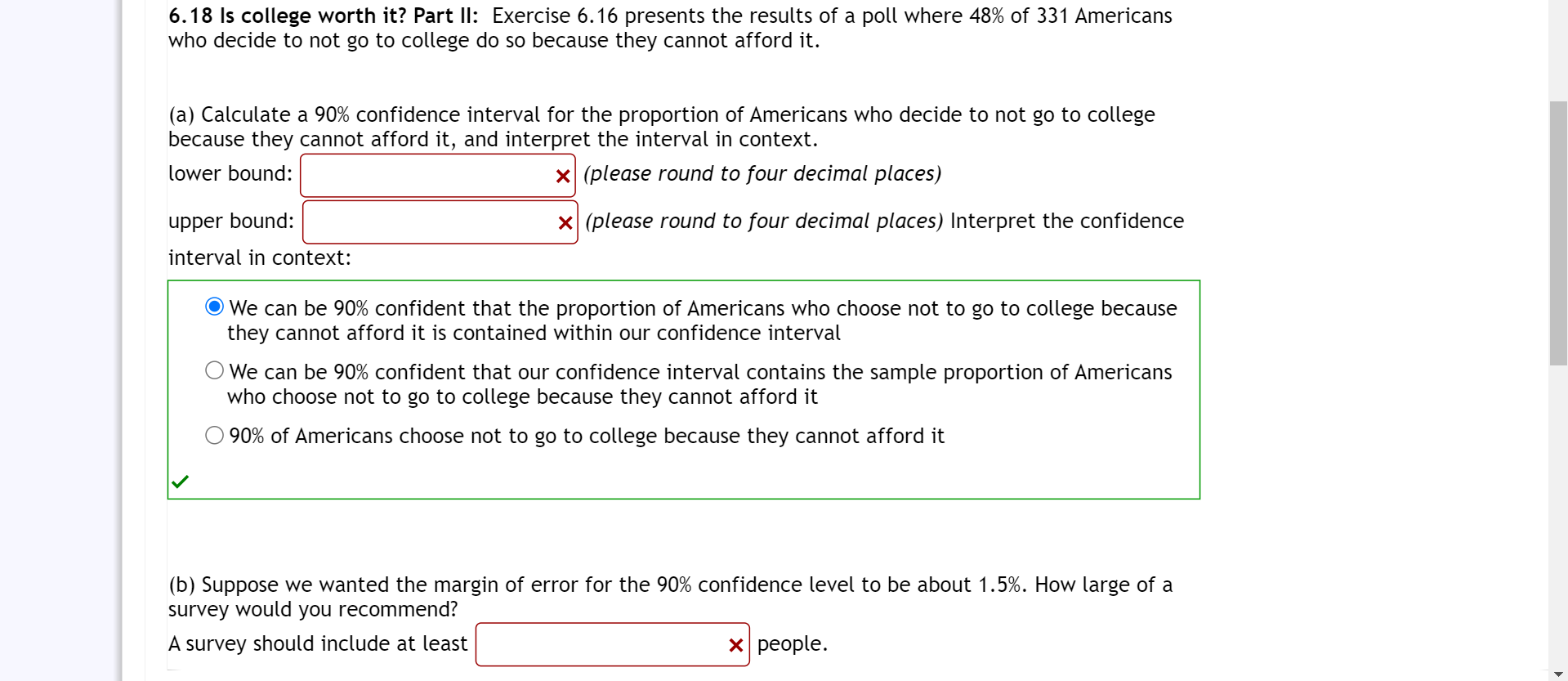
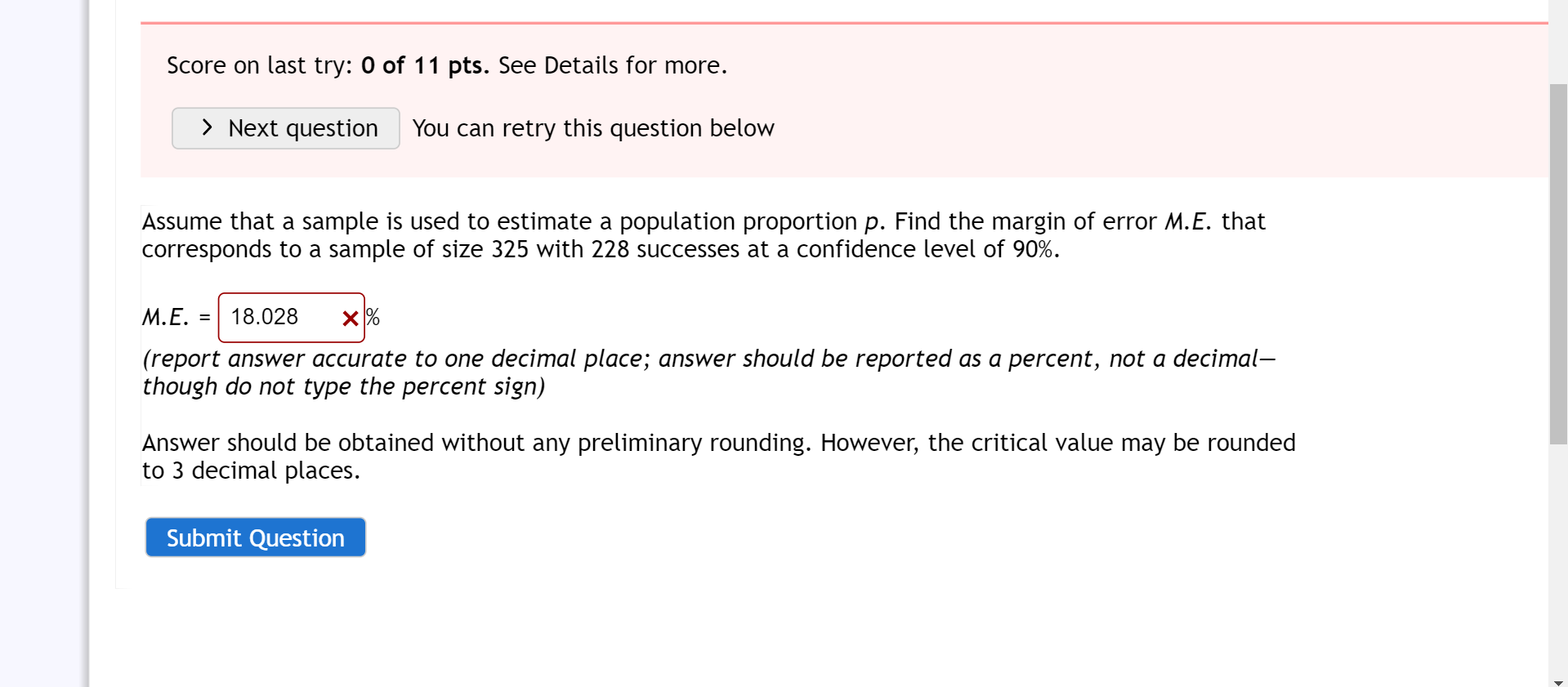
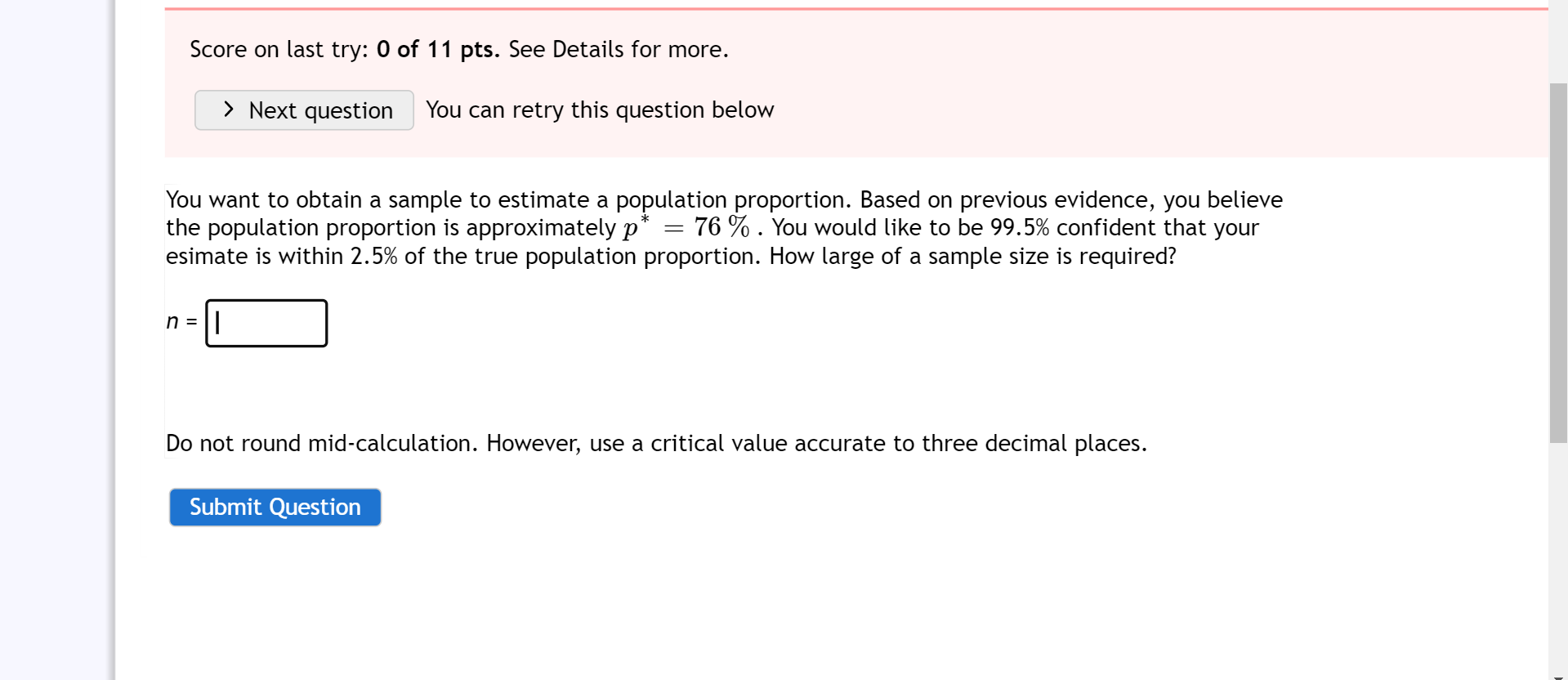
6.18 Is college worth it? Part II: Exercise 6.16 presents the results of a poll where 48% of 331 Americans who decide to not go to college do so because they cannot afford it. (a) Calculate a 90% confidence interval for the proportion of Americans who decide to not go to college because they cannot afford it, and interpret the interval in context. lower bound: :] (please round to four decimal places) upper bound: :] (please round to four decimal places) Interpret the confidence interval in context: We can be 90% confident that the proportion of Americans who choose not to go to college because they cannot afford it is contained within our confidence interval 0 We can be 90% confident that our confidence interval contains the sample proportion of Americans who choose not to go to college because they cannot afford it Q 90% of Americans choose not to go to college because they cannot afford it (b) Suppose we wanted the margin of error for the 90% confidence level to be about 1.5%. How large of a survey would you recommend? A survey should include at least :] people. Submit Question 6.34 Prenatal vitamins and Autism: Researchers studying the link between prenatal vitamin use and autism surveyed the mothers of a random sample of children aged 24 - 60 months with autism and conducted another separate random sample for children with typical development. The table below shows the number of mothers in each group who did and did not use prenatal vitamins during the three months belore pregnancy (periconceptional period). (Schmidt, 2011] Autism Typical Development Total No vitamin 111 70 181 Vitamin 143 159 302 Total 254 27.9 483 1a) State appropriate hypotheses to test for independence of use o1 prenatal vitamins during the three months before pregnancy and autism. "03 Pvitamin = Pno vitamin H51 Pvitamin ' Pna vitamin 0 H0: pvitamin = Pno vitamin Ha: Pvitamin Pna vitamin J (b) Complete the hypothesis test and state an appropriate conclusion. What is the value of the test statistic for this test? :] (Please round to two decimal places) What is the p-value associated with this test? :] (Please round to four decimal places) The result of the hypothesis is: Since p pno vitamin vitamins during the three (b) Complete the hypothesis test and state an appropriate conclusion. What is the value of the test statistic for this test? [:] (Please round to two decimal places) What is the p-value associated with this test? I: (Please round to four decimal places) The result of the hypothesis is: Score on last try: 0 of 11 pts. See Details for more. > Next question You can retry this question below Assume that a sample is used to estimate a population proportion p. Find the margin of error M.E. that corresponds to a sample of size 325 with 228 successes at a confidence level of 90%. M.E. = 18.028 x% (report answer accurate to one decimal place; answer should be reported as a percent, not a decimal though do not type the percent sign) Answer should be obtained without any preliminary rounding. However, the critical value may be rounded to 3 decimal places. Submit Question Score on last try: 0 of 1 1 pts. See Details for more. > Next question You can retry this question below You want to obtain a sample to estimate a population proportion. Based on previous evidence, you believe the population proportion is approximately p'IF = 76 % . You would like to be 99.5% confident that your esimate is within 2.5% of the true population proportion. How large of a sample size is required? Do not round mid-calculation. However, use a critical value accurate to three decimal places. Submit Question 0 Question 9 v B 3.3/11 pi' Score on last try: 3.3 of 11 pts. See Details for more. You can retry this question below You wish to test the following claim (Ha) at a significance level of a = 0.10. Hoipl = p2 Harm > 102 The 1st population's sample has 129 successes and a sample size = 644. The 2nd population's sample has 83 successes and a sample size = 625. What is the test statistic (z-score) for this sample? (Round to 3 decimal places.) test statistic = C] What is the p-value for this sample? (Round to 3 decimal places.) lThe p-value is... Score on last try: 0 of 11 pts. See Details for more. > Next question You can retry this question below You work for a marketing firm that has a large client in the automobile industry. You have been asked to estimate the proportion of households in Chicago that have two or more vehicles. You have been assigned to gather a random sample that could be used to estimate this proportion to within a 0.025 margin of error at a 90% level of confidence. a) With no prior research, what sample size should you gather in order to obtain a 0.025 margin of error? Round your answer up to the nearest whole number. n = I: households b) Your firm has decided that your plan is too expensive, and they wish to reduce the sample size required. You conduct a small preliminary sample, and you obtain a sample proportion ofp : 0.24 . Using this new information. what sample size should you gather in order to obtain a 0.025 margin of error? Round your answer up to the nearest whole number. n = [:] households Question Help: El Video

Step by Step Solution

There are 3 Steps involved in it

1 Expert Approved Answer
Step: 1 Unlock blur-text-image
Question Has Been Solved by an Expert!

Get step-by-step solutions from verified subject matter experts

Step: 2 Unlock
Step: 3 Unlock

Students Have Also Explored These Related Mathematics Questions!