







Question: I'm having trouble with question 9; could someone help me with that? Procedure: Weigh a clean dry 100ml round bottomed flask (24/40 ground glass joint)
I'm having trouble with question 9; could someone help me with that?
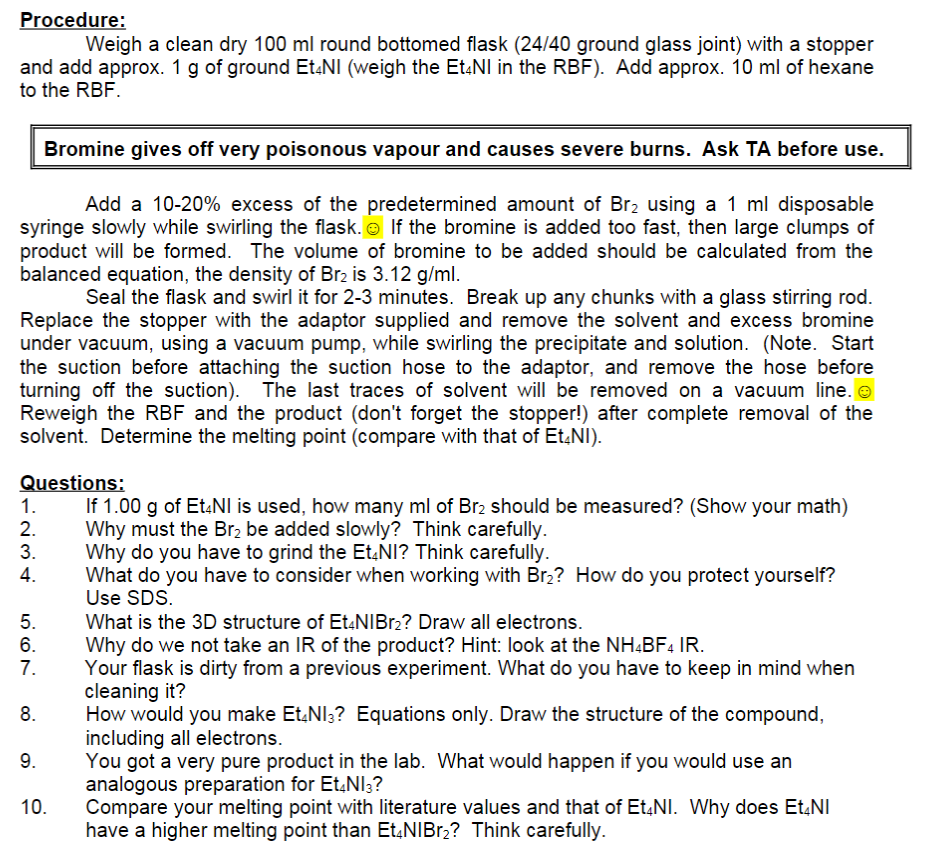
Procedure: Weigh a clean dry 100ml round bottomed flask (24/40 ground glass joint) with a stopper and add approx. 1g of ground Et4NI (weigh the Et4NI in the RBF). Add approx. 10ml of hexane to the RBF. Bromine gives off very poisonous vapour and causes severe burns. Ask TA before use. Add a 1020% excess of the predetermined amount of Br2 using a 1ml disposable syringe slowly while swirling the flask. If the bromine is added too fast, then large clumps of product will be formed. The volume of bromine to be added should be calculated from the balanced equation, the density of Br2 is 3.12g/ml. Seal the flask and swirl it for 2-3 minutes. Break up any chunks with a glass stirring rod. Replace the stopper with the adaptor supplied and remove the solvent and excess bromine under vacuum, using a vacuum pump, while swirling the precipitate and solution. (Note. Start the suction before attaching the suction hose to the adaptor, and remove the hose before turning off the suction). The last traces of solvent will be removed on a vacuum line. Reweigh the RBF and the product (don't forget the stopper!) after complete removal of the solvent. Determine the melting point (compare with that of Et4NI ). Questions: 1. If 1.00g of Et4NI is used, how many ml of Br2 should be measured? (Show your math) 2. Why must the Br2 be added slowly? Think carefully. 3. Why do you have to grind the Et4NI ? Think carefully. 4. What do you have to consider when working with Br2 ? How do you protect yourself? Use SDS. 5. What is the 3D structure of Et4NIBr2 ? Draw all electrons. 6. Why do we not take an IR of the product? Hint: look at the NH4BF4IR. 7. Your flask is dirty from a previous experiment. What do you have to keep in mind when cleaning it? 8. How would you make Et4Nl3 ? Equations only. Draw the structure of the compound, including all electrons. 9. You got a very pure product in the lab. What would happen if you would use an analogous preparation for Et4Nl3 ? 10. Compare your melting point with literature values and that of Et4NI. Why does Et4NI have a higher melting point than Et4NIBr2 ? Think carefully
Step by Step Solution
There are 3 Steps involved in it

Get step-by-step solutions from verified subject matter experts
 Study Help