







Question: I'm working in Python and need help with part (c) (d) and (e) 2.15 Project: Best Strategy to Win Consider Consider TV game Example 2.15.
I'm working in Python and need help with part (c) (d) and (e)
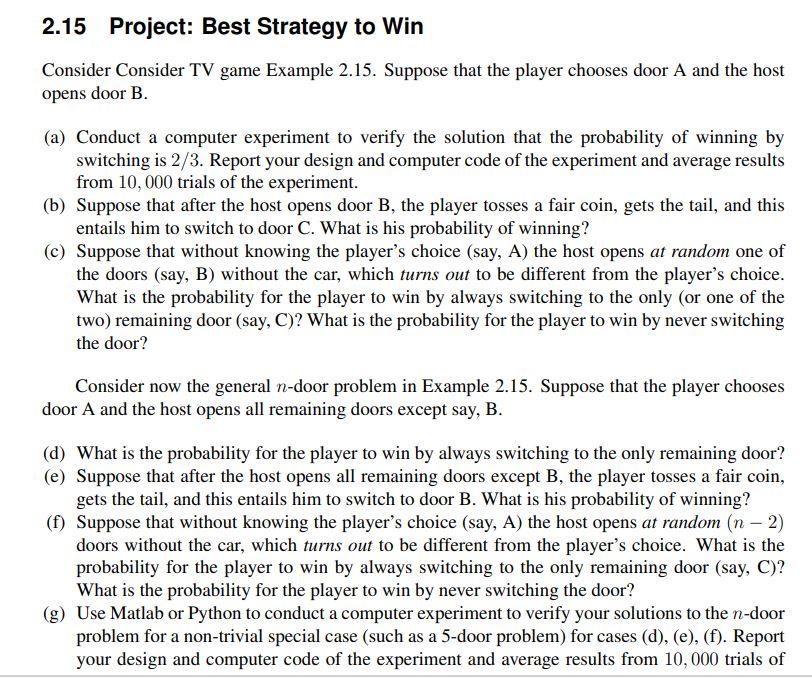
2.15 Project: Best Strategy to Win Consider Consider TV game Example 2.15. Suppose that the player chooses door A and the host opens door B. (a) Conduct a computer experiment to verify the solution that the probability of winning by switching is 2/3. Report your design and computer code of the experiment and average results from 10,000 trials of the experiment. (b) Suppose that after the host opens door B, the player tosses a fair coin, gets the tail, and this entails him to switch to door C. What is his probability of winning? (c) Suppose that without knowing the player's choice (say, A) the host opens at random one of the doors (say, B) without the car, which turns out to be different from the player's choice. What is the probability for the player to win by always switching to the only (or one of the two) remaining door (say, C)? What is the probability for the player to win by never switching the door? Consider now the general n-door problem in Example 2.15. Suppose that the player chooses door A and the host opens all remaining doors except say, B. (d) What is the probability for the player to win by always switching to the only remaining door? (e) Suppose that after the host opens all remaining doors except B, the player tosses a fair coin, gets the tail, and this entails him to switch to door B. What is his probability of winning? (f) Suppose that without knowing the player's choice (say, A) the host opens at random (n - 2) doors without the car, which turns out to be different from the player's choice. What is the probability for the player to win by always switching to the only remaining door (say, C)? What is the probability for the player to win by never switching the door? Use Matlab or Python to conduct a computer experiment to verify your solutions to the n-door problem for a non-trivial special case (such as a 5-door problem) for cases (d), (e), (f). Report your design and computer code of the experiment and average results from 10,000 trials of 2.15 Project: Best Strategy to Win Consider Consider TV game Example 2.15. Suppose that the player chooses door A and the host opens door B. (a) Conduct a computer experiment to verify the solution that the probability of winning by switching is 2/3. Report your design and computer code of the experiment and average results from 10,000 trials of the experiment. (b) Suppose that after the host opens door B, the player tosses a fair coin, gets the tail, and this entails him to switch to door C. What is his probability of winning? (c) Suppose that without knowing the player's choice (say, A) the host opens at random one of the doors (say, B) without the car, which turns out to be different from the player's choice. What is the probability for the player to win by always switching to the only (or one of the two) remaining door (say, C)? What is the probability for the player to win by never switching the door? Consider now the general n-door problem in Example 2.15. Suppose that the player chooses door A and the host opens all remaining doors except say, B. (d) What is the probability for the player to win by always switching to the only remaining door? (e) Suppose that after the host opens all remaining doors except B, the player tosses a fair coin, gets the tail, and this entails him to switch to door B. What is his probability of winning? (f) Suppose that without knowing the player's choice (say, A) the host opens at random (n - 2) doors without the car, which turns out to be different from the player's choice. What is the probability for the player to win by always switching to the only remaining door (say, C)? What is the probability for the player to win by never switching the door? Use Matlab or Python to conduct a computer experiment to verify your solutions to the n-door problem for a non-trivial special case (such as a 5-door problem) for cases (d), (e), (f). Report your design and computer code of the experiment and average results from 10,000 trials of
Step by Step Solution
There are 3 Steps involved in it

Get step-by-step solutions from verified subject matter experts
 Study Help