







Question: Imagine a problem where a player is given 100 random 1 digit numbers and a random 4 digit target. They must create an arithmetic expression
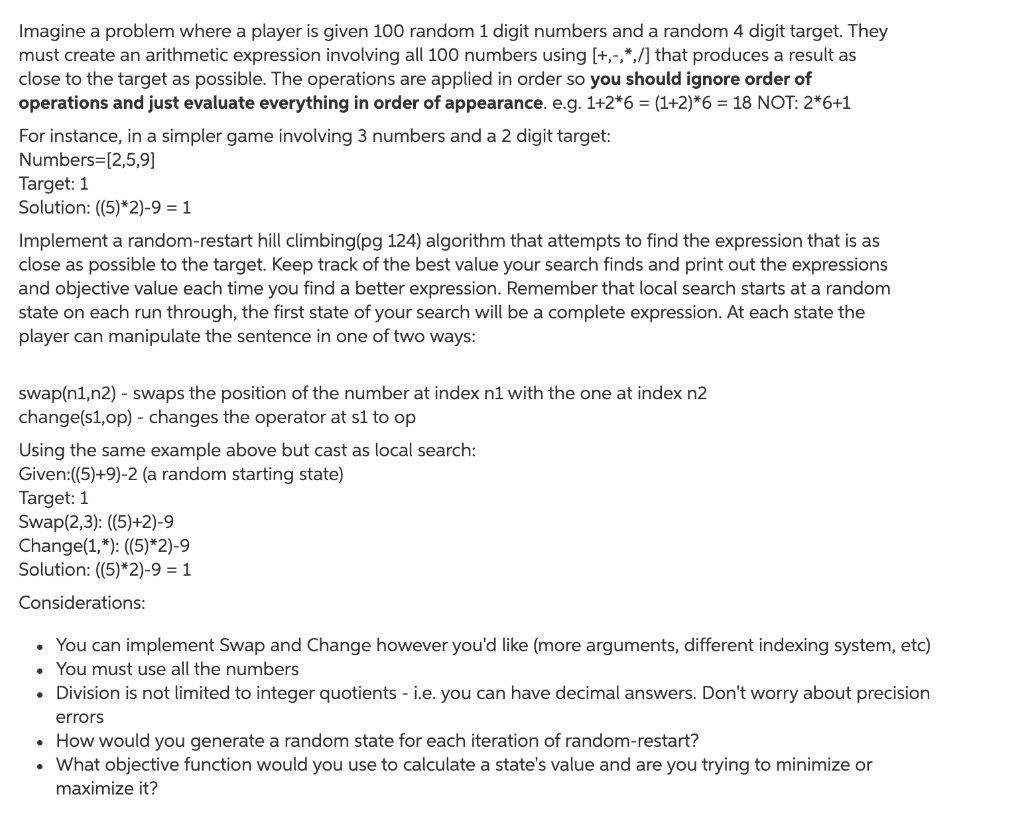
Imagine a problem where a player is given 100 random 1 digit numbers and a random 4 digit target. They must create an arithmetic expression involving all 100 numbers using (+,-,*,/] that produces a result as close to the target as possible. The operations are applied in order so you should ignore order of operations and just evaluate everything in order of appearance. e.g. 1+2*6 = (1+2)*6 = 18 NOT: 2*6+1 For instance, in a simpler game involving 3 numbers and a 2 digit target: Numbers=(2,5,9) Target: 1 Solution: ((5)*2)-9 = 1 Implement a random-restart hill climbing(pg 124) algorithm that attempts to find the expression that is as close as possible to the target. Keep track of the best value your search finds and print out the expressions and objective value each time you find a better expression. Remember that local search starts at a random state on each run through, the first state of your search will be a complete expression. At each state the player can manipulate the sentence in one of two ways: swap(n1,n2) - swaps the position of the number at index nl with the one at index n2 change(s1,0p) - changes the operator at s1 to op Using the same example above but cast as local search: Given:((5)+9)-2 (a random starting state) Target: 1 Swap(2,3): ((5)+2)-9 Change(1,*): ((5)*2)-9 Solution: ((5)*2)-9 = 1 Considerations: You can implement Swap and Change however you'd like (more arguments, different indexing system, etc) . You must use all the numbers Division is not limited to integer quotients - i.e. you can have decimal answers. Don't worry about precision errors How would you generate a random state for each iteration of random-restart? What objective function would you use to calculate a state's value and are you trying to minimize or maximize it? Imagine a problem where a player is given 100 random 1 digit numbers and a random 4 digit target. They must create an arithmetic expression involving all 100 numbers using (+,-,*,/] that produces a result as close to the target as possible. The operations are applied in order so you should ignore order of operations and just evaluate everything in order of appearance. e.g. 1+2*6 = (1+2)*6 = 18 NOT: 2*6+1 For instance, in a simpler game involving 3 numbers and a 2 digit target: Numbers=(2,5,9) Target: 1 Solution: ((5)*2)-9 = 1 Implement a random-restart hill climbing(pg 124) algorithm that attempts to find the expression that is as close as possible to the target. Keep track of the best value your search finds and print out the expressions and objective value each time you find a better expression. Remember that local search starts at a random state on each run through, the first state of your search will be a complete expression. At each state the player can manipulate the sentence in one of two ways: swap(n1,n2) - swaps the position of the number at index nl with the one at index n2 change(s1,0p) - changes the operator at s1 to op Using the same example above but cast as local search: Given:((5)+9)-2 (a random starting state) Target: 1 Swap(2,3): ((5)+2)-9 Change(1,*): ((5)*2)-9 Solution: ((5)*2)-9 = 1 Considerations: You can implement Swap and Change however you'd like (more arguments, different indexing system, etc) . You must use all the numbers Division is not limited to integer quotients - i.e. you can have decimal answers. Don't worry about precision errors How would you generate a random state for each iteration of random-restart? What objective function would you use to calculate a state's value and are you trying to minimize or maximize it
Step by Step Solution
There are 3 Steps involved in it

Get step-by-step solutions from verified subject matter experts
 Study Help