







Question: Imagine you are using an Al system for classification. We want to classify dots on the graph below as red or blue. Each dot is
Imagine you are using an Al system for classification. We want to classify dots on the graph below as red or blue. Each dot is represented by an and position.
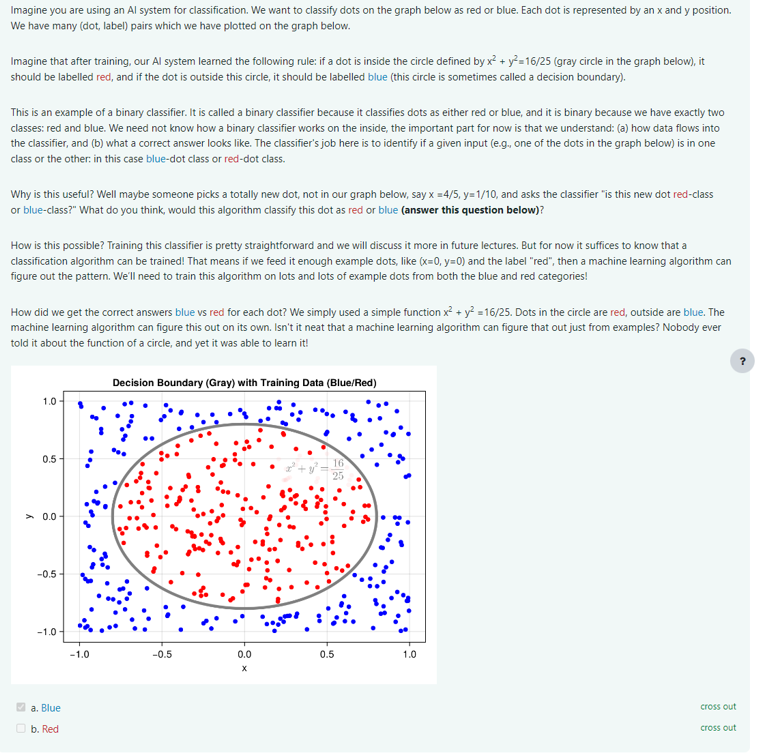
We have many dot label pairs which we have plotted on the graph below.
Imagine that after training, our Al system learned the following rule: if a dot is inside the circle defined by gray circle in the graph below it
should be labelled red, and if the dot is outside this circle, it should be labelled blue this circle is sometimes called a decision boundary
This is an example of a binary classifier. It is called a binary classifier because it classifies dots as either red or blue, and it is binary because we have exactly two
classes: red and blue. We need not know how a binary classifier works on the inside, the important part for now is that we understand: a how data flows into
the classifier, and b what a correct answer looks like. The classifier's job here is to identify if a given input
egy one of the dots in the graph below is in one
class or the other: in this case bluedot class or reddot class.
Why is this useful? Well maybe someone picks a totally new dot, not in our graph below, say and asks the classifier is this new dot redclass
or blueclass?" What do you think, would this algorithm classify this dot as red or blue answer this question below
How is this possible? Training this classifier is pretty straightforward and we will discuss it more in future lectures. But for now it suffices to know that a
classification algorithm can be trained! That means if we feed it enough example dots, like and the label "red", then a machine learning algorithm can
figure out the pattern. We'll need to train this algorithm on lots and lots of example dots from both the blue and red categories!
How did we get the correct answers blue vs red for each dot? We simply used a simple function Dots in the circle are red, outside are blue. The
machine learning algorithm can figure this out on its own. Isn't it neat that a machine learning algorithm can figure that out just from examples? Nobody ever
told it about the function of a circle, and yet it was able to learn it
a Blue
Step by Step Solution
There are 3 Steps involved in it
1 Expert Approved Answer
Step: 1 Unlock

Question Has Been Solved by an Expert!
Get step-by-step solutions from verified subject matter experts
Step: 2 Unlock
Step: 3 Unlock
 Study Help