







Question: Implement a function def postfixEvaluation(expression) : that takes, as a parameter, an expression in postfix notation (see explanation below) and outputs its value, using the
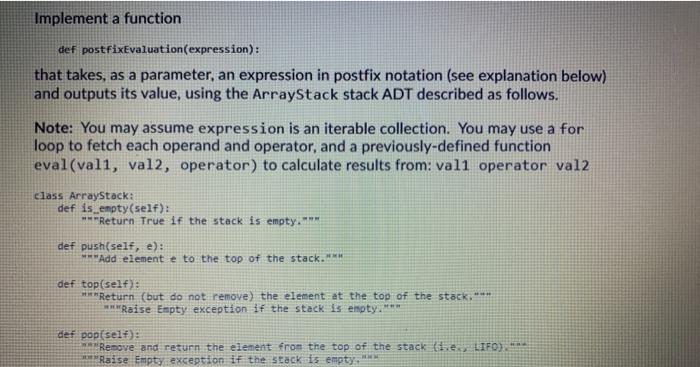
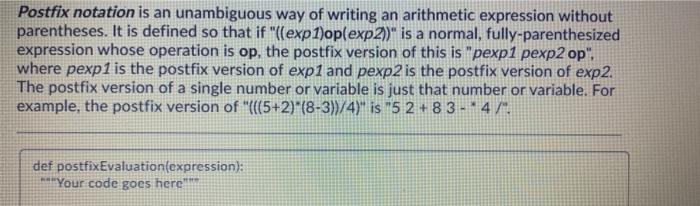

Implement a function def postfixEvaluation(expression) : that takes, as a parameter, an expression in postfix notation (see explanation below) and outputs its value, using the ArrayStack stack ADT described as follows. Note: You may assume expression is an iterable collection. You may use a for loop to fetch each operand and operator, and a previously-defined function eval(vali, val2, operator) to calculate results from: vali operator val2 class ArrayStack: def is_empty(self): Return True if the stack is empty. def push(self, e): Add elemente to the top of the stack. def top(self): HIT Return (but do not remove) the element at the top of the stack.*** wwwRaise Empty exception if the stack is empty. Men der popself): Remove and return the element from the top of the stack the LIFO) Raise Empty exception if the stack is empty... Postfix notation is an unambiguous way of writing an arithmetic expression without parentheses. It is defined so that if "((exp 1)op(exp2)" is a normal, fully-parenthesized expression whose operation is op, the postfix version of this is "pexp1 pexp2 op", where pexp1 is the postfix version of exp1 and pexp2 is the postfix version of exp2. The postfix version of a single number or variable is just that number or variable. For example, the postfix version of "(((5+2)*(8-3)/4)" is "5 2 + 8 3 - * 4/". def postfixEvaluation(expression); Your code goes here" Yes
Step by Step Solution
There are 3 Steps involved in it

Get step-by-step solutions from verified subject matter experts
 Study Help