







Question: Implement a hash table for strings. Create two hashing functions (not ones implemented in the books). It is up to you which type of chaining/probing
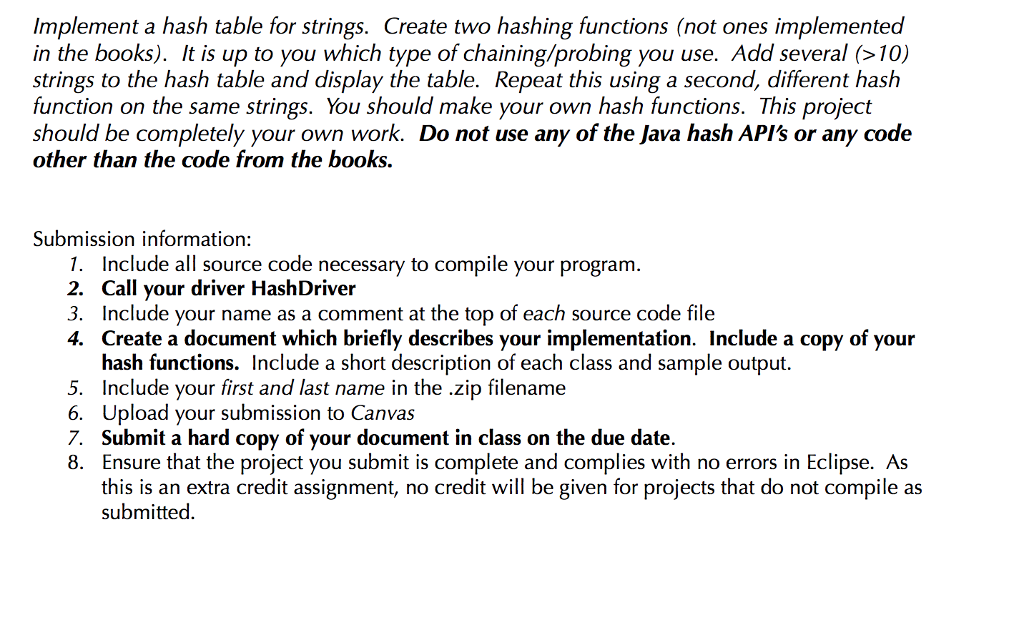
Implement a hash table for strings. Create two hashing functions (not ones implemented in the books). It is up to you which type of chaining/probing you use. Add several (>10) strings to the hash table and display the table. Repeat this using a second, different hash function on the same strings. You should make your own hash functions. This project should be completely your own work. Do not use any of the Java hash APIs or any code other than the code from the books.
Submission information: 1. Include all source code necessary to compile your program. 2. Call your driver HashDriver 3. Include your name as a comment at the top of each source code file 4. Create a document which briefly describes your implementation. Include a copy of your
hash functions. Include a short description of each class and sample output. 5. Include your first and last name in the .zip filename 6. Upload your submission to Canvas 7. Submit a hard copy of your document in class on the due date. 8. Ensure that the project you submit is complete and complies with no errors in Eclipse. As
this is an extra credit assignment, no credit will be given for projects that do not compile as submitted.
Implement a hash table for strings. Create two hashing functions (not ones implemented in the books). It is up to you which type of chaining/probing you use. Add several (>10) strings to the hash table and display the table. Repeat this using a second, different hash function on the same strings. You should make your own hash functions. This project should be completely your own work. Do not use any of the Java hash API's or any code other than the code from the books. Submission information: Include all source code necessary to compile your program. 2. 1. Call your driver HashDriver 3. Include your name as a comment at the top of each source code file 4. Create a document which briefly describes your implementation. Include a copy of your hash functions. Include a short description of each class and sample output. 5. Include your first and last name in the zip filename 6. Upload your submission to Canvas 7. Submit a hard copy of your document in class on the due date. 8. Ensure that the project you submit is complete and complies with no errors in Eclipse. As this is an extra credit assignment, no credit will be given for projects that do not compile as submitted. Implement a hash table for strings. Create two hashing functions (not ones implemented in the books). It is up to you which type of chaining/probing you use. Add several (>10) strings to the hash table and display the table. Repeat this using a second, different hash function on the same strings. You should make your own hash functions. This project should be completely your own work. Do not use any of the Java hash API's or any code other than the code from the books. Submission information: Include all source code necessary to compile your program. 2. 1. Call your driver HashDriver 3. Include your name as a comment at the top of each source code file 4. Create a document which briefly describes your implementation. Include a copy of your hash functions. Include a short description of each class and sample output. 5. Include your first and last name in the zip filename 6. Upload your submission to Canvas 7. Submit a hard copy of your document in class on the due date. 8. Ensure that the project you submit is complete and complies with no errors in Eclipse. As this is an extra credit assignment, no credit will be given for projects that do not compile as submitted
Step by Step Solution
There are 3 Steps involved in it

Get step-by-step solutions from verified subject matter experts
 Study Help