







Question: Implement a program by C language(not C++ or Java): Assume a graph represents a social network: the vertices are people and the edges are friendship
Implement a program by C language(not C++ or Java):
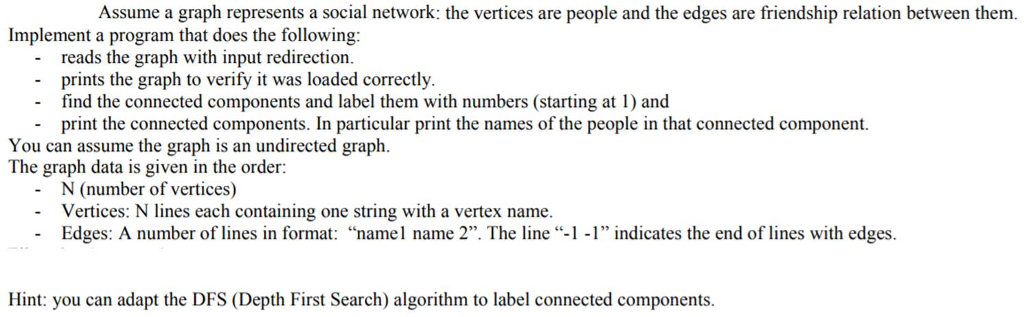
Assume a graph represents a social network: the vertices are people and the edges are friendship relation between them. Implement a program that does the following: - reads the graph with input redirection - prints the graph to verify it was loaded correctly. find the connected components and label them with numbers (starting at 1) and print the connected components. In particular print the names of the people in that connected component. You can assume the graph is an undirected graph The graph data is given in the order: N (number of vertices) - Vertices: N lines each containing one string with a vertex name. - Edges: A number of lines in format: "namel name 2" The line "-" indicates the end of lines with edges Hint: you can adapt the DFS (Depth First Search) algorithm to label connected components. Assume a graph represents a social network: the vertices are people and the edges are friendship relation between them. Implement a program that does the following: - reads the graph with input redirection - prints the graph to verify it was loaded correctly. find the connected components and label them with numbers (starting at 1) and print the connected components. In particular print the names of the people in that connected component. You can assume the graph is an undirected graph The graph data is given in the order: N (number of vertices) - Vertices: N lines each containing one string with a vertex name. - Edges: A number of lines in format: "namel name 2" The line "-" indicates the end of lines with edges Hint: you can adapt the DFS (Depth First Search) algorithm to label connected components
Step by Step Solution
There are 3 Steps involved in it

Get step-by-step solutions from verified subject matter experts
 Study Help