







Question: Implement MVA formulas (10.1) to (10.4) in a spreadsheet for the Penny Fab example with (j) = 2 hours and celj) = 0.5 for j
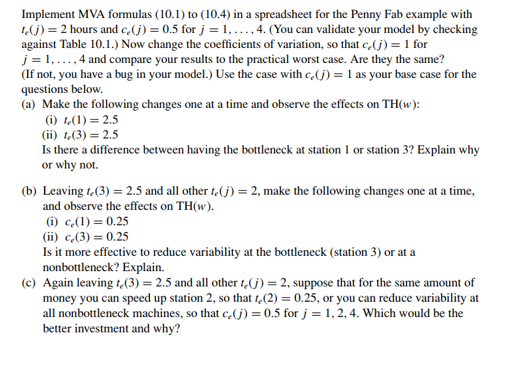
Implement MVA formulas (10.1) to (10.4) in a spreadsheet for the Penny Fab example with (j) = 2 hours and celj) = 0.5 for j = 1,...,4. (You can validate your model by checking against Table 10.1.) Now change the coefficients of variation, so that ce()= 1 for j = 1, ..., 4 and compare your results to the practical worst case. Are they the same? (If not, you have a bug in your model.) Use the case with ce()) = 1 as your base case for the questions below. (a) Make the following changes one at a time and observe the effects on TH(w): (1) 1(1) = 2.5 (ii) te(3) = 2.5 Is there a difference between having the bottleneck at station 1 or station 3? Explain why or why not. (b) Leaving te(3) = 2.5 and all other te(j) = 2, make the following changes one at a time, and observe the effects on TH(w). (i) c(1) = 0.25 (ii) Ce(3) = 0.25 Is it more effective to reduce variability at the bottleneck (station 3) or at a nonbottleneck? Explain. (c) Again leaving te(3) = 2.5 and all other te() = 2, suppose that for the same amount of money you can speed up station 2, so that 1(2) = 0.25, or you can reduce variability at all nonbottleneck machines, so that c.(j) = 0.5 for j = 1, 2, 4. Which would be the better investment and why? Implement MVA formulas (10.1) to (10.4) in a spreadsheet for the Penny Fab example with (j) = 2 hours and celj) = 0.5 for j = 1,...,4. (You can validate your model by checking against Table 10.1.) Now change the coefficients of variation, so that ce()= 1 for j = 1, ..., 4 and compare your results to the practical worst case. Are they the same? (If not, you have a bug in your model.) Use the case with ce()) = 1 as your base case for the questions below. (a) Make the following changes one at a time and observe the effects on TH(w): (1) 1(1) = 2.5 (ii) te(3) = 2.5 Is there a difference between having the bottleneck at station 1 or station 3? Explain why or why not. (b) Leaving te(3) = 2.5 and all other te(j) = 2, make the following changes one at a time, and observe the effects on TH(w). (i) c(1) = 0.25 (ii) Ce(3) = 0.25 Is it more effective to reduce variability at the bottleneck (station 3) or at a nonbottleneck? Explain. (c) Again leaving te(3) = 2.5 and all other te() = 2, suppose that for the same amount of money you can speed up station 2, so that 1(2) = 0.25, or you can reduce variability at all nonbottleneck machines, so that c.(j) = 0.5 for j = 1, 2, 4. Which would be the better investment and why
Step by Step Solution
There are 3 Steps involved in it

Get step-by-step solutions from verified subject matter experts
 Study Help