







Question: Implement the following classes using Java: BookSho +title: String +author: String ISBN: int + price: double + numberOfCopies: int books: Book 1.. .n Date: java.util.
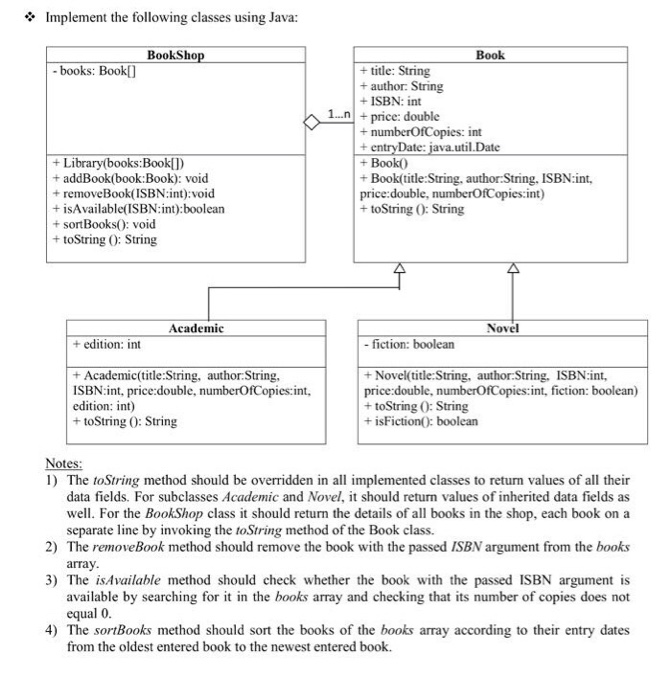
Implement the following classes using Java: BookSho +title: String +author: String ISBN: int + price: double + numberOfCopies: int books: Book 1.. .n Date: java.util. Date Book() Book(tile:String, author:String. ISBN:int, + Library(books:Book) + addBook(book:Book): void +removeBook(ISBN:int):void + isAvailable(ISBN:int):boolean + sortBooks0: void +toString O: String price:double, numberOfCopies int) +toString O: String Academic Novel + edition: int - fiction: boolean + Academictitle:String, author.String, ISBN:int, price:double, numberOfCopies int, edition: int) +toString O: String +Novel(title:String, author String. ISBN:int, price:double, numberOfCopies:int, fiction: boolean) +toString 0: String +isFiction0: boolean Notes: 1) The toString method should be overridden in all implemented classes to return values of all their data fields. For subclasses Academic and Novel, it should return values of inherited data fields as well. For the BookShop class it should return the details of all books in the shop, each book on a separate line by invoking the toString method of the Book class. 2) The removeBook method should remove the book with the passed ISBN argument from the books 3) The isAvailable method should check whether the book with the passed ISBN argument is 4) The sortBooks method should sort the books of the books array according to their entry dates array available by searching for it in the books array and checking that its number of copies does not equal 0 from the oldest entered book to the newest entered book
Step by Step Solution
There are 3 Steps involved in it

Get step-by-step solutions from verified subject matter experts
 Study Help