







Question: Implement the following Java class TM to simulate a deterministic Turing machine. public class TM { public TM(String[] delta,String q0, String qa,String qr) public void
Implement the following Java class TM to simulate a deterministic Turing machine.
public class TM {
public TM(String[] delta,String q0, String qa,String qr)
public void run(String w)
}
States are represented by alphanumeric strings.A Turing machine is specified by the parameters to the constructor. The
array delta defines the transition function. Each string in delta has the form q X p Y D, representing a transition from state q
to p with the label D Y X , . The parameters q0, qa, and qr define the start, accept, and reject states respectively.
The blank symbol is represented by the underscore _.
The method run simulate s the computations of the TM on the input w and print s the sequen ce of
configurations to the console. If the TM halts, it also prints ACCEPT or REJECT.
A test program and its output are shown in the picture below:
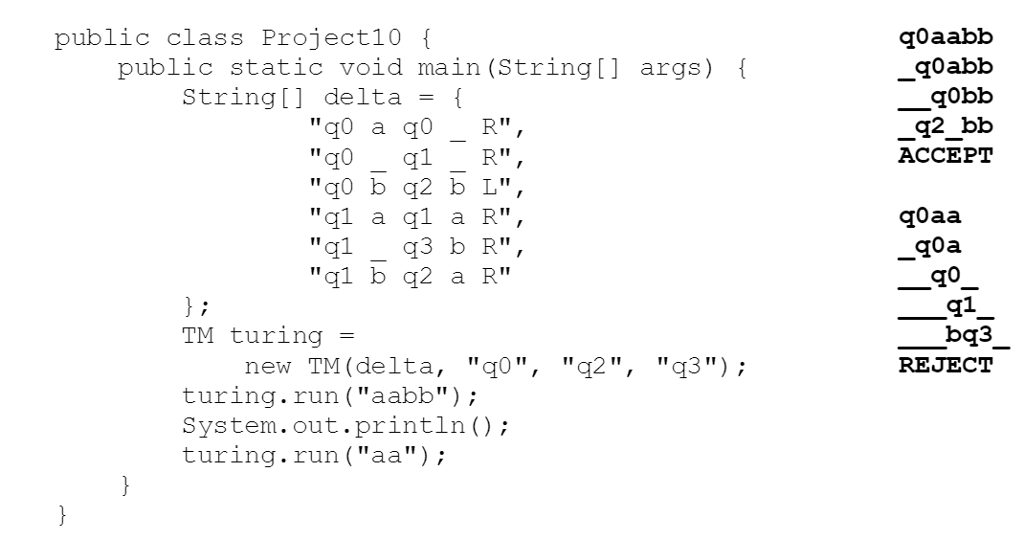
public class Project10 public static void main (String I args) String delta go a go R", q1 q1 a q1 a R q1 q3 b R q1 b q2 a 11 TM turing new TM (delta "go", "g2 ''q3''); turing. run ("aabb" System. out. println turing run aa"); goaabb goabb gobb q2 bb ACCEPT goaa goa go REJECT public class Project10 public static void main (String I args) String delta go a go R", q1 q1 a q1 a R q1 q3 b R q1 b q2 a 11 TM turing new TM (delta "go", "g2 ''q3''); turing. run ("aabb" System. out. println turing run aa"); goaabb goabb gobb q2 bb ACCEPT goaa goa go REJECT
Step by Step Solution
There are 3 Steps involved in it

Get step-by-step solutions from verified subject matter experts
 Study Help