







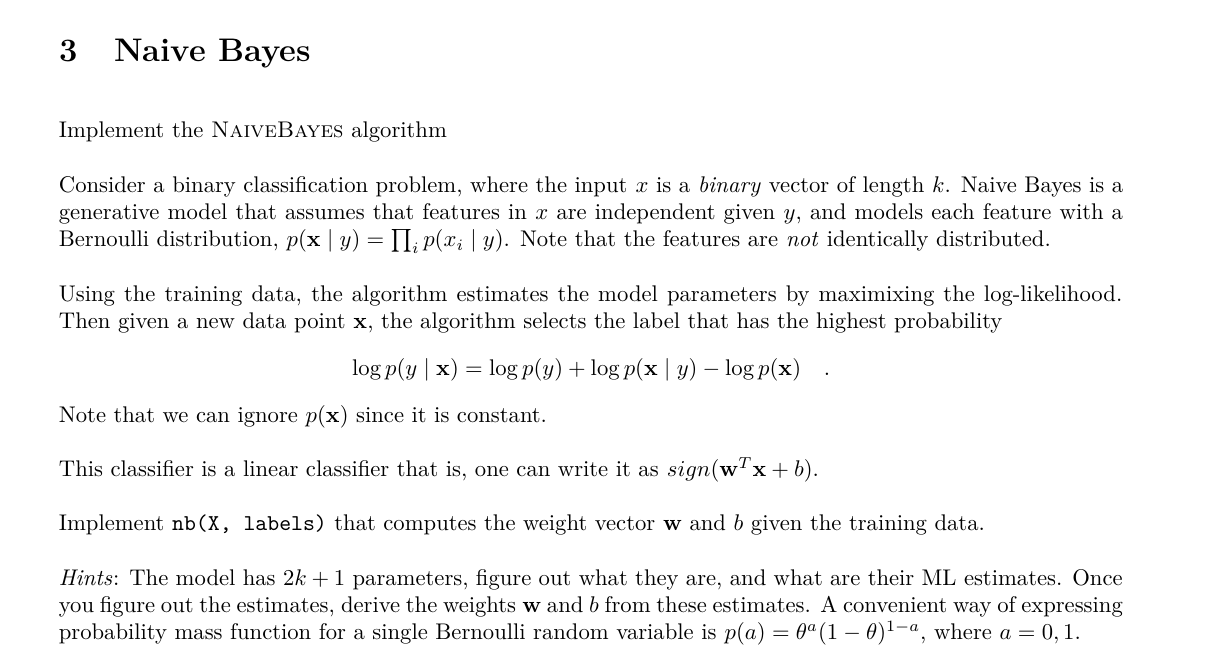
Question: Implement the NAIVEBAYES algorithm Consider a binary classification problem, where the input x is a binary vector of length k . Naive Bayes is a
Implement the NAIVEBAYES algorithm
Consider a binary classification problem, where the input is a binary vector of length Naive Bayes is a
generative model that assumes that features in are independent given and models each feature with a
Bernoulli distribution, Note that the features are not identically distributed.
Using the training data, the algorithm estimates the model parameters by maximixing the loglikelihood.
Then given a new data point the algorithm selects the label that has the highest probability
Note that we can ignore since it is constant.
This classifier is a linear classifier that is one can write it as sign
Implement labels that computes the weight vector and given the training data.
Hints: The model has parameters, figure out what they are, and what are their ML estimates. Once
you figure out the estimates, derive the weights and from these estimates. A convenient way of expressing
probability mass function for a single Bernoulli random variable is where You have to fill the below python code according to the above and given instructions. Note that it corrects using another code. I will attach the correcting algorithmic code too. Answer: "import sys
import numpy as np
def nbX labels:
Computes the weight vector w and and bias b corresponding
to the Naive Bayes classifier with Bernoulli components.
Parameters
X : an array of size n k
training input data for the classifier, elements must be
labels : an array of size n
training labels for the classifier, elements must be
Returns
w : an array of size k
weights corresponding to the classifier
bias: real number
bias term corresponding to the classifier
cnt k Xshape
w npzerosk
b
# place your code here
return w b
def mainargv:
D nploadtxtargv
X D::
labels D:
printnbX labels
# This allows the script to be used as a module and as a standalone program
if namemain:
if lensysargv:
printusage: python s filename' sysargv
else:
mainsysargv Correcting code: "import numpy as np
from utils import errormsg, ApproxTest
@points
class NbTesterApproxTest:
def testnbself:
D nploadtxttesttoytxt
X D::
labels D:
nb loadsrcnbnb
w b nbX labels
w nparray
b
self.assertApproxw w errormsgIncorrect weight vector input toy.txt w w
self.assertApproxb b errormsgIncorrect bias input toy.txt b b
Step by Step Solution
There are 3 Steps involved in it
1 Expert Approved Answer
Step: 1 Unlock

Question Has Been Solved by an Expert!
Get step-by-step solutions from verified subject matter experts
Step: 2 Unlock
Step: 3 Unlock
 Study Help