







Question: Implement the sorting algorithm: HEAP-Sort (C+) pseudocode for Heap-Sort void buildMaxHeap (int A[0... (A.length-1)]) int heapSize-A.length; for(int i- heapSize/2-1; i>-0 i--) [ maxHeapi fy (A
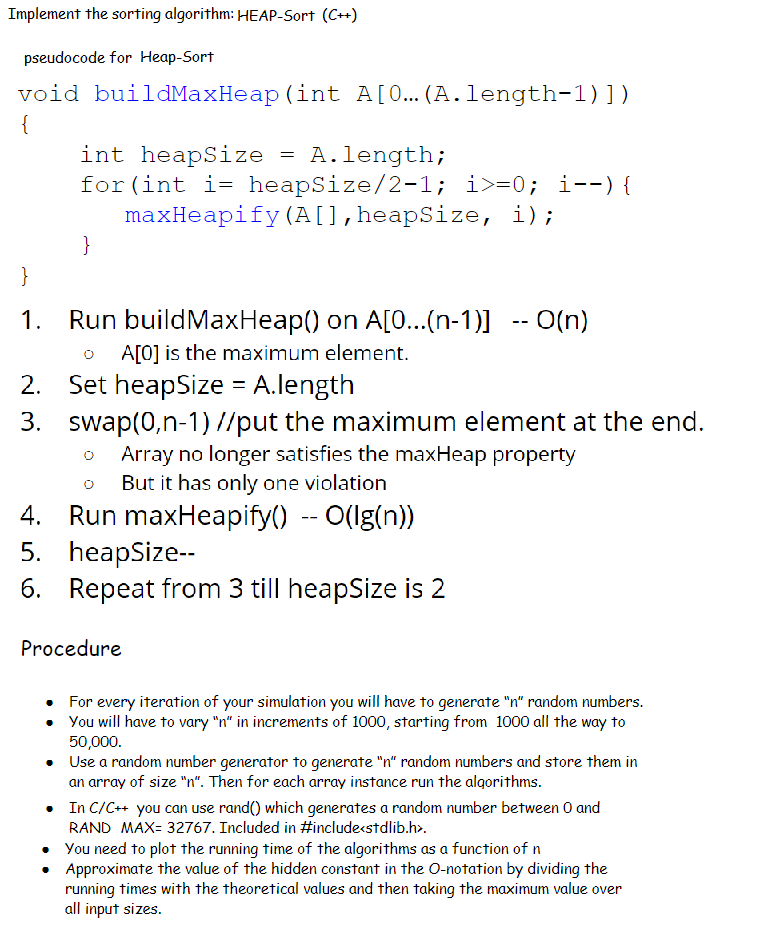
Implement the sorting algorithm: HEAP-Sort (C+) pseudocode for Heap-Sort void buildMaxHeap (int A[0... (A.length-1)]) int heapSize-A.length; for(int i- heapSize/2-1; i>-0 i--) [ maxHeapi fy (A [ ] , heapsize, 1); 1. Run buildMaxHeap) on A[O...(n-1)] - O(n) A[0] is the maximum element o 2. Set heapSize- A.length 3. swap(0,n-1) //put the maximum element at the end. o Array no longer satisfies the maxHeap property o But it has only one violation 4. Run maxHeapify) O(lg(n)) 5. heapSize-- 6. Repeat trom 3 till heapsize IS 2 Procedure For every iteration of your simulation you will have to generate "n" random numbers . You will have to vary "n" in increments of 1000, starting from 1000 all the way to 50,000. .Use a random number generator to generate "n" random numbers and store them in an array of size "n". Then for each array instance run the algorithms .In C/C+ you can use randO which generates a random number between 0 and RAND MAX-32767. Included in #includestdlib.h> You need to plot the running time of the algorithms as a function of n Approximate the value of the hidden constant in the O-notation by dividing the runnina times with the theoretical values and then takina the maximum value over all input sizes . . Implement the sorting algorithm: HEAP-Sort (C+) pseudocode for Heap-Sort void buildMaxHeap (int A[0... (A.length-1)]) int heapSize-A.length; for(int i- heapSize/2-1; i>-0 i--) [ maxHeapi fy (A [ ] , heapsize, 1); 1. Run buildMaxHeap) on A[O...(n-1)] - O(n) A[0] is the maximum element o 2. Set heapSize- A.length 3. swap(0,n-1) //put the maximum element at the end. o Array no longer satisfies the maxHeap property o But it has only one violation 4. Run maxHeapify) O(lg(n)) 5. heapSize-- 6. Repeat trom 3 till heapsize IS 2 Procedure For every iteration of your simulation you will have to generate "n" random numbers . You will have to vary "n" in increments of 1000, starting from 1000 all the way to 50,000. .Use a random number generator to generate "n" random numbers and store them in an array of size "n". Then for each array instance run the algorithms .In C/C+ you can use randO which generates a random number between 0 and RAND MAX-32767. Included in #includestdlib.h> You need to plot the running time of the algorithms as a function of n Approximate the value of the hidden constant in the O-notation by dividing the runnina times with the theoretical values and then takina the maximum value over all input sizes
Step by Step Solution
There are 3 Steps involved in it

Get step-by-step solutions from verified subject matter experts
 Study Help