







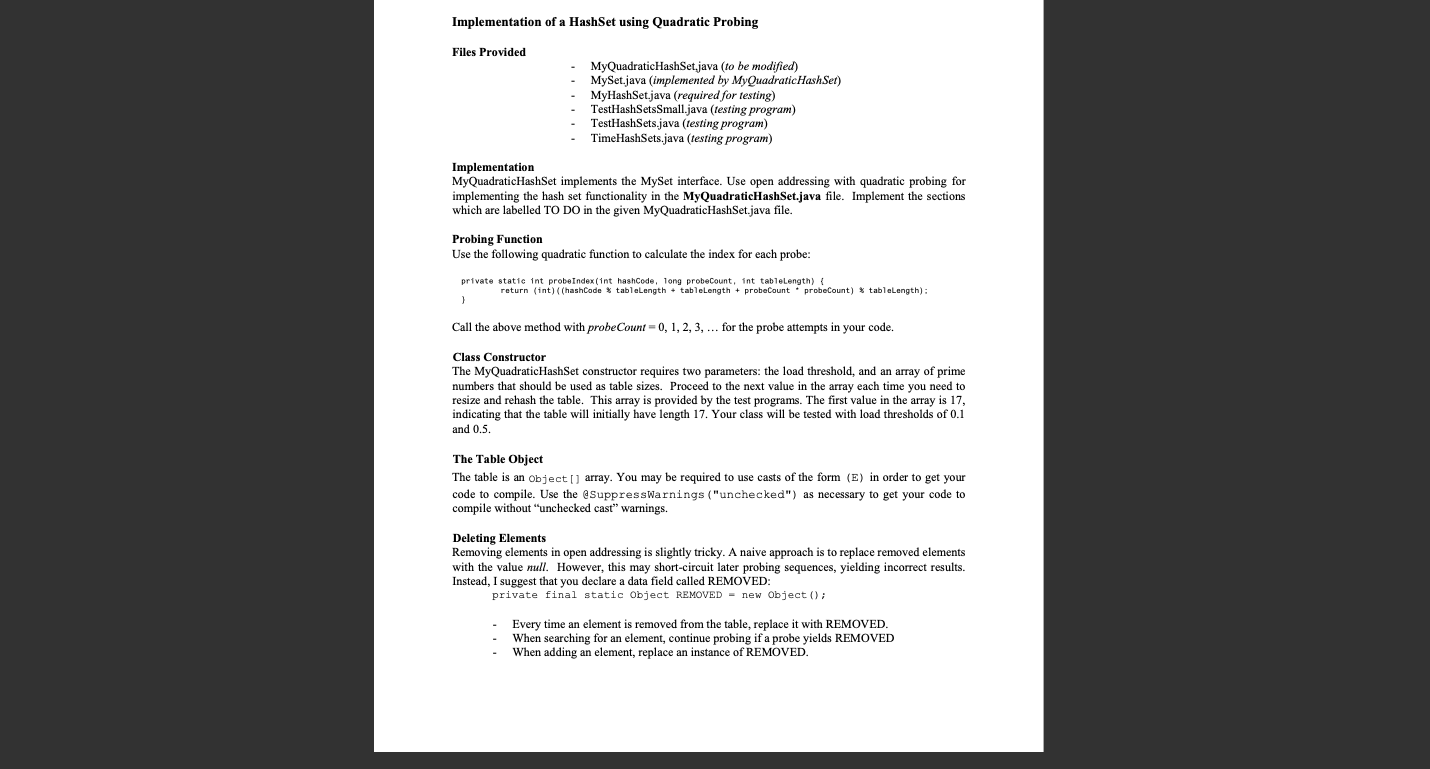
Question: Implementation of a HashSet using Quadratic Probing Files Provided - MyQuadraticHashSet,java ( to be modified ) - MySet.java ( implemented by MyQuadraticHashSet ) - MyHashSet.java
Implementation of a HashSet using Quadratic Probing
Files Provided
MyQuadraticHashSet,java to be modified
MySet.java implemented by MyQuadraticHashSet
MyHashSet.java required for testing
TestHashSetsSmall.java testing program
TestHashSets.java testing program
TimeHashSets.java testing program
Implementation
MyQuadraticHashSet implements the MySet interface. Use open addressing with quadratic probing for implementing the hash set functionality in the MyQuadraticHashSet.java file. Implement the sections which are labelled TO DO in the given MyQuadraticHashSet.java file.
Probing Function
Use the following quadratic function to calculate the index for each probe:
private static int probeIndexint hashCode, n g probeCount, int tableLength&
return inthashCode tableLength tableLength probeCount probeCount tableLength;
Call the above method with probeCount ldots for the probe attempts in your code.
Class Constructor
The MyQuadraticHashSet constructor requires two parameters: the load threshold, and an array of prime numbers that should be used as table sizes. Proceed to the next value in the array each time you need to resize and rehash the table. This array is provided by the test programs. The first value in the array is indicating that the table will initially have length Your class will be tested with load thresholds of and
The Table Object
The table is an object array. You may be required to use casts of the form E in order to get your code to compile. Use the @SuppressWarnings unchecked as necessary to get your code to compile without "unchecked cast" warnings.
Deleting Elements
Removing elements in open addressing is slightly tricky. A naive approach is to replace removed elements with the value null. However, this may shortcircuit later probing sequences, yielding incorrect results. Instead, I suggest that you declare a data field called REMOVED:
private final static object REMOVED new Object;
Every time an element is removed from the table, replace it with REMOVED.
When searching for an element, continue probing if a probe yields REMOVED
When adding an element, replace an instance of REMOVED. Resizing Table
Resize and rehash the table whenever the number of elements in the table plus the number of occurrences of REMOVED exceeds thresholdSize.
The iterator method:
Consequently, you do not need to implement an Iterator class for this assignment. However, since your class will implement MySet, which in turn extends java. lang. Iterable, you will need to have an iterator method. Given that none of the tests or timings use an iterator, it is all right to leave the iterator unimplemented.
Testing Your Hash Set
TestHashSetsSmall will test MyQuadraticHashSet on a really small test case.
TestHashSets will test it on larger cases, comparing its results on the add, contains, and remove operations to the results of performing the same operations on a java.util.HashSet.
TimeHashSets to compare its runtime performance to that of java.utili.HashSet and MyHashSet the textbook's hash set class
Sample Results:
Here is a sample output from the TimeHashSets test program:
Each set will be timed on add operations, contains operations, and remove
operations.
Timing java.util.TreeSet
Runtine: seconds
Timing java.util.HashSet
Runtine: seconds
Timing MyHashSet from textbook Runtime:
seconds
Timing MyQuadraticHashSet with load threshold
Runtire: seconds
Timing MyQuadraticHashSet with load threshold
Runtime: seconds
Your runtimes do not need to match, but reexamine your code if your runtimes are drastically worse.
Submission: Submit your modified and commented MyQuadraticHashSet.java file.
Step by Step Solution
There are 3 Steps involved in it
1 Expert Approved Answer
Step: 1 Unlock

Question Has Been Solved by an Expert!
Get step-by-step solutions from verified subject matter experts
Step: 2 Unlock
Step: 3 Unlock
 Study Help