







Question: import java.awt.*; public class TestRandomWalker { public static final int STEPS = 500; public static void main(String[] args) { RandomWalker walker = new RandomWalker(); //
import java.awt.*; public class TestRandomWalker {
public static final int STEPS = 500; public static void main(String[] args)
{ RandomWalker walker = new RandomWalker();
// instantiate Walker object
DrawingPanel panel = new DrawingPanel(500, 500);
Graphics g = panel.getGraphics();
// advanced features -- center and zoom in the image
panel.getGraphics().translate(250, 250);
panel.getGraphics().scale(4, 4);
// make the walker walk, and draw its movement
int prevX = walker.getX();
// initialize Walker display
int prevY = walker.getY();
for (int i = 1; i
g.setColor(Color.BLACK);
g.drawLine(prevX, prevY, walker.getX(), walker.getY());
// update Walker display
walker.move(); // move
Walker 1 step
prevX = walker.getX(); // update x
value
prevY = walker.getY(); // update y
value
g.setColor(Color.RED);
g.drawLine(prevX, prevY, walker.getX(), walker.getY());
// update Walker display int steps = walker.getSteps();
// record Walker steps
if (steps % 10 == 0)
{ System.out.println(steps + " steps"); }
panel.sleep(100); } } }
PROGRAM
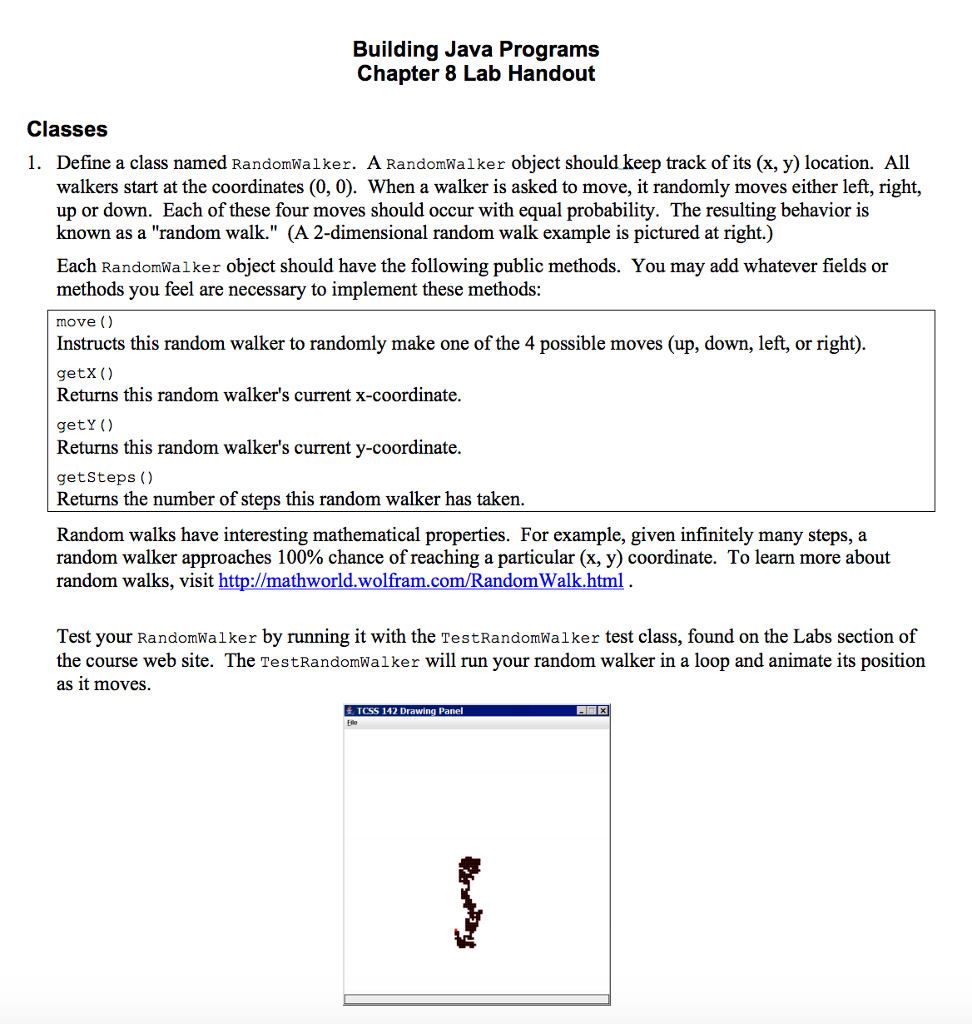
Building Java Programs Chapter 8 Lab Handout Classes 1. Define a class named Randomwalker. A Randomwalker object should keep track of its (x, y) location. All walkers start at the coordinates (0,00. When a walker is asked to move, it randomly moves either left, right, up or down. Each of these four moves should occur with equal probability. The resulting behavior is known as a "random walk." (A 2-dimensional random walk example is pictured at right.) Each Randomwalker object should have the following public methods. You may add whatever fields or methods you feel are necessary to implement these methods: move Instructs this random walker to randomly make one of the 4 possible moves (up, down, left, or right. getX Returns this random walker's current x-coordinate. getY Returns this random walker's current y-coordinate. getsteps Returns the number of steps this random walker has taken. Random walks have interesting mathematical properties. For example, given infinitely many steps, a random walker approaches 100% chance of reaching a particular (x, y) coordinate. To learn more about random walks, visit http://mathworld.wolfram.com/RandomWalk.html Test your RandomWalker by running it with the TestRandomWalker test class, found on the Labs section of the course web site. The TestRandomwalker will run your random walker in a loop and animate its position as it moves. SS 142 awing Pane
Step by Step Solution
There are 3 Steps involved in it

Get step-by-step solutions from verified subject matter experts
 Study Help