







Question: import java.io.*; import java.util.*; import java.util.stream.Collectors; public class Solution { public static class DirectedGraph { /* Adjacency List representation of the given graph */ private
import java.io.*; import java.util.*; import java.util.stream.Collectors;
public class Solution {
public static class DirectedGraph { /* Adjacency List representation of the given graph */ private Map
public String toString() { StringBuffer s = new StringBuffer(); for (Integer v : adjList.keySet()) s.append(" " + v + " -> " + adjList.get(v)); return s.toString(); }
public void add(Integer vertex) { if (adjList.containsKey(vertex)) return; adjList.put(vertex, new ArrayList
public void add(Integer source, Integer dest) { add(source); add(dest); adjList.get(source).add(dest); }
/* Indegree of each vertex as a Map
public Map
}
// Complete the bfsDistance function below. public static Map
public static void main(String[] args) throws IOException { BufferedWriter bufferedWriter = new BufferedWriter(new FileWriter(System.getenv("OUTPUT_PATH"))); BufferedReader bufferedReader = new BufferedReader(new InputStreamReader(System.in));
int sVertex = Integer.parseInt(bufferedReader.readLine().trim());
DirectedGraph digraph = new DirectedGraph();
String line; while ((line = bufferedReader.readLine()) != null) { String[] v = line.split(" "); digraph.add(Integer.parseInt(v[0]), Integer.parseInt(v[1])); } Map
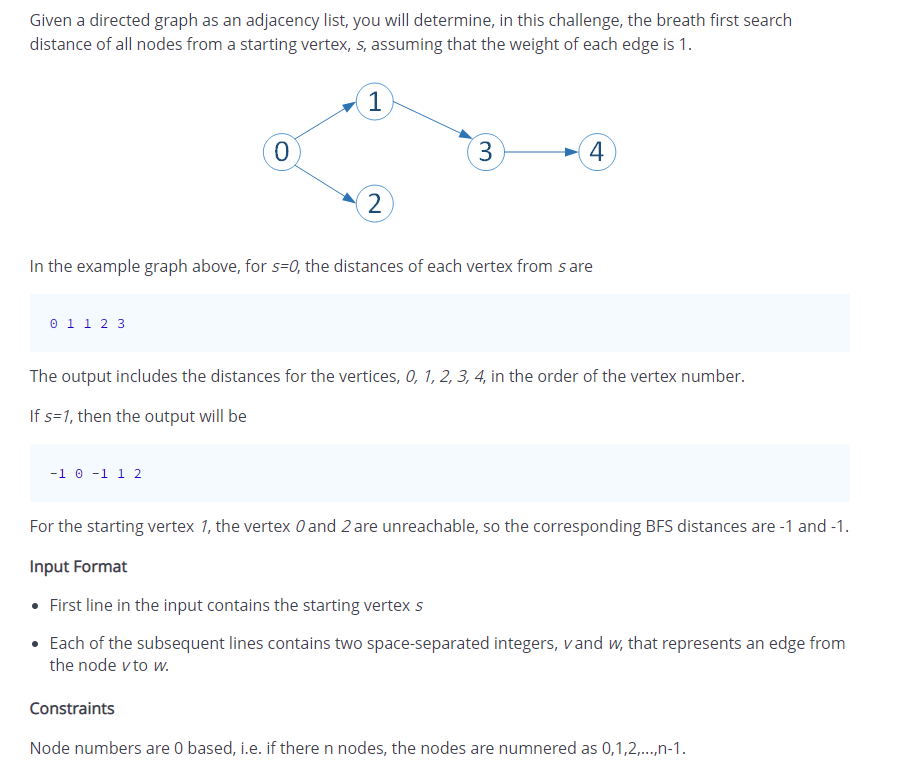
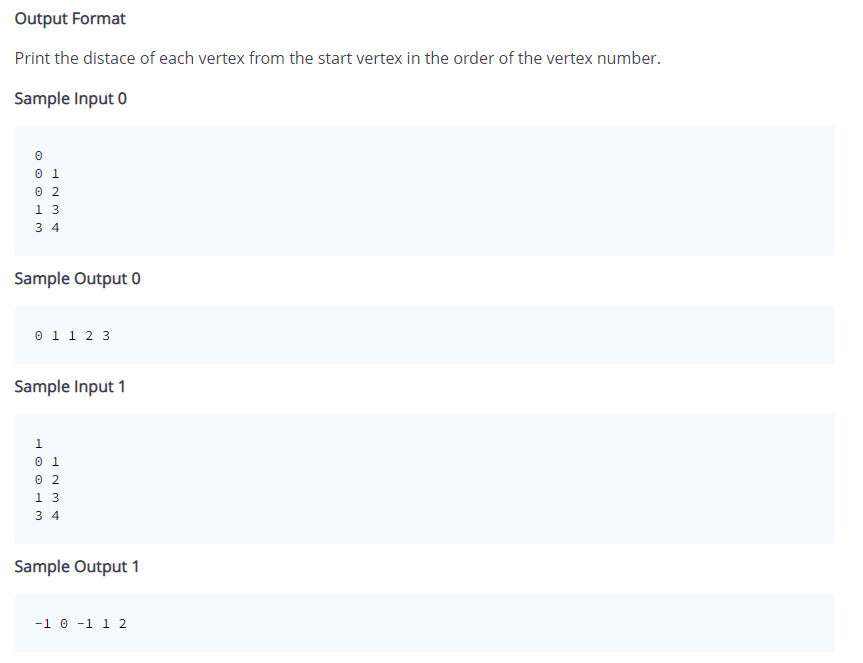
Given a directed graph as an adjacency list, you will determine, in this challenge, the breath first search distance of all nodes from a starting vertex, s, assuming that the weight of each edge is 1. 1 0 3 4. 2 In the example graph above, for s=0, the distances of each vertex from s are 011 23 The output includes the distances for the vertices, 0, 1, 2, 3, 4, in the order of the vertex number. If s=1, then the output will be -1 0-1 1 2 For the starting vertex 1, the vertex 0 and 2 are unreachable, so the corresponding BFS distances are -1 and -1. Input Format First line in the input contains the starting vertex s Each of the subsequent lines contains two space-separated integers, vand w, that represents an edge from the node vto w. Constraints Node numbers are 0 based, i.e. if there n nodes, the nodes are numnered as 0,1,2,...,n-1. Output Format Print the distace of each vertex from the start vertex in the order of the vertex number. Sample Input 0 0 1 02 13 3 4 Sample Output o 01123 Sample Input 1 1 1 02 1 3 3 4 Sample Output 1 -1 0-1 12 Given a directed graph as an adjacency list, you will determine, in this challenge, the breath first search distance of all nodes from a starting vertex, s, assuming that the weight of each edge is 1. 1 0 3 4. 2 In the example graph above, for s=0, the distances of each vertex from s are 011 23 The output includes the distances for the vertices, 0, 1, 2, 3, 4, in the order of the vertex number. If s=1, then the output will be -1 0-1 1 2 For the starting vertex 1, the vertex 0 and 2 are unreachable, so the corresponding BFS distances are -1 and -1. Input Format First line in the input contains the starting vertex s Each of the subsequent lines contains two space-separated integers, vand w, that represents an edge from the node vto w. Constraints Node numbers are 0 based, i.e. if there n nodes, the nodes are numnered as 0,1,2,...,n-1. Output Format Print the distace of each vertex from the start vertex in the order of the vertex number. Sample Input 0 0 1 02 13 3 4 Sample Output o 01123 Sample Input 1 1 1 02 1 3 3 4 Sample Output 1 -1 0-1 12
Step by Step Solution
There are 3 Steps involved in it

Get step-by-step solutions from verified subject matter experts
 Study Help