







Question: Important note: Angular momentum can always be calculated for a moving object, even if the object is not tied to anything or rotating around a
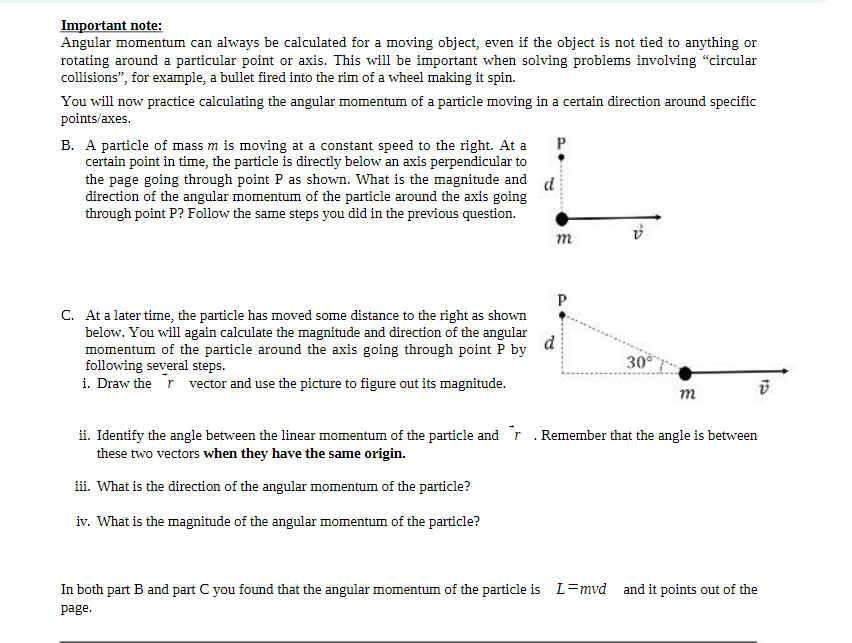
Important note: Angular momentum can always be calculated for a moving object, even if the object is not tied to anything or rotating around a particular point or axis. This will be important when solving problems involving "circular collisions", for example, a bullet fired into the rim of a wheel making it spin. You will now practice calculating the angular momentum of a particle moving in a certain direction around specific points/axes. B. A particle of mass m is moving at a constant speed to the right. At a certain point in time, the particle is directly below an axis perpendicular to the page going through point P as shown. What is the magnitude and d direction of the angular momentum of the particle around the axis going through point P? Follow the same steps you did in the previous question. m C. At a later time, the particle has moved some distance to the right as shown below. You will again calculate the magnitude and direction of the angular momentum of the particle around the axis going through point P by d following several steps. 30 i. Draw the r vector and use the picture to figure out its magnitude. m ii. Identify the angle between the linear momentum of the particle and r . Remember that the angle is between these two vectors when they have the same origin. iii. What is the direction of the angular momentum of the particle? iv. What is the magnitude of the angular momentum of the particle? In both part B and part C you found that the angular momentum of the particle is _=mvd and it points out of the page
Step by Step Solution
There are 3 Steps involved in it

Get step-by-step solutions from verified subject matter experts
 Study Help