





Question: Important note: For the questions that Matlab is needed, you need to report both the output (i.e., results) of the Matlab and the scripts that
Important note: For the questions that Matlab is needed, you need to report both the output (i.e., results) of the Matlab and the scripts that you wrote to address the questions.
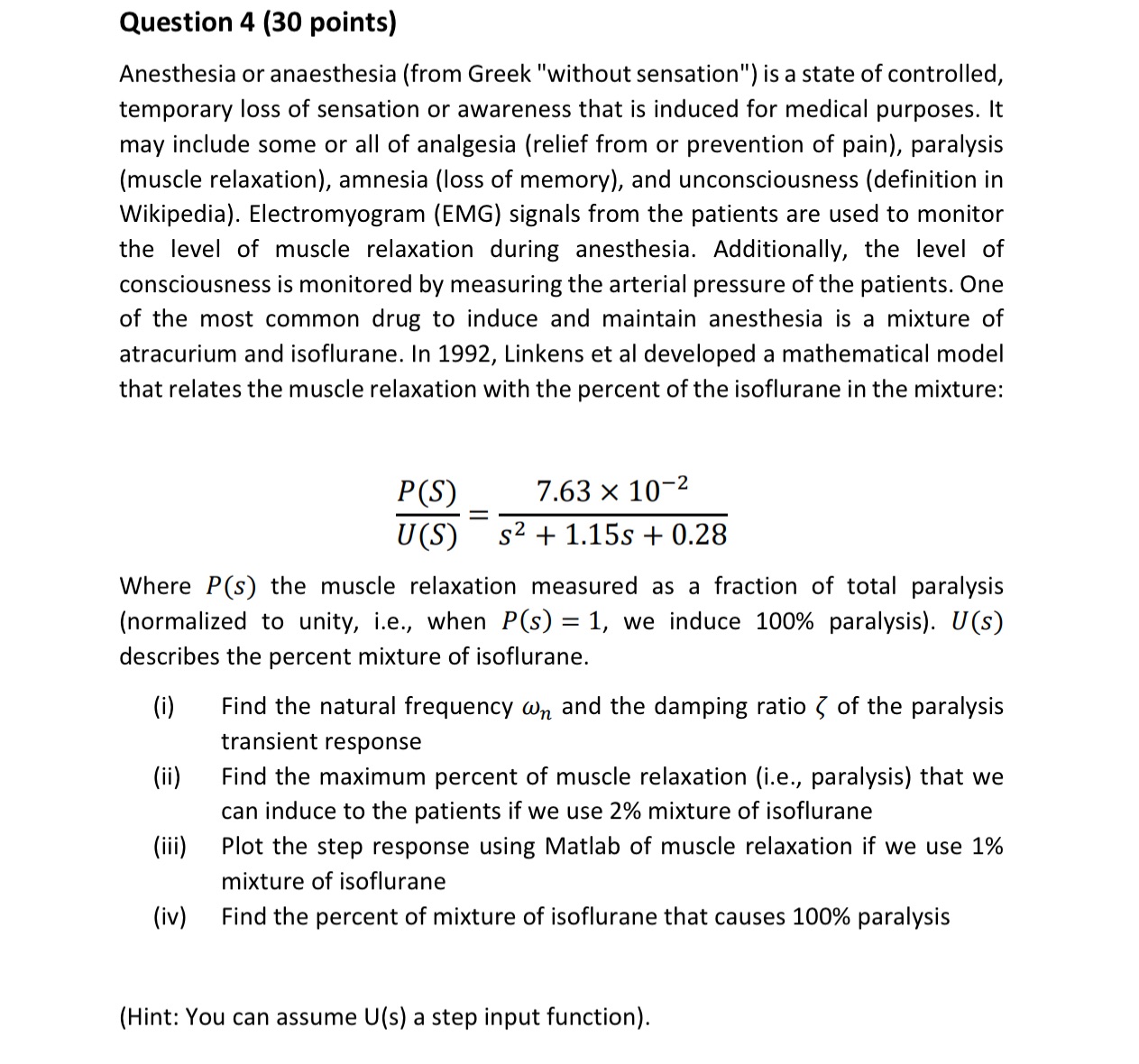
Question 4 (30 points) Anesthesia or anaesthesia (from Greek "without sensation") is a state of controlled, temporary loss of sensation or awareness that is induced for medical purposes. It may include some or all of analgesia (relief from or prevention of pain), paralysis (muscle relaxation), amnesia (loss of memory), and unconsciousness (definition in Wikipedia). Electromyogram (EMG) signals from the patients are used to monitor the level of muscle relaxation during anesthesia. Additionally, the level of consciousness is monitored by measuring the arterial pressure of the patients. One of the most common drug to induce and maintain anesthesia is a mixture of atracurium and isoflurane. In 1992, Linkens et al developed a mathematical model that relates the muscle relaxation with the percent of the isoflurane in the mixture: P(S) 7.63x10⁷? U(S) s2+41.15s+0.28 Where P(s) the muscle relaxation measured as a fraction of total paralysis (normalized to unity, i.e., when P(s) =1, we induce 100% paralysis). U(s) describes the percent mixture of isoflurane. (i) Find the natural frequency w,, and the damping ratio { of the paralysis transient response (ii) Find the maximum percent of muscle relaxation (i.e., paralysis) that we can induce to the patients if we use 2% mixture of isoflurane (iii) Plot the step response using Matlab of muscle relaxation if we use 1% mixture of isoflurane (iv) Find the percent of mixture of isoflurane that causes 100% paralysis (Hint: You can assume U(s) a step input function)

