







Question: In 3D space, the Cartesian coordinates (x, y, z) can be converted to spherical coordinates (radius r, inclination theta, azimuth phi] by the following equations:
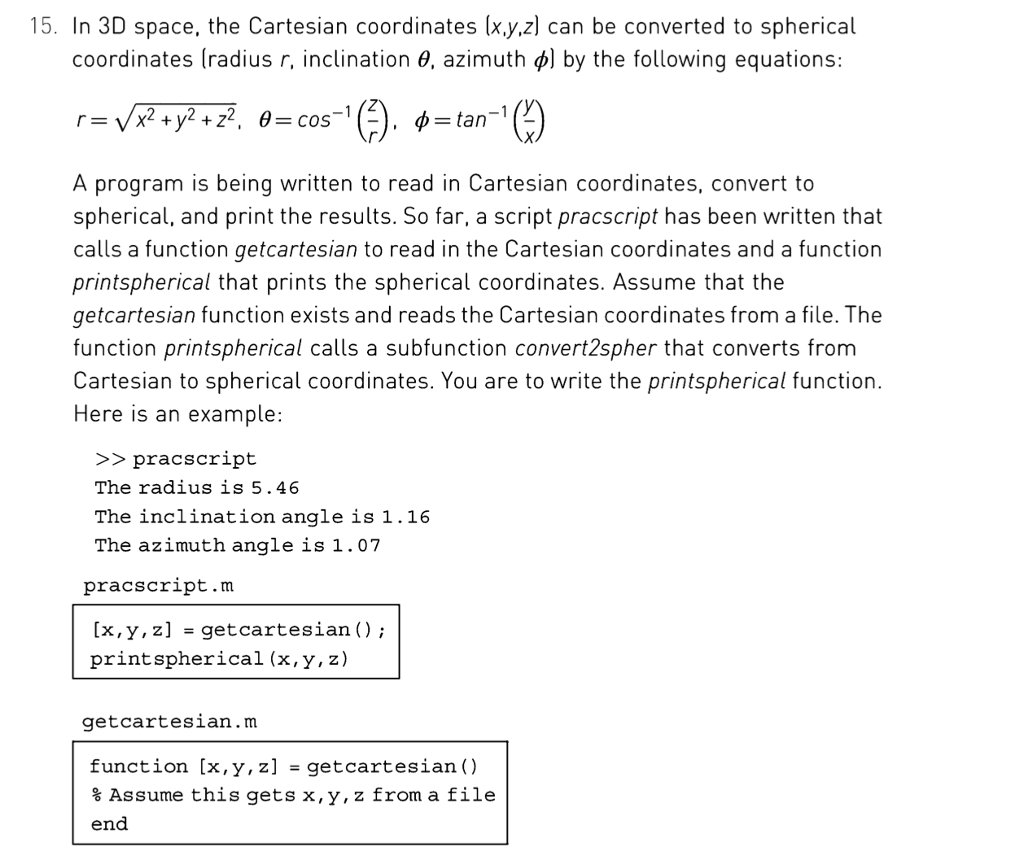
In 3D space, the Cartesian coordinates (x, y, z) can be converted to spherical coordinates (radius r, inclination theta, azimuth phi] by the following equations: r = squareroot x^2 + y^2 + z^2, theta = cos^-1 (z/r), phi = tan^-1 (y/x) A program is being written to read in Cartesian coordinates, convert to spherical, and print the results. So far, a script pracscript has been written that calls a function getcartesian to read in the Cartesian coordinates and a function printspherical that prints the spherical coordinates. Assume that the getcartesian function exists and reads the Cartesian coordinates from a file. The function printspherical calls a subfunction convert2spher that converts from Cartesian to spherical coordinates. You are to write the printspherical function. Here is an example: >> pracscript The radius is 5.46 The inclination angle is 1.16 The azimuth angle is 1.07 pracscript .m [x, y, z] = getcartesian (); printspherical (x, y, z) getcartesian .m function [x, y, z] = getcartesian ()% Assume this gets x, y, z from a file end
Step by Step Solution
There are 3 Steps involved in it

Get step-by-step solutions from verified subject matter experts
 Study Help