







Question: In a labour context, bargaining in bad faith includes: Select one: a. A fair reason for refusing to make a concession. b. Refusal to compromise.
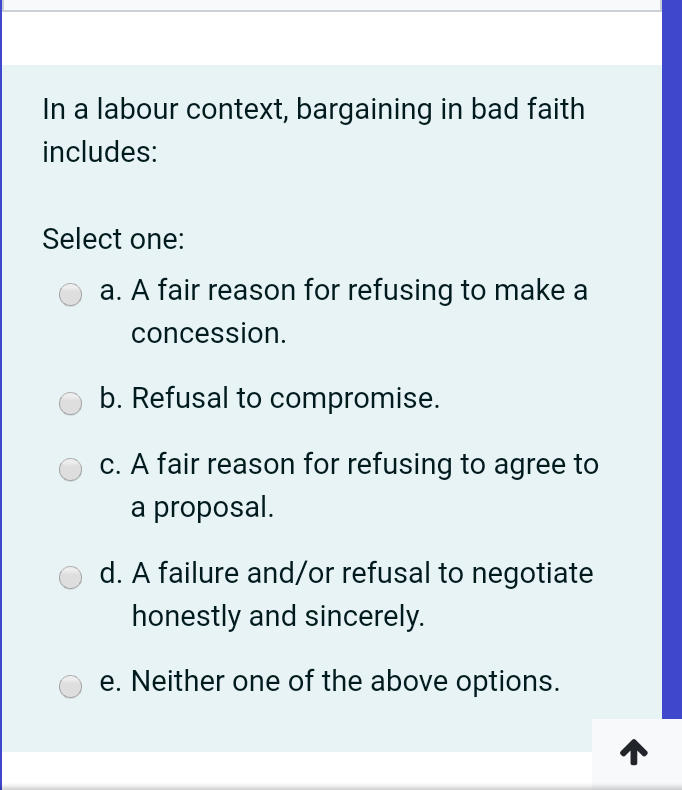
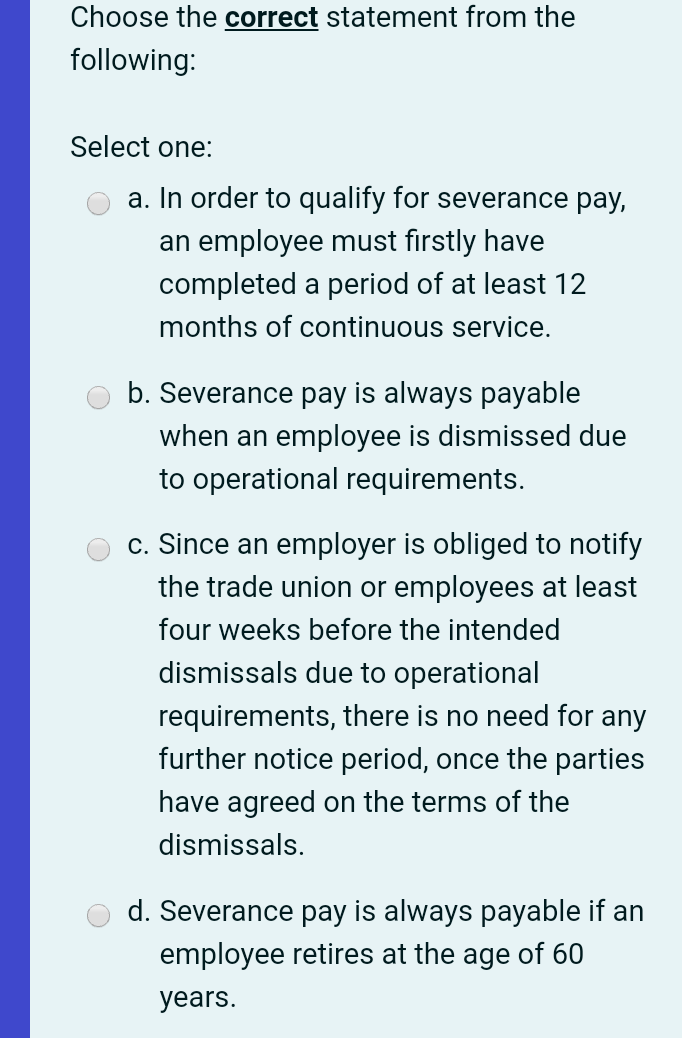
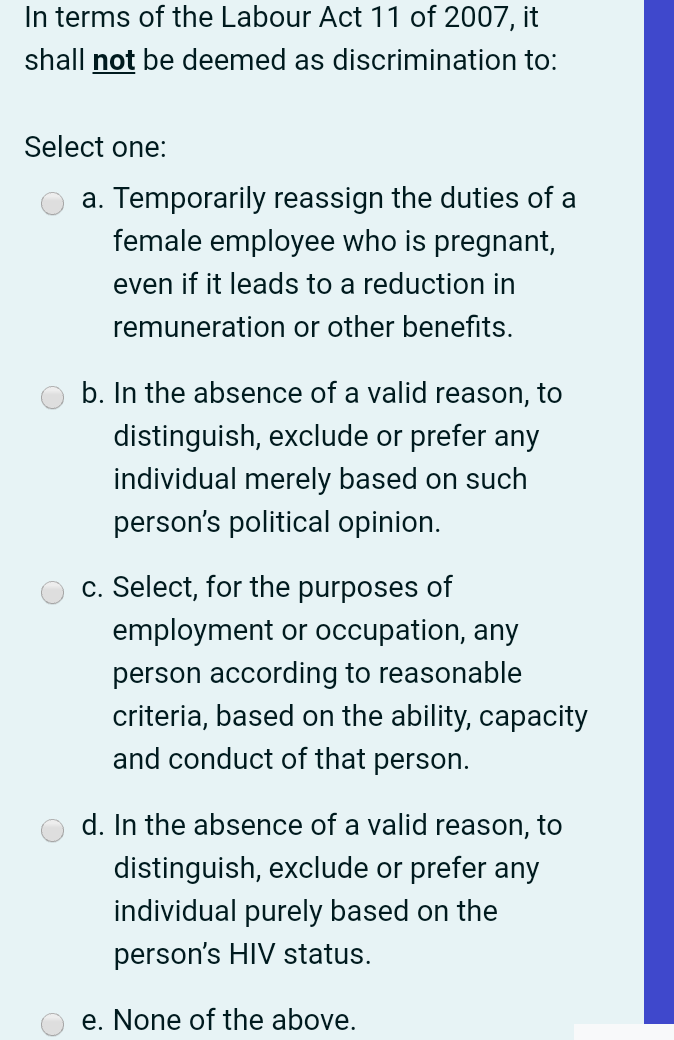
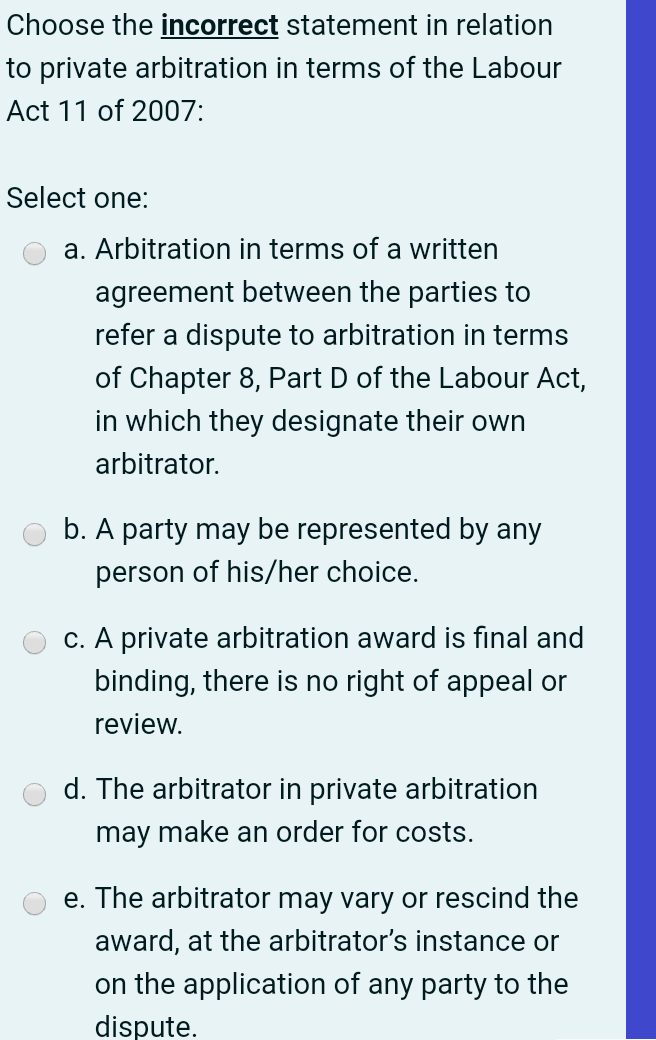
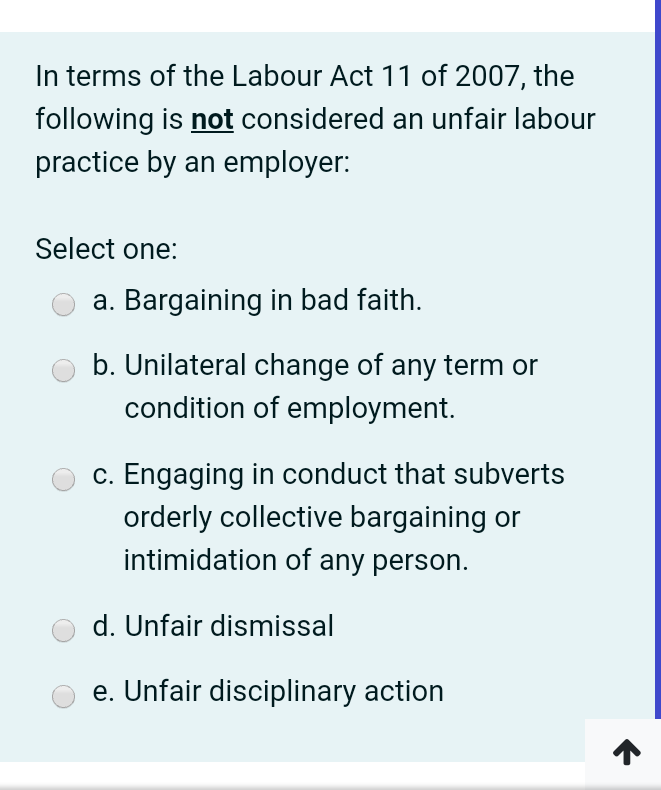
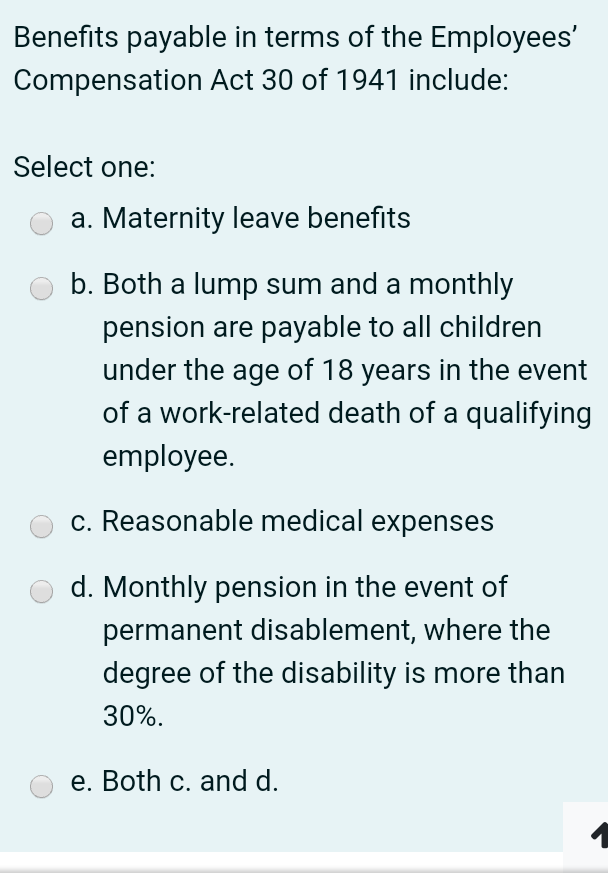
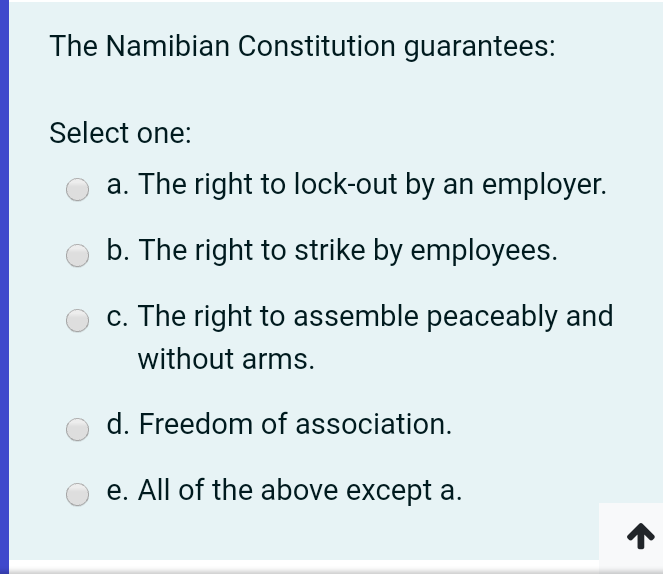
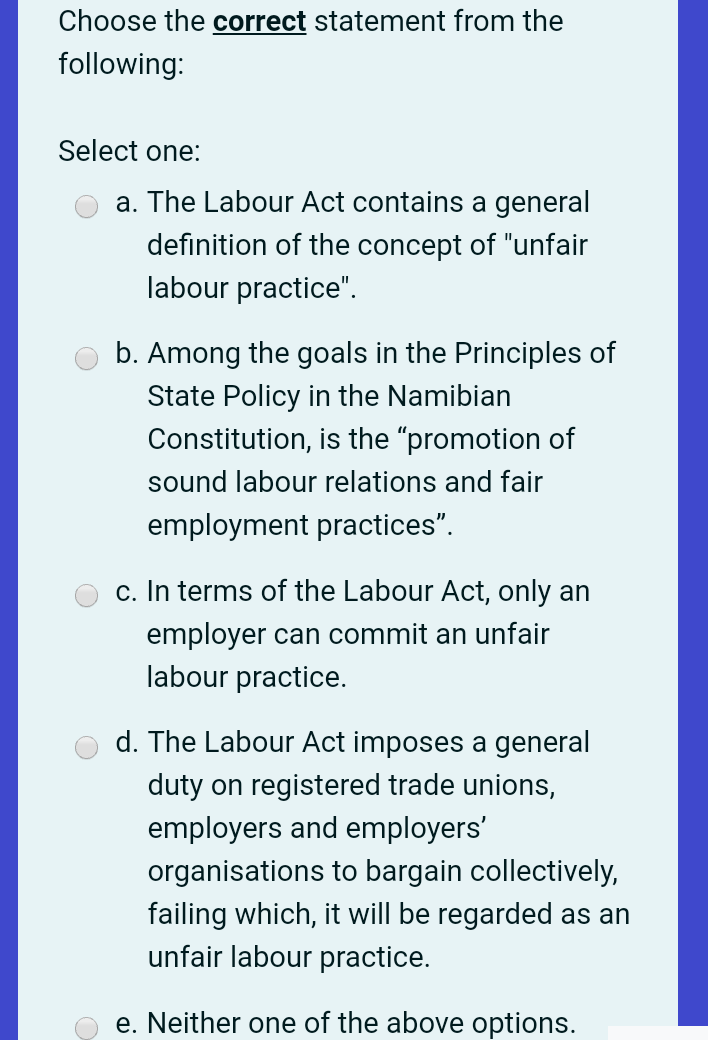
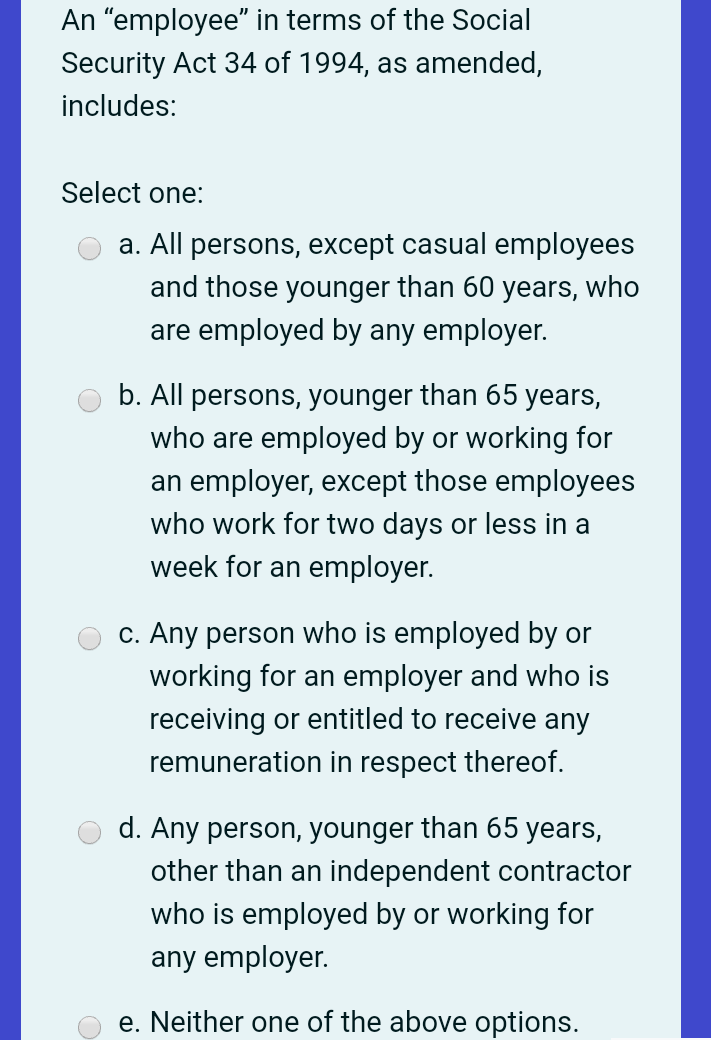
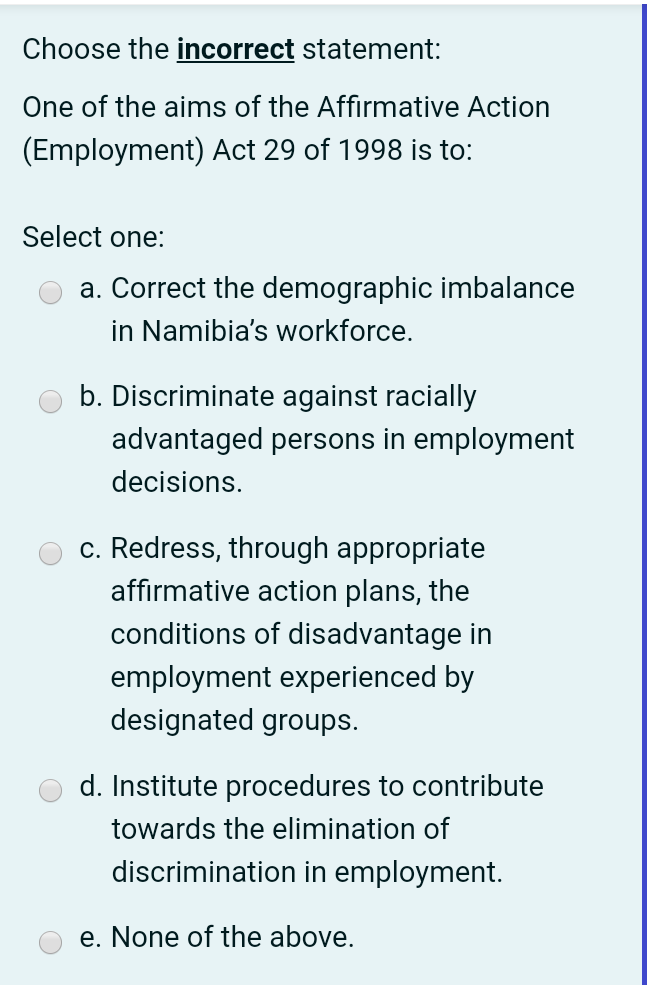
In a labour context, bargaining in bad faith includes: Select one: a. A fair reason for refusing to make a concession. b. Refusal to compromise. C. fair reason for refusing to agree to a proposal. d. A failure and/or refusal to negotiate honestly and sincerely. e. Neither one of the above options. Choose the correct statement from the following: Select one: a. In order to qualify for severance pay, an employee must firstly have completed a period of at least 12 months of continuous service. b. Severance pay is always payable when an employee is dismissed due to operational requirements. c. Since an employer is obliged to notify the trade union or employees at least four weeks before the intended dismissals due to operational requirements, there is no need for any further notice period, once the parties have agreed on the terms of the dismissals. d. Severance pay is always payable if an employee retires at the age of 60 years. In terms of the Labour Act 11 of 2007, it shall not be deemed as discrimination to: Select one: a. Temporarily reassign the duties of a female employee who is pregnant, even if it leads to a reduction in remuneration or other benefits. b. In the absence of a valid reason, to distinguish, exclude or prefer any individual merely based on such person's political opinion. c. Select, for the purposes of employment or occupation, any person according to reasonable criteria, based on the ability, capacity and conduct of that person. d. In the absence of a valid reason, to distinguish, exclude or prefer any individual purely based on the person's HIV status. e. None of the above. Choose the incorrect statement in relation to private arbitration in terms of the Labour Act 11 of 2007: Select one: a. Arbitration in terms of a written agreement between the parties to refer a dispute to arbitration in terms of Chapter 8, Part D of the Labour Act, in which they designate their own arbitrator. b. A party may be represented by any person of his/her choice. c. A private arbitration award is final and binding, there is no right of appeal or review. d. The arbitrator in private arbitration may make an order for costs. e. The arbitrator may vary or rescind the award, at the arbitrator's instance or on the application of any party to the dispute. In terms of the Labour Act 11 of 2007, the following is not considered an unfair labour practice by an employer: Select one: a. Bargaining in bad faith. b. Unilateral change of any term or condition of employment. c. Engaging in conduct that subverts orderly collective bargaining or intimidation of any person. d. Unfair dismissal e. Unfair disciplinary action Benefits payable in terms of the Employees' Compensation Act 30 of 1941 include: Select one: a. Maternity leave benefits b. Both a lump sum and a monthly pension are payable to all children under the age of 18 years in the event of a work-related death of a qualifying employee. c. Reasonable medical expenses d. Monthly pension in the event of permanent disablement, where the degree of the disability is more than 30%. e. Both c. and d. The Namibian Constitution guarantees: Select one: a. The right to lock-out by an employer. b. The right to strike by employees. c. The right to assemble peaceably and without arms. d. Freedom of association. e. All of the above except a. Choose the correct statement from the following: Select one: a. The Labour Act contains a general definition of the concept of "unfair labour practice". b. Among the goals in the Principles of State Policy in the Namibian Constitution, is the promotion of sound labour relations and fair employment practices. c. In terms of the Labour Act, only an employer can commit an unfair labour practice. d. The Labour Act imposes a general duty on registered trade unions, employers and employers' organisations to bargain collectively, failing which, it will be regarded as an unfair labour practice. e. Neither one of the above options. An employee in terms of the Social Security Act 34 of 1994, as amended, includes: Select one: a. All persons, except casual employees and those younger than 60 years, who are employed by any employer. b. All persons, younger than 65 years, who are employed by or working for an employer, except those employees who work for two days or less in a week for an employer. c. Any person who is employed by or working for an employer and who is receiving or entitled to receive any remuneration in respect thereof. d. Any person, younger than 65 years, other than an independent contractor who is employed by or working for any employer. e. Neither one of the above options. Choose the incorrect statement: One of the aims of the Affirmative Action (Employment) Act 29 of 1998 is to: Select one: a. Correct the demographic imbalance in Namibia's workforce. b. Discriminate against racially advantaged persons in employment decisions. c. Redress, through appropriate affirmative action plans, the conditions of disadvantage in employment experienced by designated groups. d. Institute procedures to contribute towards the elimination of discrimination in employment. e. None of the above
Step by Step Solution
There are 3 Steps involved in it
1 Expert Approved Answer
Step: 1 Unlock

Question Has Been Solved by an Expert!
Get step-by-step solutions from verified subject matter experts
Step: 2 Unlock
Step: 3 Unlock
 Study Help